
During the week of 9 February, the University Foundation hosted a “conclave” that led to the formation of a new regional government. At the start of the week, Brussels had a minister for the promotion of multilingualism. At the end of it, no longer. In the same week, the Bourse hosted the first “Brussels Multilingual Week”.
How central can we expect multilingualism to be for life in Brussels and Brusselers’ identity?
A monolingual minister-president?
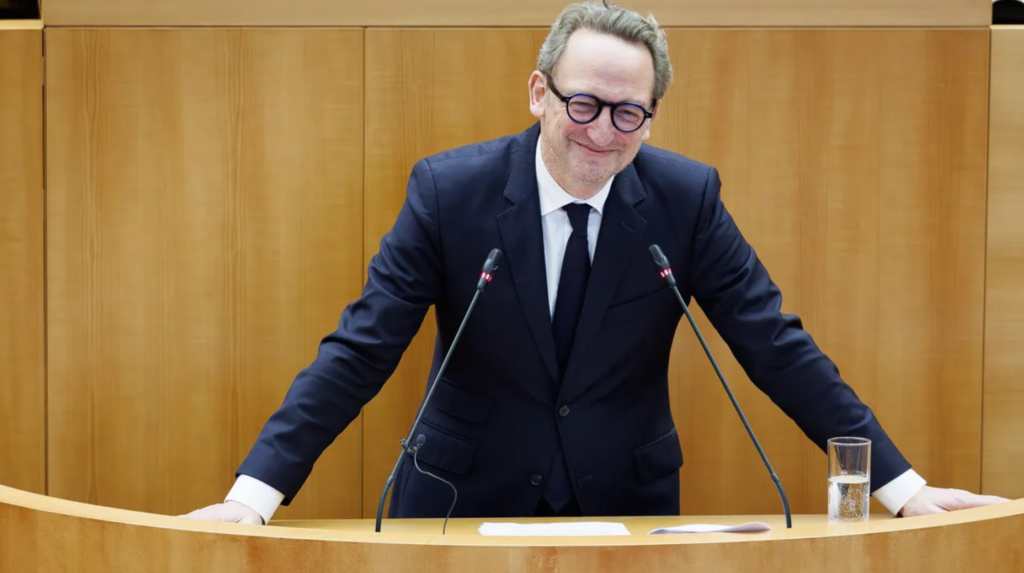
13 February 2026. At long last, twenty months after the June 2024 elections, the Brussels-Capital Region has a government. Great relief all around. And the following day, the name of the new minister-president was announced: Boris Dilliès, until then mayor of Uccle, the largest among the region’s 19 municipalities after Brussels-City.
But then came the shock. When interviewed in Dutch, not just in French, as befits the prospective leader of a bilingual region, Dilliès only managed to utter short, hesitating answers, mostly ending with a “We zullen zien” (“We shall see”) that has been the subject of many jokes ever since, including by himself.
Attenuating circumstances are easy to find. The son of a French citizen, Dilliès spent most of his childhood in the South of France, and, having hosted Brussels’ Lycée français for over forty years, Uccle has, next to Ixelles, the highest number of French inhabitants among Belgium’s 525 municipalities.
By contrast, the proportion of native Dutch speakers in Uccle is particularly low. As mayor, only a tiny fraction of Dilliès’ work had to be conducted in Dutch, he said. Not more than one wedding per year, for example.
With a pretty monolingual minister-president, is Brussels on its way to becoming a purely Francophone region, as some thought (and hoped) was happening in the 19th century and again fifty years ago.
Certainly not, according to Dilliès. On the public radio channel RTBF, he acknowledged: “My level of competence in Dutch is unacceptable for the minister-president of a bilingual region.”
Since his surprise appointment and embarrassing interview, he has lost no opportunity to repeat that he is working hard on improving his Dutch.
Regression to bilingualism?
More importantly, he is committed to implementing a governmental declaration, negotiated by the seven parties in the coalition, that includes a final chapter entitled “A strong and bilingual region”. It firmly states: “For Brusselers, access to public services in their own language is, above all, a fundamental right.”
And the rest of the chapter is devoted to ways of helping ensure that all Brussels public services are provided in Dutch as well as in French, as required by national legislation since 1966. Transgressions of this legislation due to the difficulty of recruiting enough staff competent in Dutch have been the subject of countless complaints by Flemish parties for decades.
Thus, bilingualism is not forgotten, but what about multilingualism? In its 2019 governmental agreement, the previous government declared that it “will develop a comprehensive policy to promote multilingualism among the people of Brussels, thereby strengthening Brussels’ identity and sense of citizenship, as well as social advancement and social cohesion within the Region.”
It devoted a lengthy section to “revolutionising the teaching of languages”, and in the section on public services, it promised to list the languages spoken by frontline agents in order to enable citizens to receive assistance and guidance in languages other than French and Dutch.
Moreover, Finance Minister Sven Gatz was given the “promotion of multilingualism” as one of his explicit competencies. In the new government, this competence has disappeared.
“A multilingual region where language skills are a strategic asset”
Has multilingualism been dumped? Not quite. The 2026 government declaration does contain a sentence — the opening sentence of the final chapter — that endorses, albeit briefly, the previous government’s commitment: “Brussels is a multilingual and international region where language skills are a strategic asset, both for the city and for its residents.”
On 23 February, in his inaugural address to the Parliament as minister-president, Dilliès rephrased it more strongly: “Brussels is a strong region if it gives itself the means to live up to what it truly is: a multilingual region [ce qu’elle est vraiment une région multilingue], where the knowledge of languages is a strategic asset”.
One sentence is not much, but it is something in a declaration that is only 24 pages long (compared to the 128 of its 2019 predecessor) and was written in a rush. Enough to perpetuate the resolute switch from bilingualism to multilingualism started under the previous legislature?
It depends on whether any of the ministers in the new government finds it sufficiently important. And at least one of them does.
On 25 February, in an in-depth interview with Bruzz, the new minister for employment and the economy, Laurent Hublet, declared, “We have historically been a bilingual city, and today we are a multilingual city. The majority of the population does not have French or Dutch as their mother tongue. Multilingualism is becoming very important. Anyone working in a bar needs to speak many languages, and certainly English too.”
Unsurprisingly, therefore, Hublet agreed to informally become the new minister for the promotion of multilingualism by providing a new home for the Brussels Council for Multilingualism, set up in 2020 by the then minister for multilingualism, Sven Gatz.
In February 2024, this Council published a memorandum containing a large number of recommendations. Half of them aimed to make Brusselers “trilingual+”, that is, able to communicate in French, Dutch and English, while cherishing, maintaining and transmitting their own native language if it is not one of these three.
The other half aimed to make Brussels’ public services more multilingual: native speakers of French and Dutch are not the only residents and visitors who should be able to expect to be informed and served, if not in their native language, at least in a language they understand.
Brussels Multilingualism Week
Given the lasting political uncertainty, the Brussels Council for Multilingualism also took the initiative to organise, in February 2026, together with nearly 100 partners, an unprecedented bottom-up event: the first Brussels Multilingualism Week.
Activities were organised in many different locations throughout the week, and the event culminated in an action-packed day on 14 February at the Palais de la Bourse, with forty stands and four debates.
The week provided an opportunity to celebrate Brussels’ linguistic superdiversity, to discover innovating ways of learning languages at all ages, and to reflect together on controversial issues, such as the place to be given to languages other than French and Dutch in schools and public services, the difficulty of finding enough teachers to teach Dutch to Brussels children and AI’s threat to multilingualism.
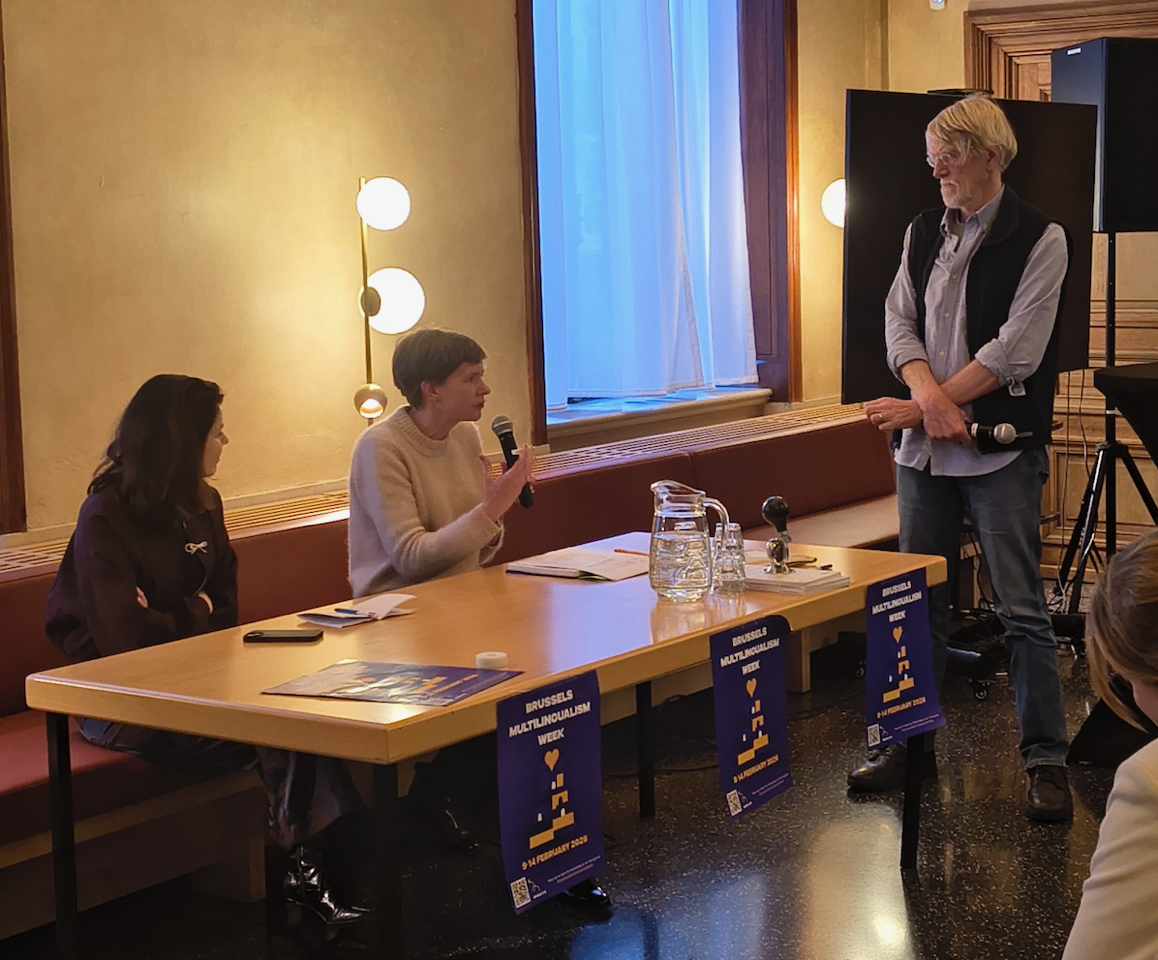
Debate between Francophone minister of education Valérie Glatigny and Flemish minister for Brussels Cieltje Van Achter. Brussels Multilingualism Week, at Bourse in Brussels, 14 February 2026.
Above all, it was an opportunity for Brusselers with a wide variety of native languages to assert together the extreme importance of multilingualism in a place like Brussels, partly as “a strategic asset for the region and for its residents”, as the government’s declaration put it.
But it is not only for economic reasons that multilingualism matters. It is just as important for social cohesion and cultural enjoyment. And it is at the core of a Brussels identity fit for the 21st century.
We Brusselers are no longer either Francophones or Nederlandstaligen, Flemings or Walloons who happen to live in Belgium’s capital city. 80% of us now have roots outside Belgium.
We are all multilingual — or in the process of becoming multilingual — not all with the same languages nor all to the same extent. Just as knowledge of Dutch and French is part of the Flemish and Walloon identity, respectively, multilingualism is henceforth a central part of who we Brusselers are.
The success of Brussels’s first multilingualism week proved that this is not mere wishful thinking. The next edition is scheduled for 15-20 February 2027. I bet that Minister-President Dilliès will want to participate.
He will have the opportunity to meet lots of fellow Brusselers — perhaps you among them — determined to make Brussels “a strong region”, that is, in his own words, “a region that gives itself the means to live up to what it truly is: a multilingual region”.
