
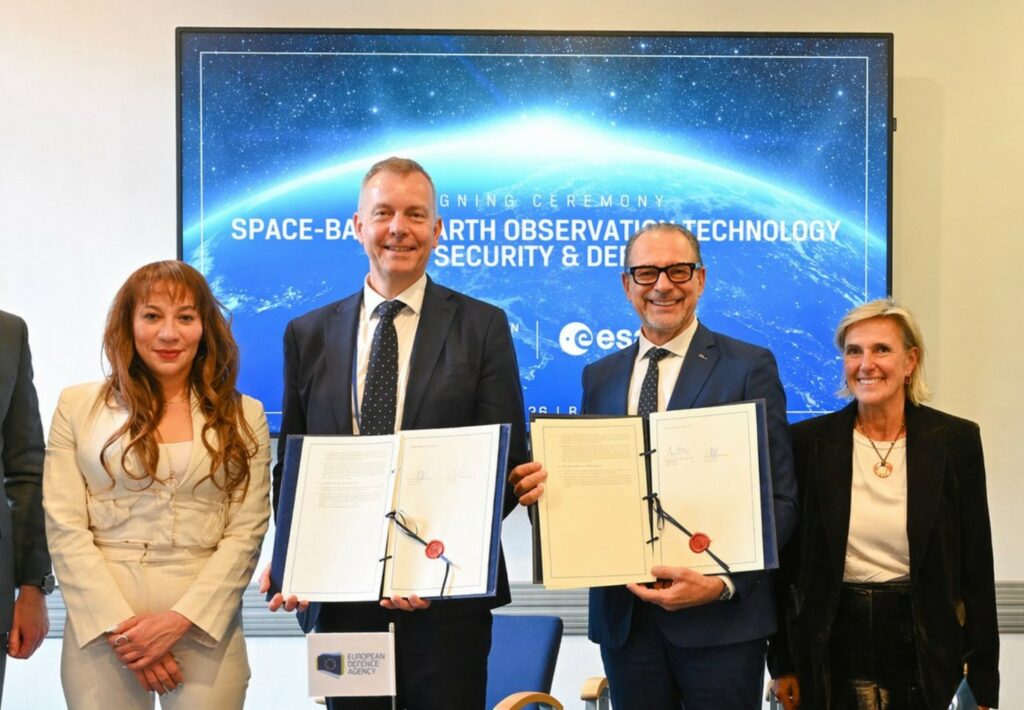
The European Space Agency and the European Defence Agency, which is an EU body, have agreed to run a joint study to map gaps in Europe’s Earth observation — satellite-based monitoring of the planet — and set out a long-term technology roadmap for security and defence.
The implementing arrangement was signed on 22 April in Brussels by ESA Director General Josef Aschbacher and EDA Deputy Chief Anders Sjöborg, ESA reported on Wednesday.
The study will assess current and future Earth observation needs, identify capability gaps and set technology development priorities up to 2040 and beyond, ESA said.
Work will take no more than 18 months and the two organisations will contribute equally to the costs.
Roadmap to 2040 and beyond
Aschbacher said ESA’s member states had given the agency a mandate to step up its role in security and defence, and that the agreement was a move “from intent to delivery.”
He cited ESA’s European Resilience from Space initiative as an existing response to “urgent security capability needs.”
ESA’s director of Earth observation programmes, Simonetta Cheli, said Earth observation is a “cornerstone capability” for security and defence and that the study would produce a long-term vision to reinforce Europe’s capabilities.
EDA Chief Executive André Denk said the work would provide an analytical basis to guide future research and development priorities and would identify “the most promising technological pathways” to maintain Earth observation capabilities for Europe’s security and defence.
The study will be carried out under a wider cooperation framework agreed between ESA and EDA in 2011, and was approved by ESA’s council in March 2026.
