
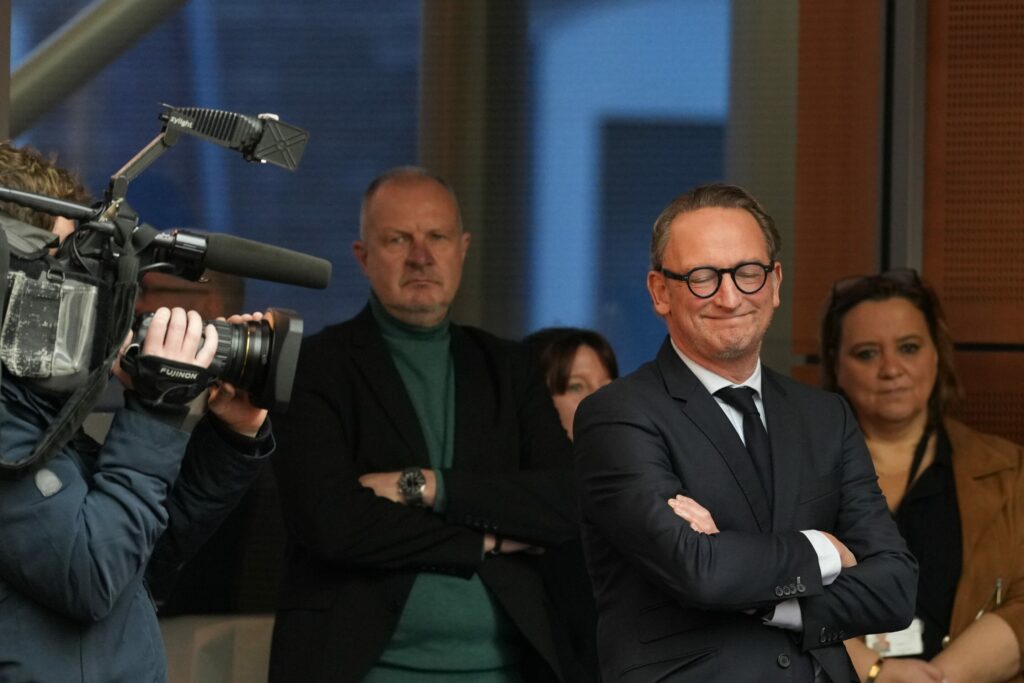
Formerly known for his car-first approach as the mayor of Uccle, Brussels' new Minister-President Boris Dilliès (MR) says he will now be implementing measures to make the city safer and more friendly to cyclists and pedestrians.
While Dilliès has not quite made a full U-turn in terms of his approach to Brussels' controversial Good Move mobility plan to make the city safer for pedestrians and cyclists, he has certainly started back-pedalling since becoming head of the Brussels Government.
"I am not saying everything about Good Move was bad. But there were a lot of things that were not good," he tells The Brussels Times.
Aiming to make Brussels better geared towards pedestrians and cyclists, the implementation of the Good Move plan led to protests and even violence in 2022 and 2023 in certain neighbourhoods, whose residents deemed the plan an attack on motorists.
"We really need to move away from dogmatism. At the same time, we shouldn’t remain stuck in the mobility policies of the 1980s," Dilliès says now.
Changing gears
In recent years, Dilliès's political party, the French-speaking liberals of MR, has been strongly critical of the Good Move plan. Local MR politicians were accused of being among the aggressive protestors destroying infrastructure in some municipalities.
MR's party leader Georges-Louis Bouchez took every opportunity to bash the mobility plan, and the green politicians who introduced it. Famously, he attacked Brussels Mobility Minister Elke Van den Brandt (Groen), who introduced the plan, and said that he knew "ways to bury Good Move".
Dilliès himself, in his position as mayor of Uccle, also took steps to undo some of the regional measures. In 2024, he invited the local television station BX1 to be present while he had bicycle racks removed – which the Brussels Mobility agency took him to court over.
Still, the Good Move plan largely survived the 613 days of difficult government negotiations. Its name became too politically charged to keep, but its spirit remains intact in the coalition agreement, meaning Dilliès will now have to carry out the plan he so vocally opposed.
In his defence, he accepts the defeat gracefully. "I have always said that Brussels needed to evolve when it comes to mobility. We are no longer in the 1980s. There has been a clear shift; we must not stand still."
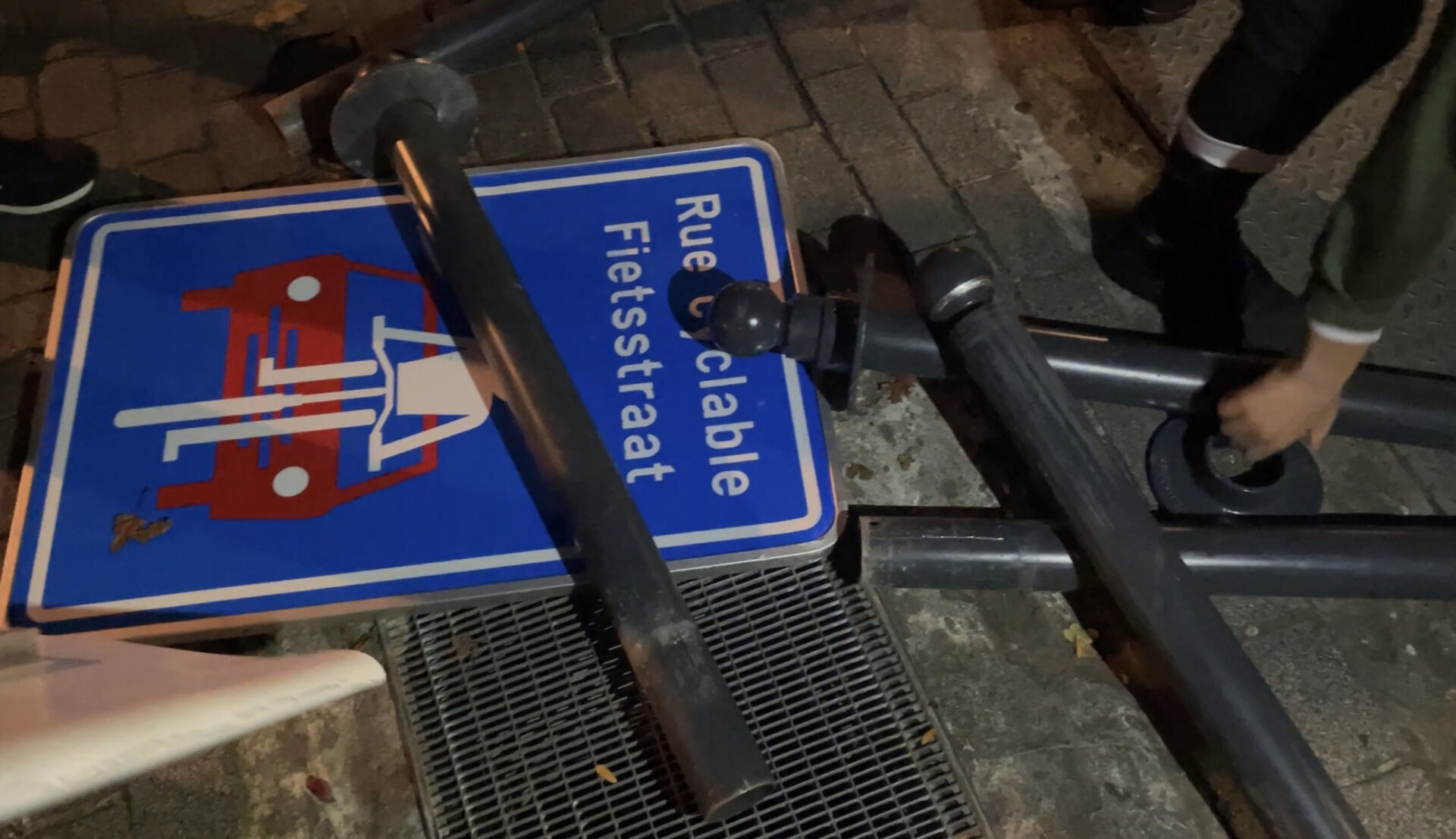
Traffic signs were destroyed as some people held a protest action against the 'Good Move' traffic circulation plan in Schaerbeek, Tuesday 25 October 2022. Credit: Belga/Nils Quintelier
He illustrates the shift in mentality with an anecdote. When he worked in the office of one of Brussels' former Minister-Presidents, François-Xavier de Donnea (MR), in the early 2000s, "maybe three people, out of about 100, came by bike", he says.
"We used to look at them with a bit of astonishment. We looked at them as if they were Martians," he laughs.
Now, "easily 30%" of people working in his office cycle to work every day, he muses, including his two chiefs of staff. "We see changes in mobility in every municipality, in every social and professional sector."
While a convinced motorist himself, he believes the worst things are extremism and dogmatism. "Mobility must evolve, and ensuring greater safety for everyone, particularly pedestrians and children, is essential."
Brussels will move toward a more balanced framework by 2030, he explains. More consultation, smaller “mailles” (perimeters) in the traffic plans, and a focus on school zones. Additionally, Brussels' infamous concrete blocks will become a thing of the past.
The end goal, he says, is a smooth traffic flow for everyone. During his time as mayor, however, he felt that the previous government imposed measures on municipalities overnight without proper consultations.
Thanking cyclists
Now, he wants to hold "real consultations" with residents, businesses and shopkeepers. "We cannot force it through, like a bulldozer. So we go back to the drawing board."
He stresses that he believes cyclists in Brussels deserve their rightful place. "We must encourage them, we must protect them, we must thank them," Dilliès says.
Thank them? "Yes, as a motorist myself, when someone swaps their car for a bike – and this happens regularly lately – I say thank you to them. Because they are making more space for me, as someone who needs to use my vehicle. That’s the logic of it."
Nothing, he says, annoys him more than when drivers tell him about aggressive cyclists, suggesting that they should not be allowed to ride in certain places.
"I'm sure some of them are very aggressive. I've seen them," he recounts. "But I know plenty of aggressive drivers too, and their aggression can have far more serious consequences."
In short, he says, everyone needs to understand that motorists are not the enemy, but neither are cyclists or pedestrians. "We need to break out of this pattern of pitting one group against the other."
