
It’s true: we don’t live in continuous narratives. We live in fragments, and it’s in those fragments that we recognise ourselves most clearly.
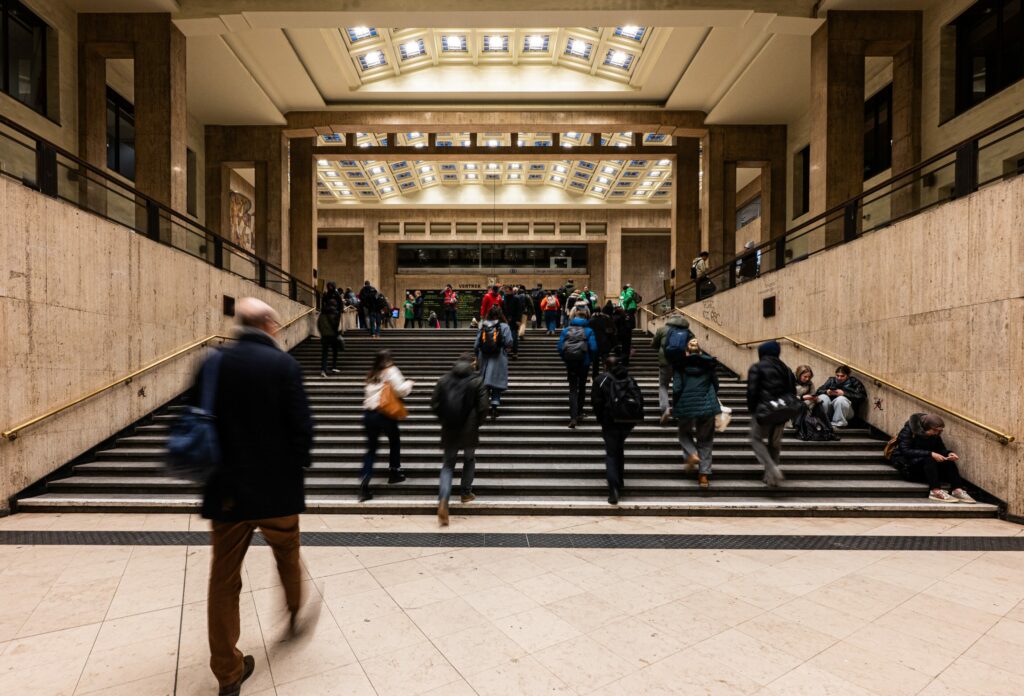
Brussels is a city of constant recalibration, its languages, neighborhoods, and histories adjusting in real time. Nowhere is that more visible than at its center. The station itself, originally conceived by the architect Victor Horta and completed after his death, already carries that sense of movement in its design, built less to contain the city than to choreograph passage through it.
I learned how to move through the world at Brussels Central Station, not in any formal sense, with lessons or instructions, but in the way the body understands things before the mind can name them. How to step without colliding. How to hesitate without stopping. How to belong to a current that never quite settles.
I grew up in Brussels, the child of Moroccan immigrants, and the station was one of those places you kept passing through, on the way to places, between errands, at departures and returns. It wasn’t a destination. It was the place in between, the place where you adjusted.
Part of its pull, something I only understood later, was how closely it resembled the shape of our lives. Nothing there was still for long, but nothing was rare either. Movement was constant, ordinary, almost taken for granted. People arrived, left, reappeared, changed direction. You were always in transition, even when you weren’t going anywhere in particular.
That felt familiar.
At first glance, it’s all motion. Trains arrive, doors open, people spill out, schedules flicker and update, the quiet infrastructure of the city’s day setting its pace without announcing it. But if you stand there long enough, you notice something else. Nothing moves continuously. Everything happens in fragments.
The system runs on interruption.
As a kid, I didn’t think of it that way. I just learned the rhythm. You don’t walk in a straight line. You angle slightly, correct, speed up, slow down. A second too late and you’re in someone else’s path. A second too early and you hesitate, recalibrate, try again. Every movement is a small negotiation.
At home, things carried that same unsettled continuity. We weren’t uprooted, but we weren’t fully anchored either. Languages overlapped, French and Flemish outside, Darija-Arabic inside. Expectations shifted depending on where you stood, who you were speaking to, what was being asked of you. There was no single, stable version of things to rest in.
So you learned to move within that.
Not dramatically, not all at once, but in small, ongoing adjustments. You learned how to read a situation quickly, how to shift tone, how to occupy a space without fully claiming it. The station didn’t teach that so much as mirror it back. It gave it a visible form, one instance of a larger, shared negotiation happening across the city.
So I learned to live in transitions. Not the big ones, leaving, arriving, but the small gaps in between. The half second where you’re not fully one thing or another.
You can see those gaps clearly on a train at night. The motion feels steady, but it isn’t. There are tiny slowdowns, almost imperceptible, where the rhythm softens before picking up again. In those brief intervals, your thoughts change shape. You stop thinking in full stories and start thinking in pieces.
The station works the same way.
You enter it abruptly. One moment you’re outside, the next you’re inside a system already in motion. Every morning, the same corridors fill with different timings. Someone checks their watch twice in one motion. Someone missteps and merges into a different stream. No one stops, but no one moves perfectly either.
And yet, inside that density, something quieter happens.
There are moments, brief and almost accidental, when your gaze unfocuses. You’re standing on the platform or moving with the crowd, and for a fraction of a second you stop tracking individual faces, destinations, outcomes. The announcements blur into sound. Footsteps become a kind of rhythm. Your attention loosens.
It’s not distraction. It’s closer to a form of meditation, but one that lasts only an instant.
In that instant, you’re still moving, still part of the system, but no longer pushing against it. You’re carried. The usual calculations, where am I going, am I late, who’s in my way, fall silent. Not resolved, just suspended.
Then it passes. You refocus. You step forward. The decisions return.
But something lingers, a sense that even in the most crowded, hurried place, there are openings. Not outside the flow, but inside it.
Waiting exists, but only briefly. It’s dense, not empty, full of micro decisions. Step forward or hold back, pass or yield, commit or adjust. Fractions of a second that determine everything.
Even the building insists on this. Corridors widen where you expect them to narrow. Ceilings curve instead of running straight. Staircases open up just before they should constrict. You’re constantly correcting without realising it.
Most people don’t notice. They pass through.
For a long time, so did I.
Outside the station, the same structure shaped my memory. The house I grew up in is gone now. I tried to rebuild it in my mind, but memory doesn’t restore. It is more a vague arrangement of places, made even vaguer with the passage of time. The kitchen light arrives too early. The hallway stretches longer than it should. A door closes a second too late. The layout is intact, but the timing slips.
Like a train that follows the right track but never quite arrives on time.
When I left Belgium for the United States as a young man, nothing cleanly broke. It shifted. Language, relationships, habits, everything continued, but slightly out of sync. I wasn’t starting over. I was recalibrating, the way the city itself does, quietly and constantly, without resolution.
Years later, back in Brussels with my wife, Robin, we stayed near the center. From our window, we could see the station.
From above, it looked smooth. Efficient. Almost calm.
She saw flow.
I saw the interruptions holding it together.
The moment that made this clear came years earlier, on an ordinary evening. My train pulled into Central. The tunnel replaced the outside view. The doors opened. People stepped out.
I didn’t, not right away.
The delay was tiny, less than a second. But it broke something open. The gap between the train and the platform, something I had crossed thousands of times, suddenly demanded attention. It wasn’t bigger. It just wasn’t neutral anymore.
People moved around me. The system didn’t pause. The doors stayed open, but not for me, for the schedule.
Then I stepped forward. Or maybe I had already started. It’s hard to locate the exact beginning.
What stayed wasn’t the action, but the hesitation.
Around that time, someone told me, “You grew up here. This is where you are.”
It sounded simple, but “here” kept shifting. It wasn’t a place you could hold onto. It existed only in the instant you arrived, and disappeared as soon as you settled. I had known that for a long time without naming it.
A shoelace coming loose at the edge of a platform.
A pause before stepping off a curb.
Holding a door half a second longer than expected.
Each is a small mismatch between intention and action. Each resolves almost immediately. But in that brief gap, something becomes visible, the structure underneath.
We like to think movement is continuous, that lives unfold in clean, unbroken lines. But they don’t. They’re made of segments, tiny corrections that keep things from falling apart, most of them imperceptible.
Brussels Central Station taught me that before I understood why it mattered.
Everything there depends on timing, and timing is never exact. It stretches, compresses, hesitates. People adjust. Systems adapt. The city itself moves this way, through small, shared misalignments that make room for change.
That slight misalignment isn’t a flaw.
It’s what allows anything to move at all.
