
The EU will present an Electrification Action Plan by the summer, after leaders discussed the economic impact of 54 days of conflict in the Middle East, including a reported rise of more than €25 billion in the bloc’s bill for imported fossil fuels.
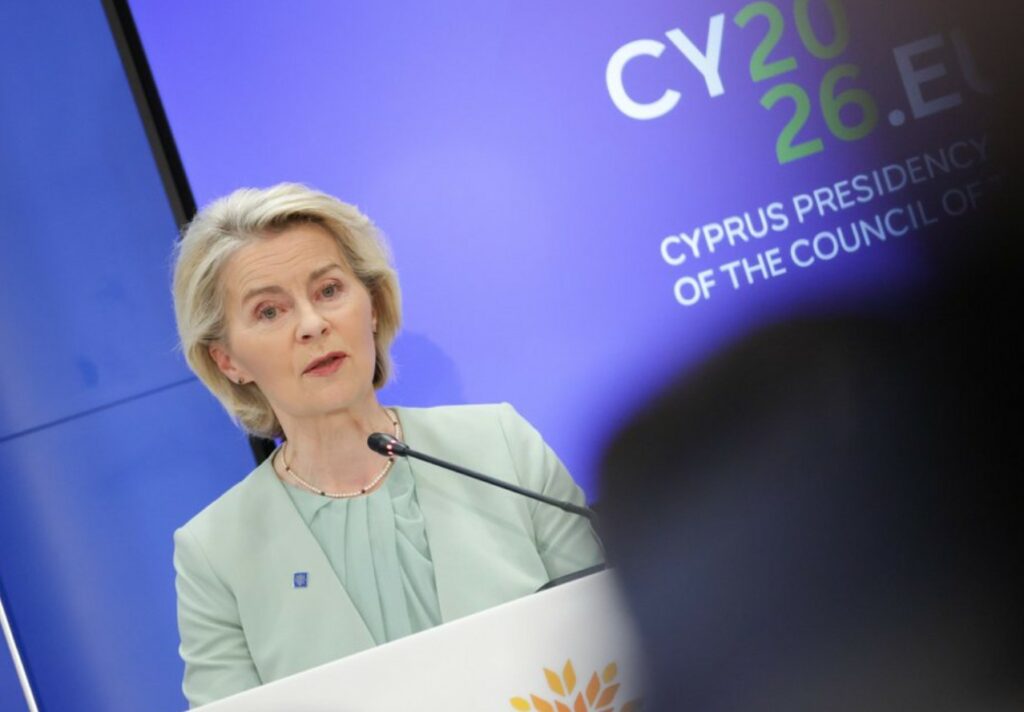
European Commission President Ursula von der Leyen, who spoke after the European Council meeting in Cyrpus on Friday, said the extra cost had come “without a single molecule of energy in addition” since the conflict began.
She said the EU’s medium-term approach discussed in recent weeks and months was to reduce dependence on imported fossil fuels and increase “home-grown” energy, including renewables and nuclear power.
Immediate measures should be tailored to each member state’s energy mix rather than a “one size fits all” approach, she said, describing an EU “toolbox” of options.
Any support should be targeted at those most in need, temporary with a clear end date, and co-ordinated across the bloc for “maximum impact”, she added, citing lessons from the 2022 energy crisis when Russia cut off gas supplies.
Von der Leyen also stated the EU would apply the same approach to fuel reserves, particularly jet fuel and diesel, where markets were “tightening”.
Roadmap signed to complete Single Market by end of 2027
Von der Leyen noted that she, Cyprus President Nikos Christodoulides — whose country holds the Council presidency — and European Parliament President Roberta Metsola signed a “One Europe, One Market” roadmap setting out milestones to complete the EU Single Market by the end of 2027.
The roadmap lists five priorities: simplifying rules, removing barriers to cross-border business and investment, trade, reducing energy prices while cutting emissions, and driving digital and AI transformation.
She also noted leaders discussed the next EU long-term budget, known as the Multiannual Financial Framework, and noted the EU will begin repaying borrowing from the Covid-era NextGenerationEU programme from 2028 onwards.
Von der Leyen said the Commission had proposed a package of “new own resources” — EU-level revenues — warning that without them the choice would be higher national contributions or lower spending capacity.
Leaders also held a discussion on the EU treaty’s mutual defence clause, which obliges member states to support another in need but is less clear on how that support should be triggered, von der Leyen said, adding that work was under way with the EU’s High Representative and the Commissioner for Defence.
