
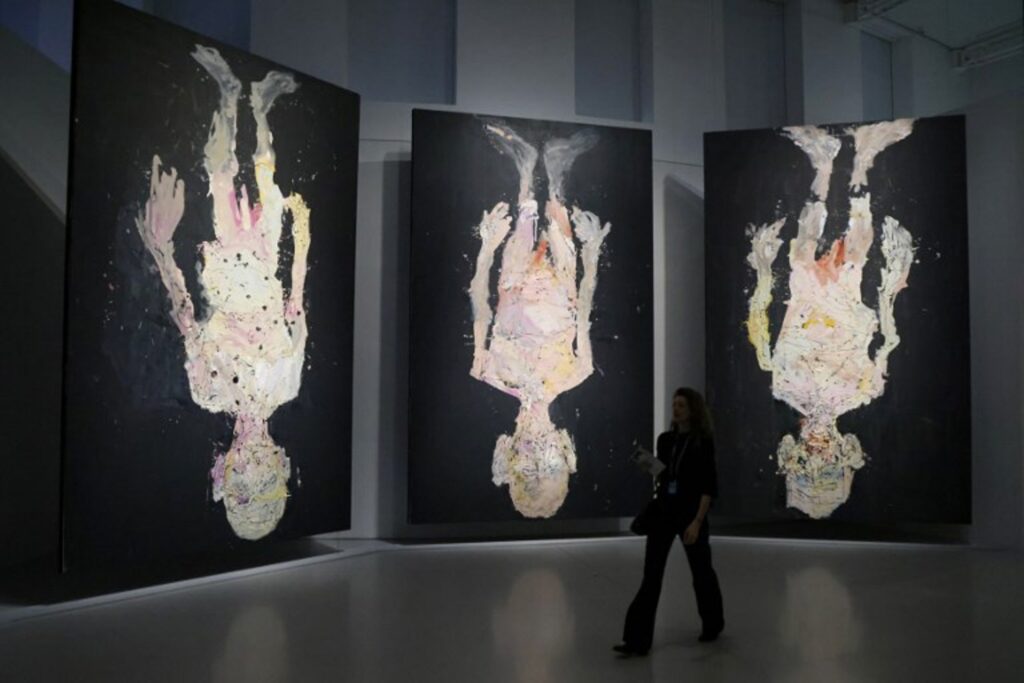
German painter, draughtsman, engraver, and sculptor Georg Baselitz, renowned for his upside-down paintings and diverse interpretations of Germany’s historical traumas, has died at the age of 88.
The news of his passing was confirmed by his gallery, which stated that Baselitz, who had “profoundly influenced his contemporaries and artists after him,” died peacefully.
Born Hans-Georg Bruno Kern in 1938 in Deutschbaselitz, near Dresden in eastern Germany, Baselitz adopted his pseudonym in 1961 as a nod to his hometown. He grew up during the Nazi era and later under the authoritarian regime of East Germany.
In 1957, he fled East Germany amid political pressures, fearing he would be forced to work in a mine after being rejected by the fine arts academies in Dresden and East Berlin.
His first exhibition in West Berlin in 1963 sparked controversy, with critics labelling it “pornography.” Authorities confiscated two of his paintings, shut down the show, and fined him. Despite this setback, Baselitz gained international recognition in Florence two years later with his 'Heroes' series.
Baselitz’s works often reflect Germany’s historical wounds, spanning themes such as post-war trauma, East German oppression, and the broader legacy of World War II. His portfolio includes the 'Heroes' series, finger paintings, fracture paintings, Soviet-inspired works, and his renowned upside-down canvases.
In a 2013 interview with 'Der Spiegel,' Baselitz spoke openly about his struggles with Germany’s wartime legacy. “All German artists grapple with a neurosis about our past," he said. "It plunged me into deep depression and immense pressure. My paintings are, in a way, battles.”
He has also courted controversy with his views on women in art, claiming in the same interview that they “do not paint as well as men.” While acknowledging exceptions like Agnes Martin and Paula Modersohn-Becker, Baselitz stated, “But even she is no Picasso, Modigliani, or Gauguin.”
In 1969, Baselitz introduced a groundbreaking approach to his art by flipping motifs upside down, beginning with his painting 'Der Wald auf dem Kopf' (The Forest on its Head). Reversing subjects such as figures, trees, and houses, he emphasised perception over representation. His work drew inspiration from German Expressionism, American painters like Jackson Pollock and Willem de Kooning, and Pop Art.
Speaking to 'Süddeutsche Zeitung' in January, he explained his artistic ethos: “As any artist, I want to create something unknown to others. They will be shocked by what they see. Once the shock subsides, they might perceive something—or they might not. That is the goal of every artist.”
From the 1970s, his wife Elke Kretzschmar, whom he married in 1962 shortly after moving to West Berlin, became a central subject of his art.
In recent years, Baselitz achieved notable recognition in France, being elected to the prestigious Académie des Beaux-Arts in 2019. This honour was followed by a major retrospective at the Centre Pompidou in Paris in 2021, cementing his legacy as one of Europe’s foremost modern and contemporary artists.
