
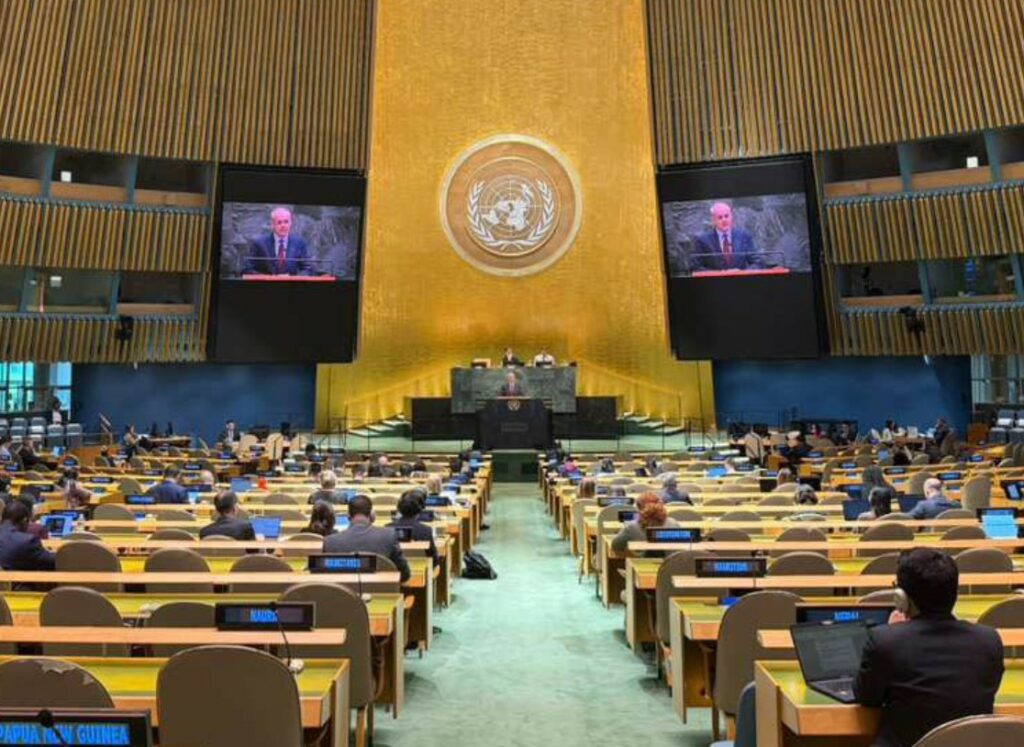
NATO told a United Nations review conference in New York on Thursday that it remains strongly committed to implementing the Treaty on the Non-Proliferation of Nuclear Weapons.
The Treaty on the Non-Proliferation of Nuclear Weapons — known as the NPT — is the main international agreement designed to limit the spread of nuclear weapons and promote disarmament, and it entered into force in 1970, the alliance noted in a statement on Thursday.
Speaking on behalf of the alliance at the treaty’s 11th Review Conference, Assistant Secretary General Boris Ruge said “nuclear non-proliferation remains as vital today as it was” when the NPT came into force.
Ruge described what he called a “gravely deteriorating security environment”, citing Russia’s full-scale invasion of Ukraine as well as Moscow’s nuclear rhetoric and “coercive nuclear signalling.”
He said NATO’s nuclear capability “retains its fundamental purpose: to preserve peace, prevent coercion, and deter aggression.”
Nuclear sharing and calls for transparency
NATO’s nuclear deterrence and nuclear sharing arrangements pre-date the NPT and were known when the treaty was negotiated and later indefinitely extended in 1995, Ruge said, adding that they have “always been fully consistent with the NPT”, NATO reported.
Ruge also said arms control, disarmament and non-proliferation “remain essential” and called on China to increase transparency around its military nuclear programme.
He also referred to Iran and the DPRK — the Democratic People’s Republic of Korea, the official name of North Korea — as “grave challenges” to the NPT.
Ruge stated that allies would work on “concrete, practical and achievable steps” at the conference, including measures to promote transparency and reduce risk.
He said allies encouraged the United States’ pursuit of “multilateral strategic stability” and called on China and Russia to engage constructively.
During the New York visit, Ruge met UN Under-Secretary-General for Disarmament Affairs Izumi Nakamitsu and the Review Conference President Do Hung Viet, as well as senior officials including from all 32 NATO allies and other partners.
The North Atlantic Council agreed a statement reaffirming the alliance’s commitment to the NPT ahead of the review conference.
