
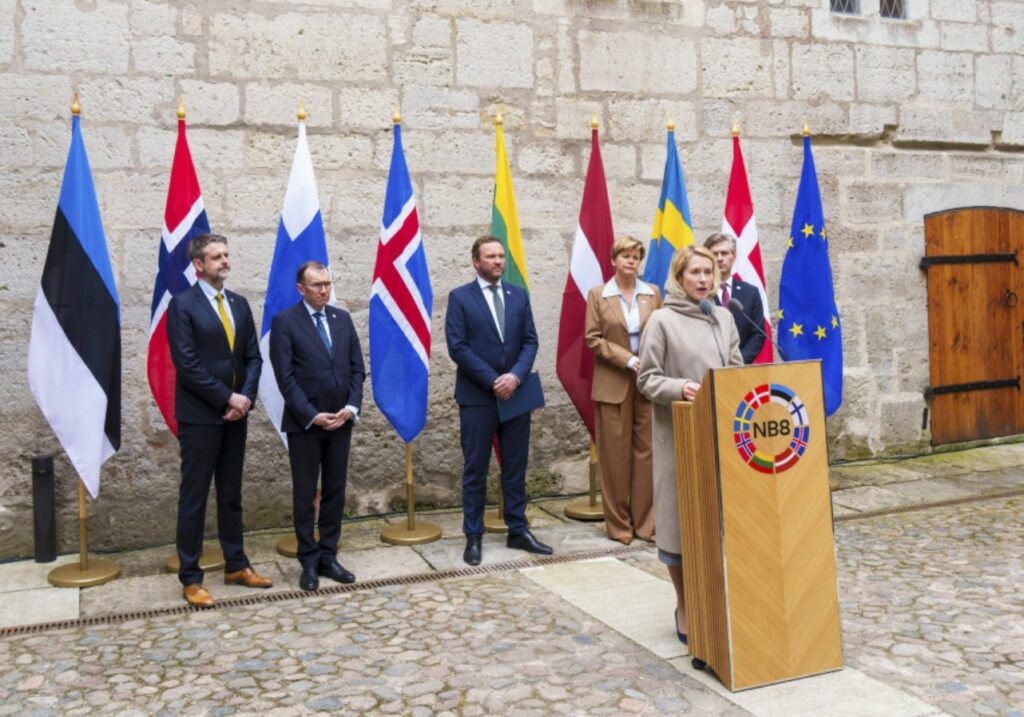
EU foreign policy chief Kaja Kallas said there was “no swift exit” from the stand-off in the Strait of Hormuz, warning that the global economy was “reeling” and that Russia was gaining extra revenue from higher oil prices.
Speaking in Estonia after talks with foreign ministers from the Nordic-Baltic Eight (NB8) group — Denmark, Estonia, Finland, Iceland, Latvia, Lithuania, Norway and Sweden — Kallas said freedom of navigation for Europe was “non-negotiable”, as cited on Thursday by the European External Action Service (EEAS).
EU foreign ministers have already agreed to expand sanctions on Iran over shipping restrictions, she said.
She added that EU naval operations could play a greater role in restoring energy and trade flows, the EEAS reported.
Kallas also stated Tehran’s nuclear and missile programmes and its support for terrorist groups “must be addressed.”
Ukraine and Russia
The NB8 countries were described as Ukraine’s “strongest supporters”, and Kallas said Russia had been pushed into a “stalemate.”
She also stated “battlefield math” showed Russia was losing a record number of soldiers.
Kallas referred to an EU “90-billion-loan” and the bloc’s “20th sanctions package”, saying the measures sent a message that the EU would provide Ukraine what it needs “to hold its ground.”
Russia’s annual Victory Day parade in Moscow was expected to take place without heavy military equipment “for the first time in years.”
She also said “hybrid attacks” by Russia were “already off the scale”, referring to tactics such as sabotage, disinformation and cyber activity.
Kallas listed further sanctions, accountability for war crimes, international isolation and “shutting the door to Russian ex-combatants” as elements of the response.
EU foreign affairs ministers are due to continue discussions next month in Cyprus on the bloc’s approach to Russia and how best to defend European security interests.
In the Q&A, Kallas said the Ukraine peace talks were “really stalling” and that “there is nothing happening there.”
She also said she did not see additional pressure on Russia reflected in a recent call between US President Donald Trump and Russian President Vladimir Putin.
