

Forgive me. I’m trying to spoil a party.
I'm referring here to Independence Day celebrations marking the 250th anniversary of the United States. If you're invited to the upcoming “Freedom 250” extravaganza in Brussels, I think the right decision is to boycott.
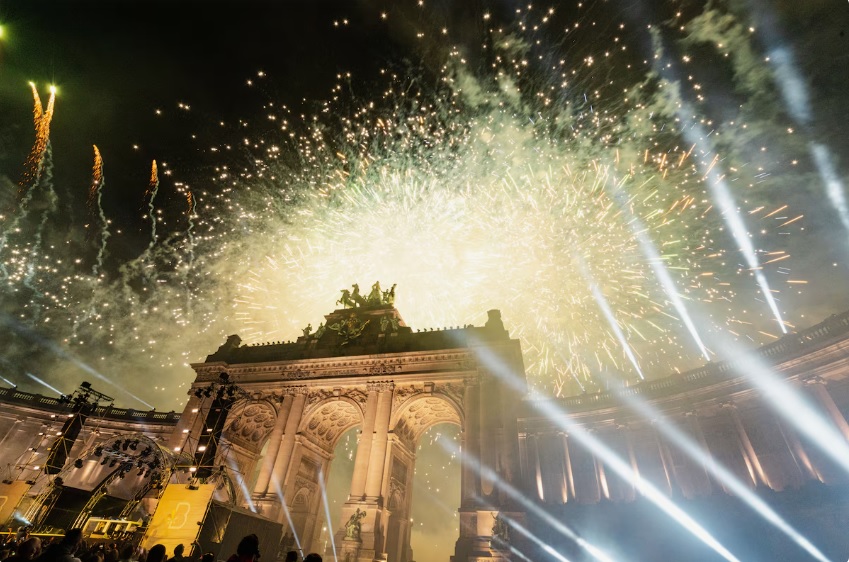
That means skipping a planned 28 June gathering of several thousand people in Cinquantenaire Park, a possible military flypast, fireworks, and performances by 1970s disco stars Chic and perhaps pop singer Katy Perry too.
I love Fourth of July parties for the part they played in my upbringing and for the idea they celebrate — that people have inherent rights and can govern themselves. There's an emancipatory story in the adoption of the Declaration of Independence on July 4, 1776, that almost everyone can identify with.
The French Declaration of the Rights of Man and of the Citizen adopted after the storming of the Bastille on 14 July, 1789, is directly inspired by America’s Declaration.
But the US has deep faults and fractures.
The most serious are the legacies of slavery, genocide, and apartheid. These crimes and injustices have never been fully addressed. Presidents from George Washington to Joe Biden are implicated although in different ways and to very different degrees.
And then there’s Donald Trump. His bigotry puts him in a class of his own.
Trump routinely denigrates African Americans as having low IQs. This month he shared pictures likening former president Barack Obama to dirty water. Trump's surrogates have ordered books on race and gender to be removed from libraries and they’ve imposed a de facto resegregation of the government workforce.
In Europe, the Trump administration backs Viktor Orban, the Hungarian ultranationalist who decries race-mixing, as well as the Alternative for Germany or AfD party, whose members minimise Nazi-era crimes. Marco Rubio, Trump's secretary of state, recently warned Europeans about the "erasure" of their civilisation from migration, a trope that portrays non-white peoples as invaders.
I did not have state-sponsored racism on my bingo card for the 2020s. But here we are.
Neo-royalism
A second reason to boycott is corruption. That includes moral corruption associated with Trump himself.
Two years ago, Trump was found guilty of falsifying business records to influence the 2016 election in a case involving payments to the adult film star Stormy Daniels. The verdict made Trump the first former or sitting president in American history to be convicted of a crime.
Trump also has been found liable for sexual abuse in a separate civil case.
And lest we forget, there is a pesky FBI document in the Epstein files containing unsubstantiated allegations from an anonymous woman who claims she was sexually assaulted by Trump when she was as young as 13. The allegation is unverified and the White House has called it "completely baseless". This past weekend Trump insisted he was "not a paedophile".
Then there's the appearance of corruption in plain sight, much of that seemingly linked to people and companies establishing financial ties to Trump or the Trump family.
Albanian authorities are suspected of seeking to curry favour with Trump by giving his daughter Ivanka and his son-in-law Jared Kushner permission to develop an island into a luxury resort.
The United Arab Emirates is suspected of investing large sums of money in the Trump family's cryptocurrency business in exchange for favourable decisions such as access to highly coveted American-made AI chips.
Elon Musk, who helped bankroll Trump’s presidential campaign, was put in charge of the Department of Government Efficiency, or DOGE. That may have given Musk access to the USXports database, potentially giving him an advantage over rival defence contractors including from Europe.
Trump’s behaviour in office has been described as a form of neo-royalism, where his administration mixes private enterprise and diplomacy, and acts more like royalty in medieval Europe than an anchor for the modern nation-state.
But being able to define these phenomena does not mean they represent a new normal. Nor do they herald the dawn of a new order that we must accommodate.
Europe's future
The third reason to boycott is the Trump administration’s pernicious behaviour where Europe's future is at stake.
The bad faith — particularly in the treatment of Ukraine — began during Trump's first term when he appointed Seattle hotelier Gordon Sondland as US ambassador to the EU.
Sondland was part of efforts to pressure President Volodymyr Zelensky to investigate Burisma, the Ukrainian energy company where President Biden’s son Hunter served on the board. At stake for Zelensky was US support worth $391 million.
Sondland later testified that there had been a "quid pro quo" involving pressure on the Ukrainians.
Sondland's successor in Trump's second administration is Andrew Puzder, a former anti-abortion attorney and fast-food chief executive who has been critical of trade unions and who unabashedly promotes US technology dominance and hydrocarbons.
Alberto Alemanno, a law professor at HEC Paris, has warned that Puzder’s most recent comment, that Europe needs more rather than less fossil fuels, expressly undermines Europe’s goal of greater energy sovereignty.
"It's a trap," wrote Alemanno. "We’re being told to feel energy-poor so we buy American."
A diplomatic affront?
Representatives of the EU institutions will be concerned that skipping the 28 June party risks a diplomatic affront. True, work continues between the EU and US on a wide range of issues from critical minerals to semiconductors.
But here’s the thing: many in the Eurocracy still believe that pandering to the Trump administration will mitigate its threats to Europe. The truth is that you have to stand up to bullies.
Consider the EU troops sent to Greenland in January after Trump threatened to annex the island from Denmark. The Europeans would have been no match for US firepower, but they were willing to shed blood — and the deployment helped force Trump to back down.
Sticking two fingers up at Trump’s so-called Donroe Doctrine and his neo-imperialist delusions felt good. Even better, it worked.
Some EU officials may worry about hypocrisy. They have more in common with the Trump administration than they’d probably care to admit. But officials who shrug at migrant abuses or a return to fossil fuels, or who say it’s time to make concessions to Russia, are going to attend anyway.
For those thinking about taking a pass, they can strengthen their resolve by recalling how the Trump administration has slapped visa bans on their fellow Europeans.
These include a former European Commissioner, Thierry Breton, and four representatives of civil society organisations, sanctioned by the US State Department on the grounds of censoring American viewpoints. In reality, the sanctions were retaliation for monitoring online content carried by platforms owned by tech oligarchs like Musk.
In addition, fierce opposition to plans for the party, including draping a monumental arch with American flags, and a flypast by US warplanes, has been gaining traction in Belgium.
Trump’s role model has long been the Kremlin-aligned Hungarian autocrat Viktor Orbán, who was ousted in elections this month. But EU authorities started avoiding Orbán long before that vote, sidelining him whenever they could at meetings of the European Council.
It's high time EU leaders adopted a similar mindset toward Trump and his factotums in Brussels.
Yes, a Fourth of July party nominally celebrates the founding of the United States and, as such, should transcend any single presidency. But under the Trump administration, the nation has veered too far from its founding ideals, with enormous consequences for Europe and for the entire world.
I’m confident there will be future July Fourth parties in Brussels where Americans and Europeans will have something to celebrate. For now, the best course of action is to keep this summer’s Freedom 250 invitation in the drawer — as an artefact of an era most of us can’t wait to see the back of.
