
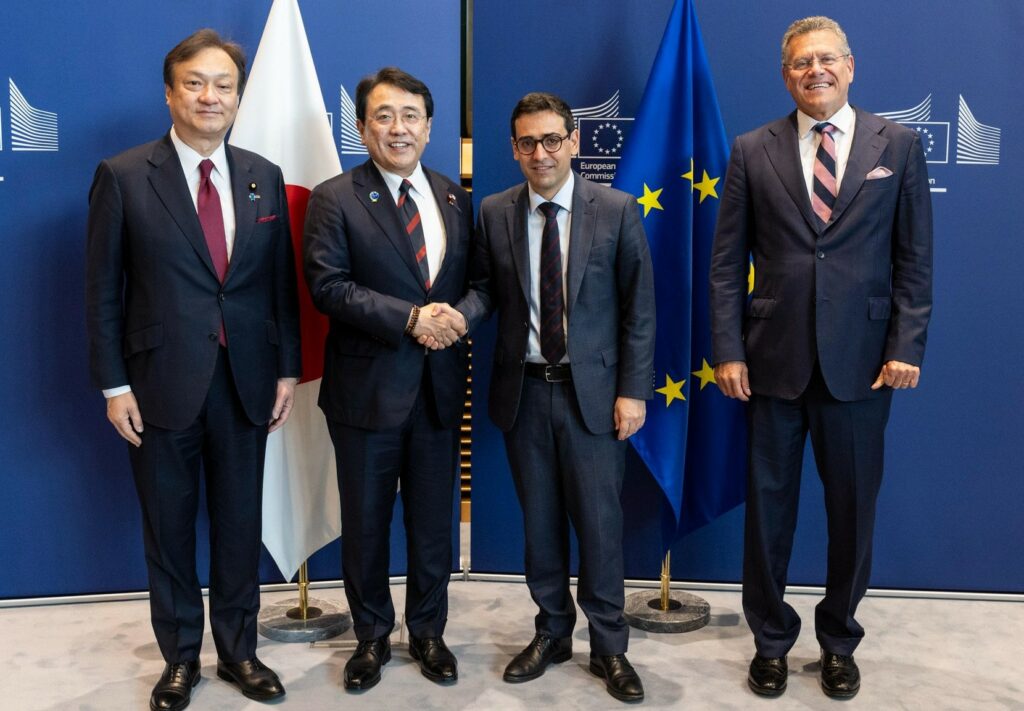
The EU and Japan have agreed to step up cooperation on trade, industrial policy and economic security after holding their seventh High-Level Economic Dialogue in Brussels on 7 May 2026.
The talks were the first to be held in a “reinforced” format that expands the dialogue beyond previous areas of cooperation, the European Commission informed on Friday.
The meeting was co-chaired for the EU by Stéphane Séjourné, Executive Vice-President for Prosperity and Industrial Strategy, and Maroš Šefčovič, Commissioner for Trade and Economic Security, while Japan was represented by economy minister Akazawa Ryosei and state foreign minister Horii Iwao.
Both sides reaffirmed their commitment to a rules-based international order and said they would continue efforts to reform and support the World Trade Organization, as well as cooperate through other groupings including the G7 and engagement between the EU and the Comprehensive and Progressive Agreement for Trans-Pacific Partnership.
They also discussed the situation in the Middle East and reaffirmed the importance of stable and transparent energy markets, as well as “secure and uninterrupted” trade flows, including safety of navigation and protection of critical maritime routes and infrastructure.
Supply chains, critical minerals and export restrictions
The EU and Japan raised concerns about “all forms of economic coercion” by third countries and said they regretted the recent expansion of export restrictions, calling for export controls to be narrowly defined, non-discriminatory and in line with international law and practice, according to the Commission.
They also expressed “serious concerns” about non-market policies and practices that they said are leading to harmful overcapacity and market distortions.
The two sides reaffirmed work to strengthen supply chains under the EU–Japan Competitiveness Alliance agreed at the EU–Japan Summit in July 2025, including in areas such as critical minerals, batteries, clean technology and clean energy including offshore wind, hydrogen and solar, as well as steel, robotics, biotech, defence and space industry.
Ministers welcomed progress made through matchmaking sessions for strategic projects under the EU Critical Raw Materials Act — an EU law designed to support access to materials such as lithium and rare earths — and said they intended to explore support for additional joint critical mineral projects.
They acknowledged ongoing discussions between the European Investment Bank and the Japan Bank for International Cooperation on cooperation.
The EU and Japan also agreed to reinforce cooperation under an upgraded working group on economic security, including work on assessing and mitigating technology transfer risks and structured engagement with the private sector and technology holders.
In response to Japan’s concerns about the EU’s proposed measure on steel, both sides agreed to continue discussions in light of the EU–Japan Economic Partnership Agreement and World Trade Organization agreements, while also stating that stronger global action is needed to tackle steel overcapacity.
Both sides said they would continue discussions on industrial policy and supply chains, including in the automobile and battery sectors, and work towards the next EU–Japan Summit.
