
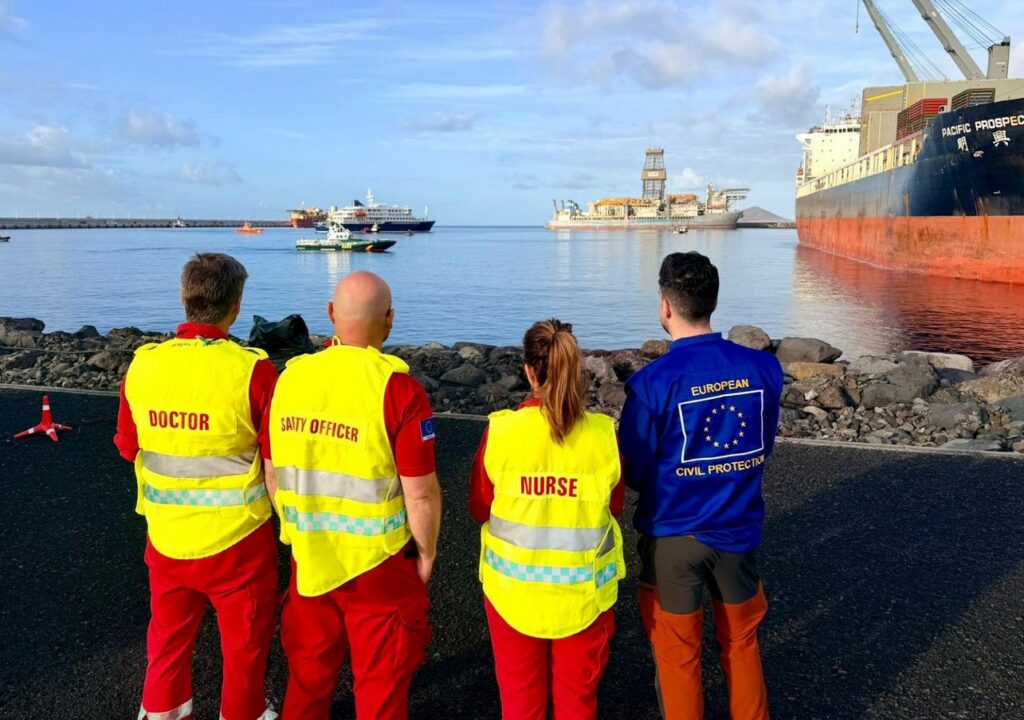
The European Commission has coordinated EU support for evacuations and other measures linked to a Hantavirus outbreak involving passengers on the MV Hondius cruise ship anchored off Tenerife.
The risk to the general population in Europe is “very low”, given that appropriate infection prevention and control measures are being implemented and hantaviruses are not easily spread between people, the European Commission and the European Centre for Disease Prevention and Control (ECDC) said on Monday night.
Spain activated the EU Civil Protection Mechanism on 6 May, after which the Commission’s Emergency Response Coordination Centre began facilitating evacuations from the ship.
The mechanism is an EU system that helps countries request and coordinate assistance during emergencies.
Five repatriation flights coordinated and co-funded by the EU took place on Sunday 10 May, departing from Tenerife and carried out by France, Spain, the Netherlands, Greece and Ireland. A sixth and final flight operated by the Netherlands took place on Monday.
The Commission said it has also mobilised response capabilities and stockpiles from its strategic reserve, known as rescEU. A medical evacuation aircraft from the EU fleet — hosted by Norway — has been pre-positioned in Tenerife, and additional transport, logistics capacity and protective equipment are ready to be deployed if needed.
Health coordination alongside evacuations
A Liaison Officer has been deployed to Tenerife to support on-site coordination with the relevant authorities, the Commission said.
The ECDC also sent two experts from the EU Health Task Force to the ship before passengers were disembarked.
The Commission added it is working with Spain, EU member states, countries participating in the EU Civil Protection Mechanism, the ECDC, the World Health Organization and G7 partners on the health response.
National health authorities are being brought together through the EU Health Security Committee, chaired by the Commission, to align measures for safe disembarkation, repatriation and follow-up of passengers. Coordination is taking place through daily meetings and targeted contacts.
“Health threats can easily cross borders and that is why coordination is key,” commissioner for equality, EU Commissioner preparedness and crisis management Hadja Lahbib said.
The Commission is “working around the clock” to ensure actions are “swift and effective”, she added.
Commissioner for health and animal welfare Olivér Várhelyi said the Commission is “closely monitoring” the situation and remains ready to support member states.
The risk to the general population in Europe is currently considered “very low”, he informed.
The ECDC is publishing daily outbreak updates with figures, case definitions and a risk assessment for the EU and European Economic Area population.
