

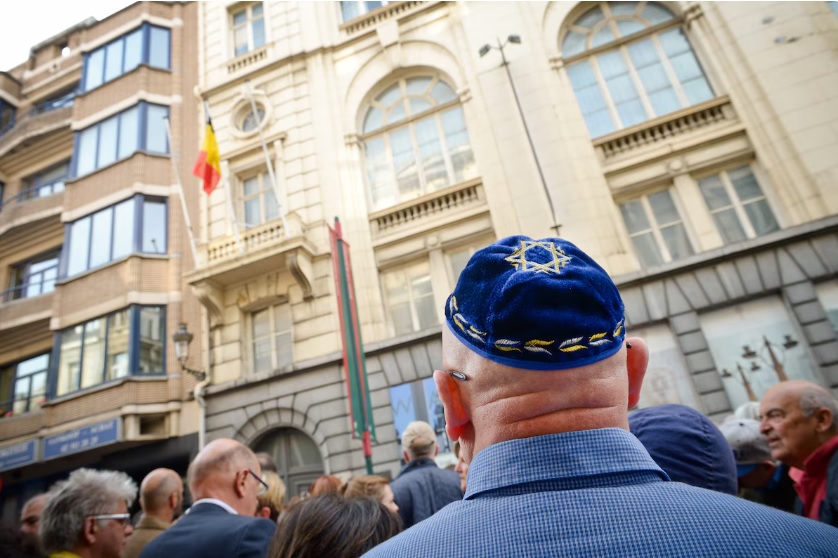
It begins in small decisions: whether to wear a kippah when leaving home, whether a Star of David pendant should be visible or hidden away, whether safety is still something assumed, or something constantly calculated.
In recent months, following a series of antisemitic assaults, acts of intimidation, and attacks on Jewish institutions and neighbourhoods, I have increasingly heard the same quiet question in conversations within the community and in my work: Am I still safe here?
It is not always spoken directly. Sometimes it appears as hesitation before stepping outside. Sometimes it surfaces in the way people scan public spaces more carefully. At other times, it exists as a persistent background tension that is difficult to name but deeply felt.
As someone working in the field of mental health, I am struck not only by the events that give rise to these feelings, but by their psychological accumulation. Safety is not only a physical condition; it is also an internal sense of continuity, predictability, and belonging. When that sense becomes fragile, the impact reaches far beyond the immediate moment of fear.
This reflection is not a statistical account or a political argument. It is an attempt to understand, from a psychological perspective, what it means to live with a growing sense of vulnerability tied to identity in a European city that many have long experienced as home.
The psychology of perceived threat
Human beings are naturally sensitive to threat. When danger is rare and clearly defined, stress tends to be temporary. But when signals of threat become repeated, uncertain, or socially reinforced, something shifts internally. The mind and body begin to remain partially alert, even in ordinary situations.
Psychologically, this resembles what trauma researchers describe as chronic hypervigilance: a nervous system that no longer fully trusts the environment to remain predictable.
It can appear subtly: choosing different routes home, noticing who is nearby on public transport, or reconsidering how visible one’s identity should be in a particular space.
This is not overreaction; it is adaptation.
The difficulty arises when adaptation becomes constant. Over time, relaxation becomes harder to access, as if part of the mind never fully stops scanning for risk.
Identity under pressure
For many Jewish individuals in Brussels, the current climate is experienced not only as a question of safety, but also of visibility and belonging.
Identity is usually lived without continuous reflection — it simply exists in the background of everyday life. But when antisemitic incidents become more frequent or more visible, identity itself can begin to feel managed.
Questions emerge that are psychologically significant:
- Am I safe wearing a kippah or a Star of David pendant?
- Do I display my identity openly or conceal it?
- What reactions might this symbol provoke?
- How will I be perceived in different neighbourhoods or contexts?
I remember a young man describing how he checks reflections in shop windows, not out of habit, but to see whether someone might be following him.
A parent once shared hesitation about whether their child should wear visible Jewish symbols on the way to school. These are not dramatic moments, but quiet adjustments that accumulate internally over time.
What develops is a form of identity strain: aspects of the self that were once expressed freely become subject to calculation. Over time, this can lead to subtle withdrawal, avoiding certain areas, changing visible markers of identity, or participating less openly in cultural or religious life.
Even when these decisions are practical, they often carry emotional weight: a gradual sense of narrowing, of taking up less space than before.
The “dual reality” experience
One of the most psychologically striking aspects of this experience is what could be described as a dual reality.
On the surface, daily life continues normally - work, school, conversations, routines. But underneath, a parallel awareness runs quietly in the background, shaping attention, decisions, and bodily tension.
This creates a split between how life looks and how it feels. Externally, little may appear unusual. Internally, however, there can be a continuous process of evaluating safety.
Over time, this becomes exhausting in ways that are difficult to explain. Some people describe it as never fully switching off. Others notice it most clearly when they leave the city or spend time in environments where they feel less guarded.
While these experiences are deeply individual, they are also collective. Fear does not develop in isolation; it is shaped by conversations, media, shared narratives, and community awareness.
Even those who have not personally experienced antisemitic incidents may still carry unease. This reflects something broader than individual experience: a shared emotional atmosphere in which concern becomes internalised.
In this sense, psychological impact is not limited to direct events. The expectation that something could happen is often enough to change how people move through the world.
And yet, people find ways to adapt. One of the most important protective factors is connection. Contact with others who understand the experience reduces isolation and helps restore psychological grounding.
Community, in its many forms, becomes stabilising. Another important distinction is the one between realistic caution and permanent fear. Awareness of risk is not inherently harmful. But when vigilance becomes constant, it can quietly reshape daily life.
In conversations, a recurring theme is the effort to reconnect with ordinary moments: walking without scanning, attending events without hesitation, or simply being present without internal calculation. These may seem small, but psychologically they matter deeply.
The role of society
While individuals develop ways of coping, it is the broader environment that ultimately determines whether such coping becomes necessary at all.
Antisemitic intimidation and violence should never become normalised within a city that defines itself through diversity, democratic values, and coexistence.
When people begin to feel they must carefully manage how visible they are, something shifts in the social fabric itself. Participation becomes more cautious, expression more filtered, and a quiet form of withdrawal can begin.
Brussels is a city built on diversity, coexistence, and international identity. For that coexistence to remain emotionally real, not only politically stated, it must include the ability for people to live visibly without continuously questioning their safety.
When safety feels fragile, it is not only the external world that changes, but the internal sense of belonging within it. Life can slowly become a negotiation between expression and protection, openness and caution.
The deepest psychological damage of sustained fear is not only anxiety. It is the gradual erosion of the feeling that one fully belongs.
This invites uncomfortable but necessary reflection: what happens to a community when people begin to question whether they can safely express who they are? And how much psychological space is lost when identity becomes something to constantly manage?
A society begins to change long before people leave it. Sometimes, it changes the moment they no longer feel entirely safe being visible within it.
