
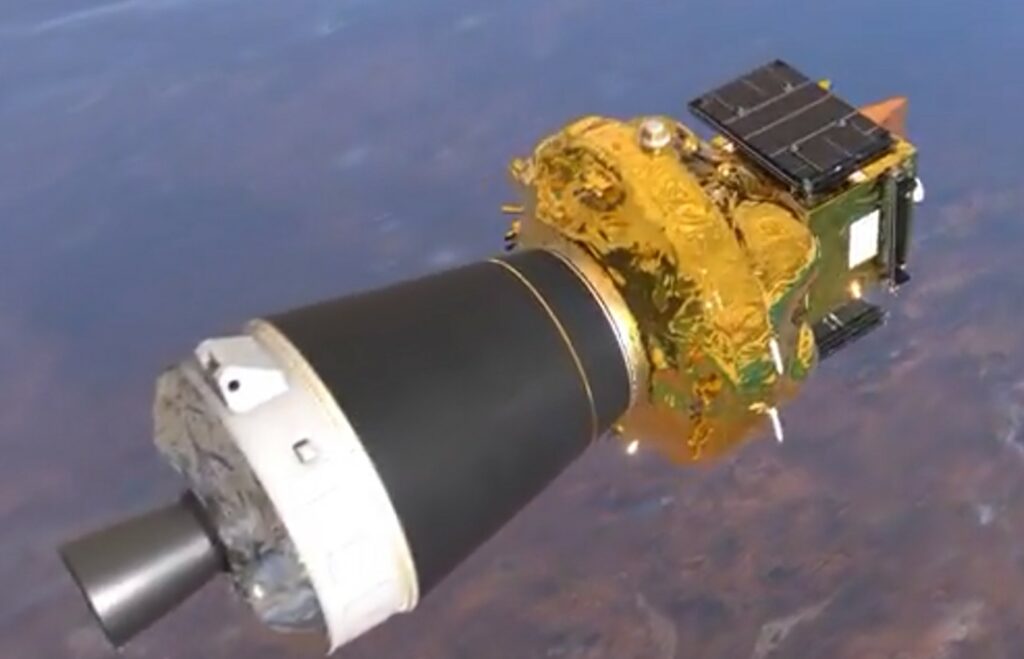
Europe’s Smile spacecraft has made first contact after launch, with its initial signal received at 06:48 CEST and its solar panels deploying a minute later.
The signal was picked up by ESA’s New Norcia ground station in Australia, and the agency said the sequence marked a successful launch, the European Space Agency announced on Tuesday.
Smile — a joint mission between the European Space Agency and the Chinese Academy of Sciences — is designed to study how Earth responds to streams of particles and bursts of radiation from the Sun.
It will use an X-ray camera to make X-ray observations of Earth’s magnetosphere — the magnetic “bubble” that surrounds the planet — and an ultraviolet camera to observe auroras, also known as the northern and southern lights.
“We are about to witness something we’ve never seen before — Earth’s invisible armour in action,” ESA Director General Josef Aschbacher said.
What Smile will observe next
The spacecraft will carry out 11 engine burns over the next month to raise its altitude, before entering a highly elongated orbit that takes it to about 121,000 km above the North Pole and down to 5,000 km above the South Pole.
Data collection is due to begin in July, after engineers unfold booms, open camera covers and check the spacecraft is operating as expected.
The X-ray camera — the mission’s largest instrument — was developed and built in the UK by the University of Leicester in collaboration with Mullard Space Science Laboratory and the Open University, working with other institutions across Europe.
Airbus Defence and Space in Spain built the payload module on behalf of ESA, which carries three of the mission’s four science instruments as well as communications equipment to send data back to Earth.
Smile was launched on Europe’s Vega-C rocket, and ESA said Avio acted as the launch service operator for the first time on this mission.
