
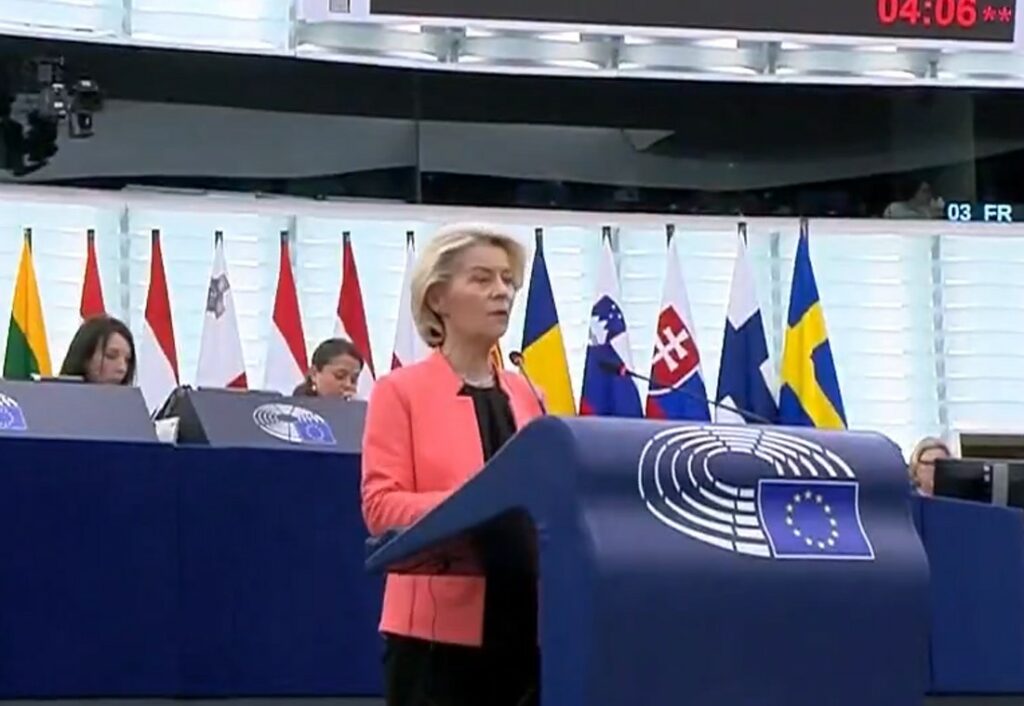
European Commission President Ursula von der Leyen has set out plans to cut remaining barriers in the EU’s Single Market and bring forward new legislation on semiconductors, cloud computing and artificial intelligence in a speech to the European Parliament.
Von der Leyen stated on Wednesday that the Commission was targeting obstacles that make it harder for businesses to operate across borders, including through a “Terrible Ten” initiative and a proposal she called “EU Inc.” — described as a single set of rules applying across the bloc.
She also criticised “gold-plating” — adding extra national requirements when implementing EU rules — and said member states should reduce it to make it easier for companies to scale up across Europe.
Von der Leyen said the Commission would present a “Chips Act 2.0” to strengthen Europe’s role in the semiconductor supply chain, after the original EU Chips Act launched three years ago and has “unlocked more than EUR 32 billion” in semiconductor investments across Europe.
A Cloud and AI Development Act will also be proposed to support what she described as a stronger European AI ecosystem, she told MEPs.
Moves on AI, energy and labour mobility
The Commission plans to open a call “in summer” for the first “AI Gigafactories”, a term von der Leyen used to describe large-scale facilities linked to developing and running advanced AI systems.
On energy and supply chains, she said the Commission had proposed “RESourceEU” and set up a Critical Raw Materials Centre, while urging more coordination on electricity networks through an EU “Grids Package” that is now with the Parliament.
An “Electrification Action Plan” will follow “in a few weeks”, she added.
Von der Leyen also announced a “Fair Labour Mobility package”, including a European Social Security Pass and plans to digitalise the recognition of professional qualifications, and said the Commission wants a stronger European Labour Authority to enforce labour mobility rules.
She urged the Parliament to adopt an “e-declaration” system, describing it as one portal and one form for the EU.
On social policy, von der Leyen said the Commission adopted its first anti-poverty strategy two weeks ago and will consult employers and trade unions on a new initiative to help people into work, including support focused on parents returning to employment.
The EU is investing EUR 1.3 billion in Poland to create new childcare places, she said.
