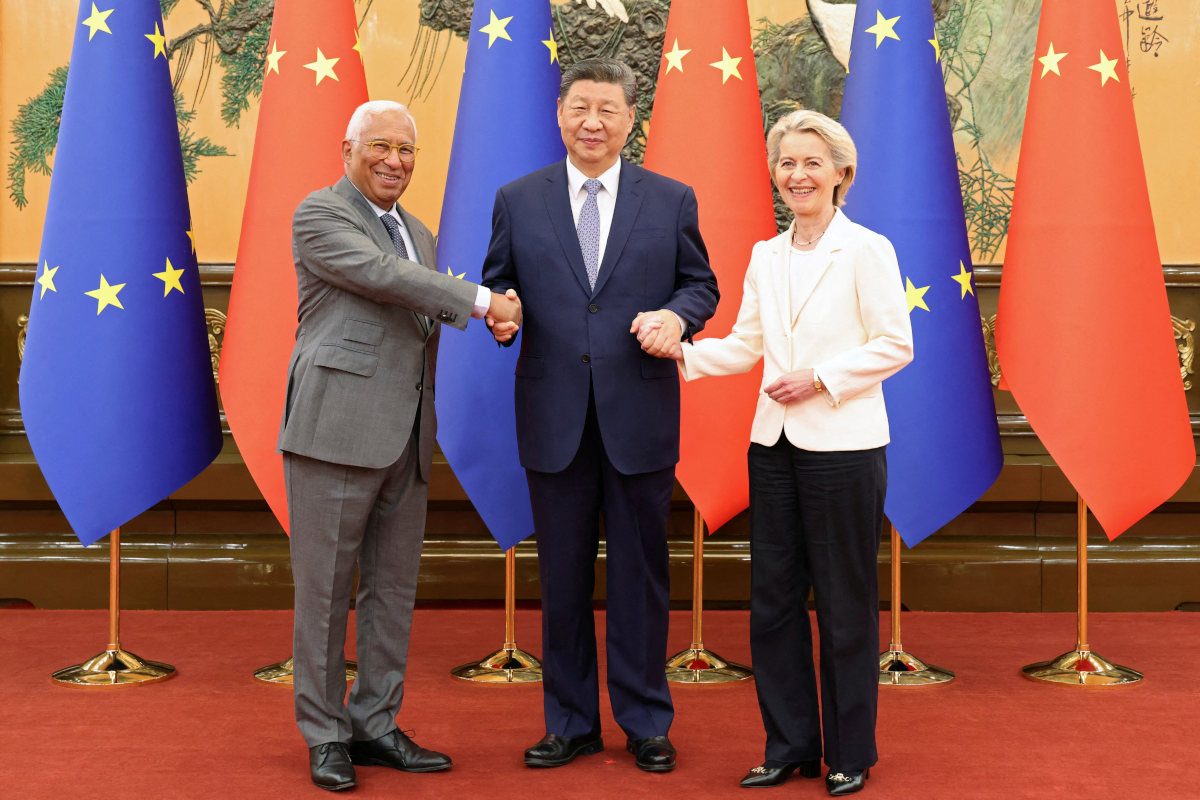
Partnership is the most accurate positioning of China-EU relations. As early as 2004, China and the EU established a Comprehensive Strategic Partnership. Among the 27 member states of the EU, 20 have established various forms of partnership with China, including 15 strategic partnerships.
This represents a valuable achievement built up over the past 50 years of China-EU relations, and a vivid reflection of the reality of the relationship today. In 2025, trade between China and the EU reached US$828.1 billion, with the volume of trade in a single day now equivalent to the total annual trade volume at the beginning of diplomatic relations. Two-way investment between China and the EU has expanded from a modest beginning to a stock of more than US$280 billion as of last year. The China-Europe Railway Express has made over 130,000 trips, with the total value of goods transported exceeding US$520 billion. These figures testify to the deeply intertwined development of China and the EU, the benefits of which are tangible and widely felt by European citizens, businesses, and all sectors of society.
First, “Made in China” has helped reduce household expenses for European families, delivering tangible improvements to European people’s quality of life. The classical British economist David Ricardo once offered profound insights into the mutually beneficial nature of international trade: while both exporters and importers benefit, the importing side often gains more in obtaining high-quality goods at lower prices.
High-quality and cost-effective Chinese products are highly popular among European consumers, while Chinese cross-border e-commerce platforms enable European consumers to enjoy diverse and personalized shopping experiences without leaving home. Against the backdrop of inflation and high energy prices, Chinese new energy vehicle manufacturers have introduced a wider range of high-quality and affordable models, helping electric vehicles gradually transition from a “premium consumer product” to a mass market choice. This has not only contributed to the EU’s green transition, but also enabled the working class to benefit from that transformation.
Second, China’s vast market offers broad development opportunities for European enterprises. China has an ultra-large-scale market of 1.4 billion people. Statistics show that China’s GDP per capita has approached US$14,000 and is steadily advancing toward the level of a moderately developed country. As the strategy to expand domestic demand continues to take effect, the growth dividends of China’s vast market will continue to be unleashed, creating more opportunities for Europe’s high-end industries, including automobiles, chemicals, and luxury goods. European companies remain confident in China’s development prospects and business environment. According to data from China’s Ministry of Commerce, in 2025, investment from the United Kingdom into China increased by 15.9%, while investment from Switzerland rose by 66.8%.
A report by the German Economic Institute indicated that Germany’s newly committed investment in China in 2025 reached approximately €7 billion, representing a year-on-year increase of more than 55%. High-end manufacturing and technology-intensive industries have become key areas attracting European investment to China. According to the European Chamber of Commerce in China, 80% of European pharmaceutical companies operating in China have chosen to expand their production footprint in the country. The corresponding figures for the machinery manufacturing and medical equipment sectors stand at 46% and 40% respectively. As profits generated in China continue to grow, a considerable share of products manufactured by European companies in China are supplied back to the European market, thereby strengthening Europe’s local industrial resilience.
Third, China’s high-level opening up is creating new opportunities for European products and services. China’s door to the outside world will only open wider. China will remain committed to advancing institutional opening up, aligning with high-standard international economic and trade rules, and fostering a first-class business environment that is market-oriented, law-based, and internationalized.
During the 15th Five-Year Plan period, China will further expand market access with a focus on the services sector, take more self-initiated measures and expand pilot programs in areas such as value-added telecommunications, biotechnology, and wholly foreign-invested hospitals. At present, the Chinese people’s demand for material goods has been largely satisfied, while substantial demand remains to be met for diversified and personalized services in areas such as healthcare, insurance, elderly care, and education. The services sector is where European countries have traditional strengths, and the EU has long maintained a surplus in trade in services with China. As China continues to advance modernization, China and the EU will write many more new chapters of mutual engagement and shared success.
China’s development represents an opportunity for the EU, not a risk, still less a threat. Given the large volume of trade and the broad scope of cooperation between China and the EU, it is only natural that differences and frictions may arise. As two major forces, two big markets, and two great civilizations, China and the EU have the capability and the wisdom to properly address such issues through dialogue and consultation.
Partners are not only those who see eye to eye; partners can also seek common ground while shelving differences. Standing at the starting point of the next 50 years of China-EU relations, we look forward to working with the EU side in the same direction to uphold the correct positioning of partnership and the prevailing trend of cooperation, and jointly promote the sound and steady development of China-EU relations, so as to deliver greater benefits to both sides and their peoples.
Promoted by Mission of the People's Republic of China to the European Union
