
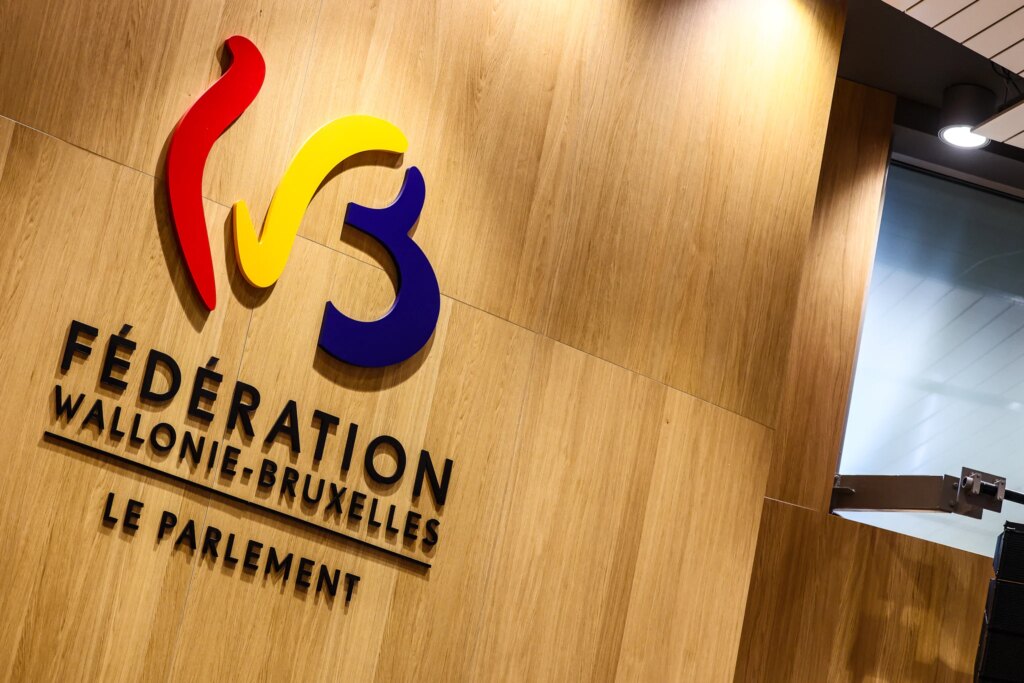
A former federal minister has reignited debate over Belgium’s institutional structure after suggesting that the French Community of Belgium, officially known as the Fédération Wallonie-Bruxelles (FWB), may no longer be fit for purpose.
Speaking on RTBF’s Matin Première, the Socialist mayor of Charleroi, Thomas Dermine (PS), who was once a minister in the De Croo government, has criticised the institution’s structure and financing model while discussing ongoing teacher strikes and budget cuts affecting education.
Dermine described the Francophone Community Government, also referred to as the Wallonia-Brussels Federation, as "inefficient and obsolete."

Charleroi mayor Thomas Dermine, former Minister for the Economy and Labour in De Croo. Credit: Belga/Nicolas Maeterlinck
Teachers 'betrayed'
The comments come as many schools across French-speaking Belgium continue strike actions over reforms and planned budget measures.
Dermine said teachers felt “betrayed” and insufficiently consulted, denouncing what he called a sense of “total improvisation” around measures expected to be implemented at the start of the next school year.
Beyond education policy, the Charleroi mayor questioned Belgium’s broader institutional complexity, asking why French-speaking Belgium still operates with "two governments and two parliaments". He suggested that greater synergies between Wallonia and Brussels could be achieved without requiring a federal constitutional reform.
Dermine also accused the current MR–Les Engagés majority of making ideological budget choices. RTBF quoted him criticising cuts to free school meals for disadvantaged children while simultaneously supporting costly tax reforms benefiting wealthier property owners. "Nothing is purely budgetary; everything is ideological," he said.
The remarks add to recurring discussions within French-speaking political circles over the role and future of the FWB, particularly amid mounting budgetary pressures and ongoing institutional debates in Belgium.
A system unique to Belgium
For Caroline Sägesser, a researcher specialising in Belgian institutions and socio-political issues at CRISP (Centre de Recherche et d’information socio-politiques), Dermine’s comments touch on a longstanding debate about the complexity of Belgium’s institutional architecture.
"The system is too complicated and not very readable for citizens because of the overlap between the Region and the Community," she explained to The Brussels Times. "This is something unique to Belgium. In countries such as Germany, Canada, Switzerland or the United States, you do not have this double structure."
According to Sägesser, the debate has resurfaced not only because of institutional concerns but also because of the Wallonia-Brussels Federation’s financial difficulties. Unlike regions, the FWB does not have its own taxation powers and therefore has limited means of increasing its revenues. "With the current crisis in education and the protests we are seeing, there are many reasons to review the system," she said.
The Brussels challenge
While some observers have advocated replacing Belgium’s current institutional arrangement with a model based on four regions – Flanders, Wallonia, Brussels, and the German-speaking Community – Sägesser believes the issue is far from straightforward.
"The problem is naturally Brussels," she said. "A four-region Belgium would be simpler and more logical, but it would require not only abolishing the French Community and transferring its powers to Wallonia and Brussels, but also having Flanders do the same."
That scenario remains politically unlikely. According to Sägesser, Flemish parties are deeply attached to maintaining the role of the Flemish Community in Brussels. "Brussels is their capital. I think there is a very clear ‘no’ on that point from the Flemish side," she said.
She also noted that some competences, particularly higher education and public broadcasting, would be difficult to regionalise entirely. "It is hard to imagine the Brussels-Capital Region financing all the universities located on its territory by itself," she said. "And it would make little sense to have separate Walloon and Brussels public broadcasters."
A good idea in theory, difficult in practice
Although she sees merit in simplifying Belgium’s institutions, Sägesser remains sceptical about the political feasibility of such a reform. "On paper, it is a good idea," she said. "If we could simultaneously build a model with four autonomous regions receiving the same competencies and ensure that Brussels is adequately financed, it would be a very good model."
However, she added that institutional reform on such a scale would require constitutional changes and broad agreement between French-speaking and Flemish political parties. "Once you leave the purely institutional dimension, it becomes clear that politically it is almost impossible," she said. "It may be a desirable solution on paper, but in practice, it is very difficult to implement in Belgium."
Instead, Sägesser believes more limited reforms could be considered, including transferring certain social policy competences away from the Wallonia-Brussels Federation while leaving education under its responsibility.
"The question is whether this is really a battle worth fighting," she said. "There may be other forms of rationalisation that are more realistic."
