
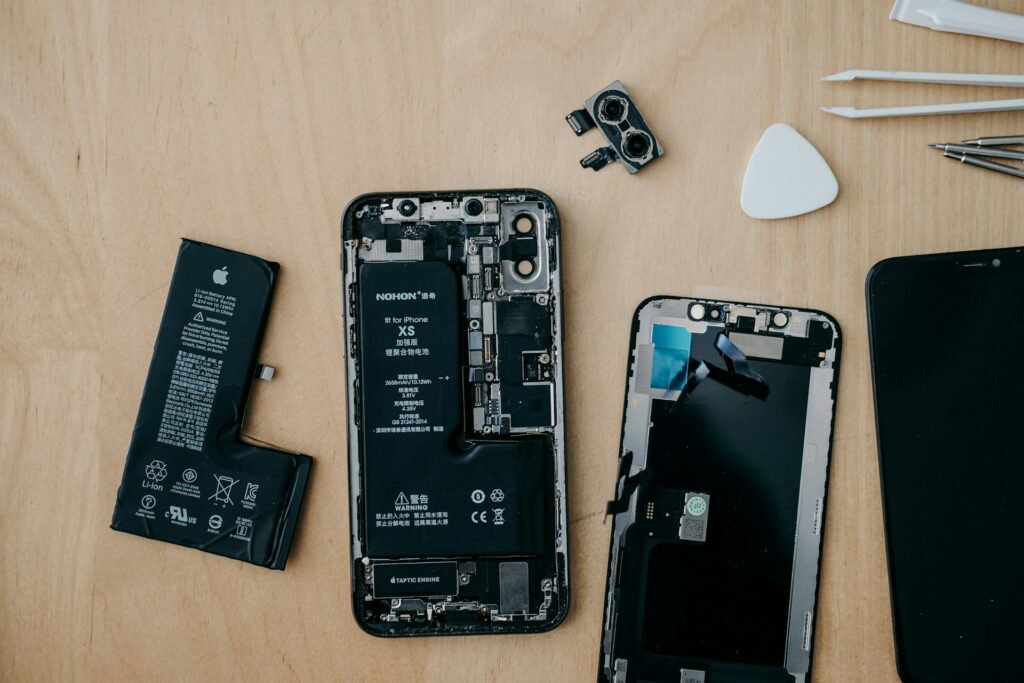
Belgium wants to extend the statutory warranty for appliances breaking down too quickly from the current two years to at least three.
People buying something from a European trader for personal use are, under EU law, entitled to a two-year statutory guarantee. But a survey has found that the majority of appliances – from smartphones and printers to loudspeakers and TVs – break down within three years, on the wrong side of that legal period.
"Consumers rightly expect that a device for which they often pay hundreds of euros will not break down after just two or three years," Federal Minister for Consumer Protection Rob Beenders (Vooruit) told The Brussels Times.
He stressed that people save up for a smartphone, a washing machine or a fridge, because they assume that they will last for years. "When that does not happen, repair must become the logical and affordable choice, rather than immediately pushing people towards a new device," he said.
Broke too soon?
In 2016, consumer protection organisation Testachats launched a platform called ‘Te Rap Kapot’ ('Broke Too Soon'), allowing consumers to report how long after purchase their product stopped working.
Since then, 14,846 consumers have reported an appliance breaking down sooner than they expected. Totalling 16.1% of all reports, these turn out to be mainly smartphones. In nearly nine in 10 (86.5%) of cases, they broke down after less than three years.
Across all categories, appliances had broken down within three years in nearly seven in 10 (69%) reports. For almost half (42%) of the cases, this happens within two years of purchase.
"Today, many consumers feel powerless when a device breaks down shortly after purchase, and they are suddenly faced with repair costs or disputes over the warranty," Beenders said.

Minister for Consumer Protection, Social Fraud and Equal Opportunities Rob Beenders (Vooruit), in the Federal Parliament in Brussels, Wednesday 13 May 2026. Credit: Belga/Dirk Waem
Therefore, the Federal Government is working on implementing European regulations designed to encourage and extend the repair of devices, so that products remain usable for longer.
"At the same time, I am also advocating at the European level for an extension of the statutory warranty from two to three years. This is good for people’s wallets, but also for the environment," he said.
"The longer devices last, the less electronic waste we produce and the more we encourage manufacturers to put quality back at the heart of their approach rather than rapid replacement," he added.
Avoiding electronic waste
Consumers agree. Given the high number of reports, Testachats surveyed its members to ask whether they were still satisfied with the current two-year statutory warranty.
On average, respondents felt that the statutory warranty should be extended to three years for small electronic devices (such as smartphones and e-readers) and to three-and-a-half years for small household appliances (such as coffee machines).
For more expensive products such as computers, they felt the period should be extended to nearly four years, and to nearly six years for large household appliances (such as washing machines). They suggested six-and-a-half years years would be suitable for electric bikes and cars.
"A two-year statutory warranty is indeed too short for today's electronic devices," said Testachats spokesperson Laura Clays. "As a consumer, you should be able to expect electric toothbrushes, blenders, toasters and certainly washing machines or cars to last longer than two years."
For her, it seems "logical" to align the statutory warranty with this expectation. "This would also incentivise manufacturers to make their production more sustainable, and help society as a whole avoid tonnes of electronic waste."

Credit: Jan Antonin Kolar/Unsplash
Additionally, the statutory warranty, as it currently stands, is not always adhered to either. Theoretically, consumers have two options: a free repair or a replacement if their appliance breaks down within two years.
However, respondents in the survey reported that in 15% of cases, they still had to pay costs: postage to get their product to a repair service, diagnostic fees, or other expenses.
The aim of the statutory warranty is also to ensure that products can be repaired as much as possible. This ultimately happened in 57% of the reported cases. In 33% of cases, a replacement was provided, and in 13% a refund. In 3% of cases, no solution was offered at all.
To gain a clear picture of the current situation regarding the premature obsolescence of devices, Testachats has now revamped the ‘Te Rap Kapot’ platform and is once again actively asking consumers to report devices that break down.
This allows it to identify systemic issues and take action should it emerge that certain devices or manufacturers are frequently implicated.
