
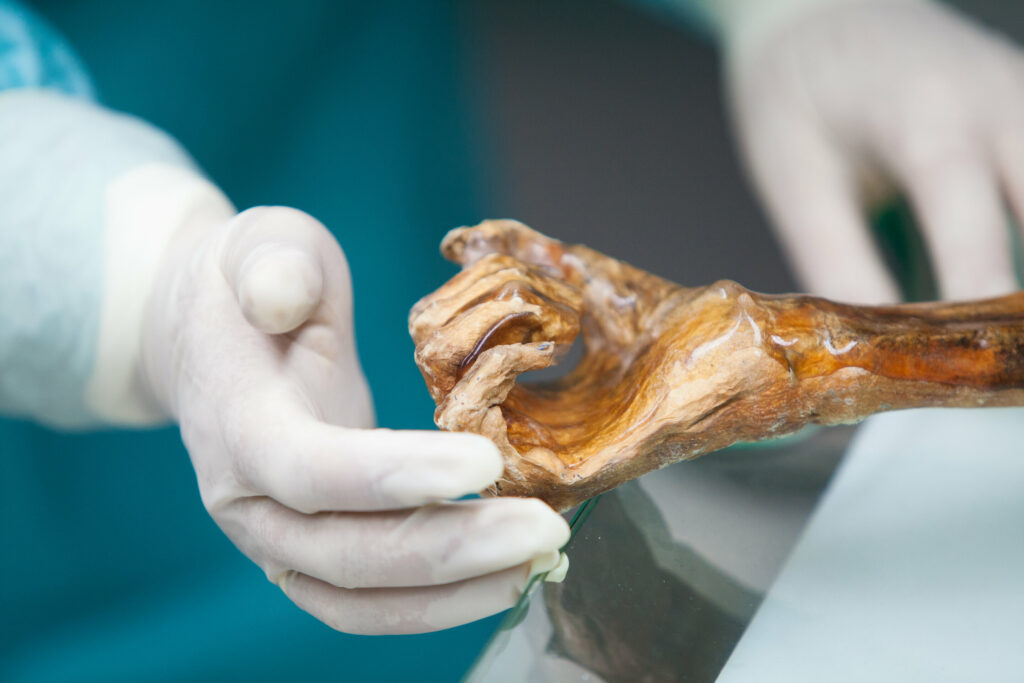
Researchers have discovered living yeast in the remains of a 5,300-year-old mummy found frozen in the Alps and have successfully used it to make sourdough bread, according to AFP.
The findings, published on Wednesday in the journal Microbiome, reveal that microorganisms have persisted and remained active within Ötzi the Iceman's body, despite decades of preservation in near-freezing conditions.
According to the French press agency, Ötzi, a Bronze Age man who died around 3,300 BC after being struck by an arrow, was discovered by hikers in 1991 in a glacier on the border between Italy and Austria. His remarkably preserved body has since provided scientists with an unprecedented window into prehistoric life.
Researchers from Eurac Research in Bolzano reportedly found several species of cold-adapted yeast living in the mummy's intestines, on his skin, and in water produced by the partial melting of the body.
"What we did not expect was to find yeast," lead researcher Mohamed Sarhan told AFP.
The team identified four different species capable of surviving at sub-zero temperatures. These microscopic fungi are normally found only in extremely cold environments such as Antarctica and the Alps, according to AFP.
Genetic analysis suggested the yeast entered the mummy shortly after death and remained preserved alongside it for thousands of years.
"These yeasts accompanied Ötzi on his long journey through the millennia," co-author Frank Maixner told AFP.
After isolating the microorganisms, scientists began cultivating them in laboratory conditions. The next question, according to Sarhan, was obvious.
"When you tell people you have yeast, they immediately ask whether you can make bread with it." The answer turned out to be yes.
The first attempts reportedly failed, but after three months of experimentation, the team succeeded in producing what Sarhan described as a "very, very good" sourdough starter. Researchers are now considering using the ancient yeast to brew beer.
Beyond the novelty of baking bread from microorganisms associated with one of the world's most famous mummies, scientists believe the discovery could have practical applications.
The yeast was found to break down phenol, a chemical used when Ötzi was first treated after his discovery to prevent fungal growth. Researchers say it could potentially be used in the future to help clean contaminated environments.
The study also sheds further light on ancient human health. Previous analysis of Ötzi's microbiome identified a gut bacterium that has largely disappeared from industrialised societies but still exists among some indigenous communities in Africa and South America.
Researchers believe ancient populations consumed far more fibre and whole grains than modern diets typically contain.
The study concludes that Ötzi should not be viewed as a biologically frozen time capsule but rather as a complex ecosystem that continues to offer new scientific insights more than five millennia after his death.
