
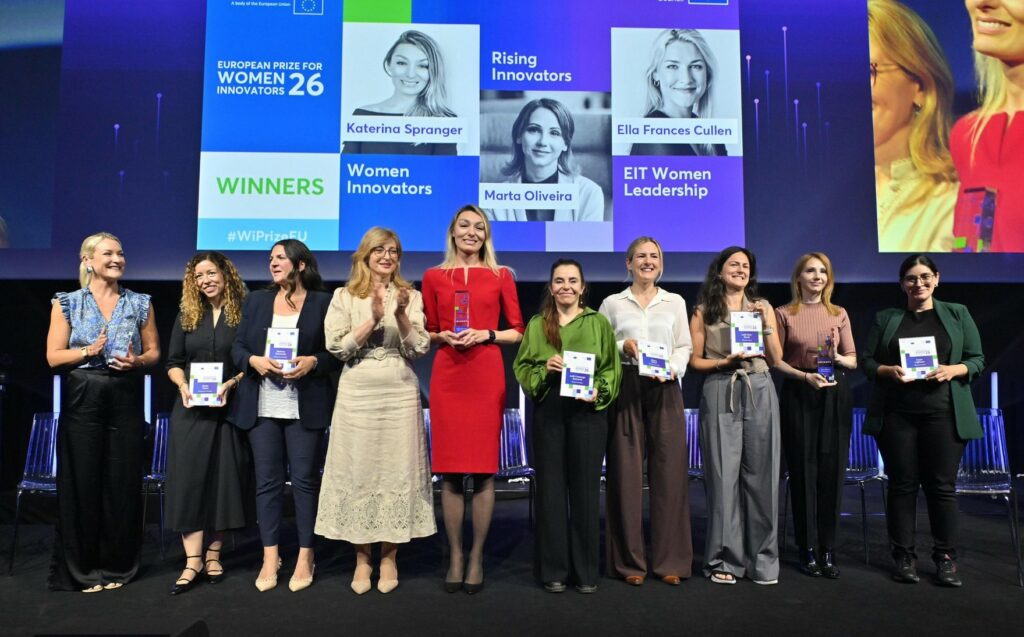
The European Commission has announced the winners of the European Prize for Women Innovators 2026 at the European Innovation Council (EIC) Summit in Brussels, recognising women entrepreneurs working on technologies ranging from healthcare to space and supply-chain transparency.
The prize, now in its 12th year, is jointly managed by the European Innovation Council and SMEs Executive Agency (EISMEA) and the European Institute of Innovation and Technology (EIT), the Commission announced on Thursday.
In the main EIC Women Innovators category, Katerina Spranger (Ukraine/UK), founder and chief executive of Oxford Heartbeat, won the top prize of €100,000 for work using artificial intelligence to improve the safety and precision of brain aneurysm treatments.
Second place went to Elena Heber (Germany), a co-founder of HelloBetter, which provides clinically validated digital therapies and AI-driven mental health solutions.
Third place went to Judit Camargo Sanromà (Spain), founder of Roka Furadada, for developing cosmetic ingredients designed to provide UV protection while reducing harm to marine ecosystems.
In the EIC Rising Innovators category for women under 35, Marta Oliveira (Belgium), co-founder and chief operating officer of ATMOS Space Cargo, won €50,000 for work on reusable space capsules designed to return materials safely from orbit.
Judit Giró Benet (Spain), founder of The Blue Box, came second for a non-invasive urine-based test intended to improve early breast cancer detection, particularly for women not well served by conventional screening.
Third place went to Carin Lightner (Switzerland), co-founder and chief executive of Enantios, for technology aimed at speeding up analysis of complex molecules for drug discovery.
Supply chains, nanomedicine and rapid disease testing
In the EIT Women Leadership category, Ella Frances Cullen (Portugal), co-founder and chief marketing officer of Minespider, won €50,000 for a platform using blockchain and AI to create digital product and battery “passports” — records intended to help trace materials through supply chains, the Commission said.
Stefania Raimondo (Italy), co-founder of Navhetec, took second place for work extracting bioactive particles from citrus juice for plant-based nanomedicine applications.
Third place went to Neide Vieira (Portugal), co-founder and chief operating officer of IPLEXMED, for graphene-based biosensors intended to enable portable rapid testing for infectious diseases.
The European Prize for Women Innovators is open to women from EU member states and countries associated with Horizon Europe — the EU’s main research and innovation funding programme.
“The European Prize for Women Innovators recognises the bold ideas and leadership of women who are transforming innovation into real-world impact,” said Ekaterina Zaharieva, the European Commissioner for Startups, Research and Innovation, in a statement.
