
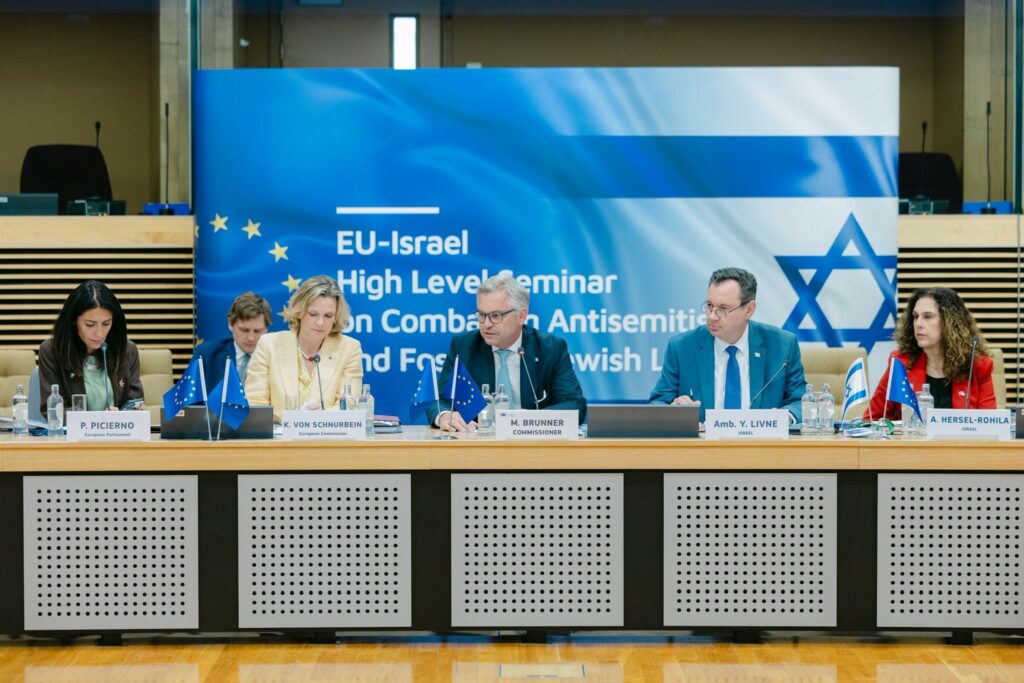
The European Commission and Israel met on Monday in Brussels for their annual EU-Israel High-Level Seminar on combating antisemitism and fostering Jewish life amid growing antisemitism in Europe and political disagreements on the Mid-East conflict.
Since 2007, the EU-Israel Seminar brings together European and Israeli authorities, civil servants, policymakers, experts, international and non-governmental organisations to discuss best practices and measures to combat antisemitism and other forms of hatred.
As part of its EU Strategy on combating antisemitism and fostering Jewish life adopted in October 2021, the EU committed to upgrade this forum to a High-level Seminar, with a focus on operational follow up. Antisemitism has always existed in some form but the situation has become alarming since 7 October 2023.
According to the Commission’s statement after the meeting, antisemitic incidents across Europe have increased sharply, with heightened security concerns for Jewish communities and growing polarisation within European societies.
Jews are being attacked, are confronted with hatred on the streets, on campus, at work. Jewish children are among the few children in Europe who, for their own safety, must go to school behind security fences and protected by the police or army.
“Antisemitism is a threat to Jews but also to our democracy,” said Commissioner for Internal Affairs and Migration, Magnus Brunner, who hosted the meeting together with EU’s coordinator on combating antisemitism, Katharina von Schnurbein. Israel was represented by ambassador Yacov Livne, Senior Deputy Director General for Public Diplomacy.
“It erodes the foundation of society: equality, human dignity and the rule of law. We stand unwaveringly committed for fostering a flourishing Jewish life in Europe,” the Commissioner added. “The EU Strategy is at the heart of our efforts to addressing antisemitism at all levels of government and society, online and offline.”
The statement underlines that the “Commission is implementing its EU Strategy with rigor and works closely with all EU Member States, among which 24 have adopted national strategies to counter antisemitism”. Countries that have not yet adopted national strategies (Belgium, Ireland and Poland) integrate their efforts to combat antisemitism into a broader anti-racism framework.
The EU Strategy includes 90 actions, focusing particularly on areas where EU-level coordination adds value, such as: Europe wide actions to address antisemitism online; ensuring Holocaust commemoration, education, and support for memorial sites; a research hub on contemporary antisemitism and Jewish life and culture; or data collection of incidents.
In addition, the Commission is developing a regulatory framework to address illegal content including antisemitism online, reinforced by a network of organisations specialized on antisemitism online. The Commission is addressing the rise of radicalization online and the exploitation of digital technologies by extremist networks through its EU Agenda on Preventing and Countering Terrorism.
Following the meeting, the EU and Israel agreed to strengthen their cooperation, in particular on the challenges and opportunities of AI, research on contemporary antisemitism and Holocaust remembrance.
The two sides also reaffirmed that the “IHRA working definition on antisemitism is the leading most effective tool to combat antisemitism”. The definition, which was proposed by the International Holocaust Remembrance Alliance, has been adopted by all EU Member States. It distinguishes between legitimate criticism of Israel and the denial of its right to exist.
A conference arranged in the European Parliament last week by the Working Group Against Antisemitism (WGAS) focused on antisemitism under the disguise of antizionism. One of the speakers was Christer Mattsson, director of the Segerstedt Institute, a research center at the University of Gothenburg in Sweden focusing on preventing violent extremism.
“It’s perfectly possible to criticize Israel, like any other country, in the harshest terms you wish, and this can be done without the mixing of antisemitic stereotypes and conspiracy theories,” he wrote recently in an op-ed in Swedish daily Dagens Nyheter. “Today, the demand is that Jews should be antizionists and unilaterally distance themselves from Israel.”
The wars in the Middle East have impacted public opinion in Europe. “It’s not only matter of adopting the definition,” an EU official told The Brussels Times. “It also important to apply the definition, which is legally non-binding. This requires training of for example law enforcement bodies and teachers and when addressing antisemitism at university campuses.”
The Israeli government regularly rejects criticism by the EU or its Member States against its policies as antisemitism. Asked if Israel’s actions have fueled the increase in antisemitism since 7 October, the two sides in the meeting declined to address the question. Leaving their political disagreements aside, they decided to focus on combating antisemitism in Europe.
