
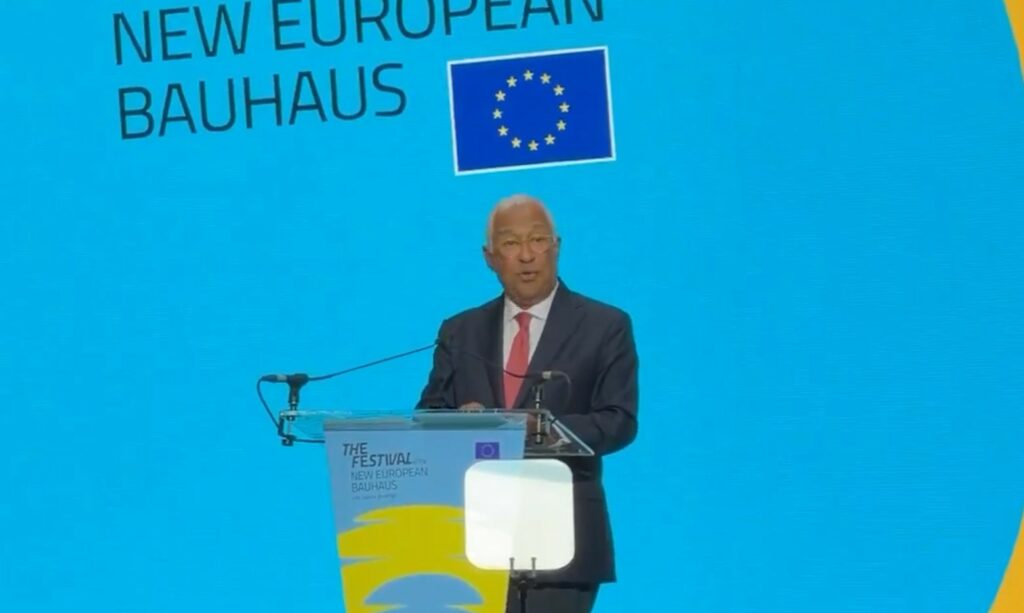
António Costa told the New European Bauhaus Festival 2026 that housing affordability and availability are concerns shared across Europe and described the situation as a “multi-layer crisis.”
Costa, speaking at the festival’s opening, said he had previously taken part in the first edition of the event in April 2021 during Portugal’s EU Council Presidency, when it was held virtually because of pandemic restrictions, as cited by the Council of the EU.
He pointed out he had argued in 2021 that art and architecture should be used to help cities adapt to climate change and changing human needs, while improving inclusivity and affordability in access to housing, the speech said.
Housing is “one of our most basic human needs” and a “fundamental human right”, he said, adding that the issue affects “every European citizen” and is “a problem shared across our continent”.
Costa said he met in April for a second time with the coalition of Mayors for Housing, which he described as a pan-European, cross-party alliance of cities and towns.
The mayors described homelessness, pressure on lower-income households, and impacts on the middle class and younger generations.
EU housing work and the New European Bauhaus
He said the European Commission now has, for the first time, a Commissioner with responsibility for housing, and that he put the housing crisis on the agenda of the European Council last October.
The Commission has also presented a strategy for affordable housing, he added.
Costa declared that responsibility for affordable housing remains at national, regional and local level, but argued the EU can “complement and support” those efforts “in full respect of the subsidiarity principle” — the EU rule that decisions should be taken as close as possible to citizens.
Mayors expect EU support through better regulation, more innovation in the construction industry, and ensuring that national and regional programmes in the next Multiannual Financial Framework (MFF) — the EU’s long-term budget — allow investment in affordable housing.
Costa linked the New European Bauhaus initiative to goals of sustainability, innovation and affordability, and called for “co-creation, co-design, and co-implementation” that involves citizens and stakeholders from the idea and design stages through to implementation and maintenance.
