
Eurozone finance ministers discussed how governments should balance tighter public finances with spending pressures from energy costs, higher interest rates and defence needs.
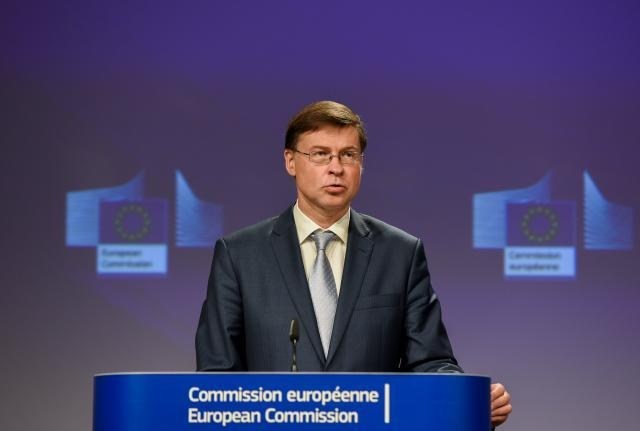
Next year’s national budgets “must reflect” the pressure on public finances from the energy shock, weaker growth, higher interest rates and defence needs, European Commission Executive Vice-President Valdis Dombrovskis said after a Eurogroup meeting on Thursday.
“Careful calibration, consolidation measures, and rigorous prioritisation” were needed to safeguard fiscal sustainability, according to Dombrovskis.
He said the European Commission and the International Monetary Fund had a “broadly convergent assessment” following the IMF’s annual consultation on the euro area, presented to ministers by IMF Managing Director Kristalina Georgieva.
The Commission agreed with the IMF’s reform priorities of strengthening energy-system resilience, deepening the EU Single Market and advancing the Savings and Investments Union, he declared.
Dombrovskis also said member states should begin planning for the period after the “national escape clause” — an EU fiscal flexibility tool that allows temporary deviation from budget rules — to ensure future fiscal adjustments are “orderly and gradual”.
Energy support and tech investment
Ministers held talks on Europe’s energy security and economic resilience, and Dombrovskis said support measures for households and businesses during the current energy shock should be “temporary and targeted” and should not increase overall demand for fossil fuels.
He said priorities included scaling up “homegrown” clean energy, continuing electrification and strengthening grid infrastructure.
He added that, at a member state’s request, the scope of the current National Escape Clause for defence “can be broadened” to cover energy measures that reduce dependence on fossil fuels.
The Eurogroup also discussed the economic aspects of what Dombrovskis called European technological sovereignty, with a focus on digital technologies including artificial intelligence, cloud computing and computer chips.
The Commission’s recent Tech Sovereignty Package is intended to reduce strategic dependencies and support Europe’s ability to develop and scale critical technologies, he said.
Dombrovskis noted that funding would be needed, adding that Europe must mobilise private capital for large strategic projects and deepen and integrate its capital markets, which he linked to the planned Savings and Investments Union.
He also cited “growing energy demands of digitalisation”, alongside “immense opportunities” created by innovation, in his closing remarks.
