

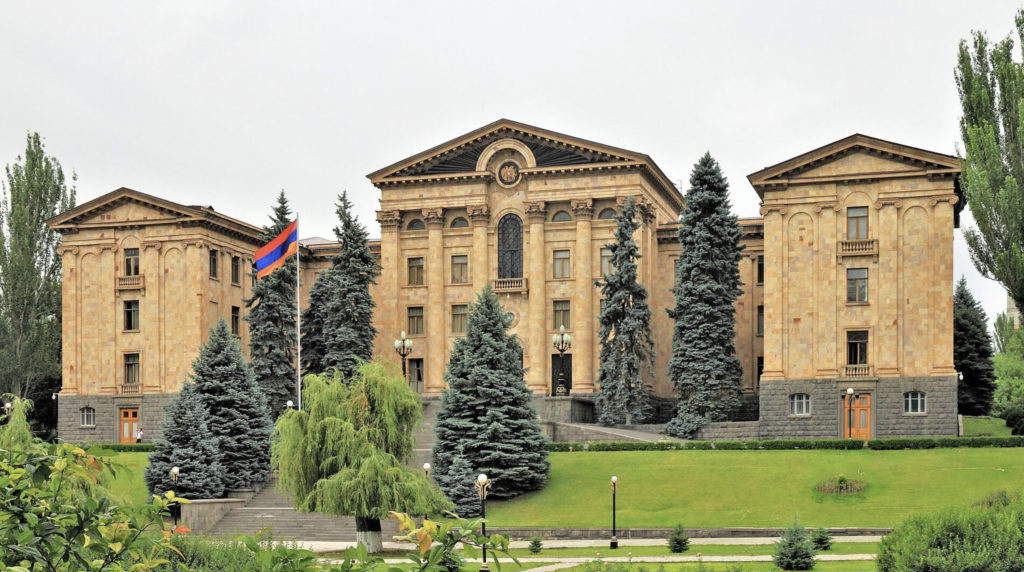
Prime Minister Nikol Pashinyan’s victory in the recent Armenian parliamentary elections has the potential to be a defining moment for the country, if not the region.
Russia’s malevolent actions in the run-up to the vote demonstrates that Moscow will not loosen its grip willingly. Hence why Pashinyan’s Western allies should offer Armenia market access, investment and security guarantees. In return they will find a reliable partner in a geostrategic key part of the world.
In common with voters in other former Soviet states seeking closer ties with Europe, Armenians voted under significant pressure from a Kremlin-orchestrated campaign of interference aimed at exploiting tensions and undermining the democratic process.
The Kremlin mobilised tens of thousands of Russian-based Armenians to vote for Moscow’s preferred candidates, ramped up disinformation, banned imports of Armenian products and even Putin himself alluded darkly to a 'Ukrainian scenario' that could befall Armenia should it pivot to the west.
Armenians did not succumb to intimidation but instead focused on the potential rewards of deeper integration with the EU. Securing visa-free travel, boosting trade links and adopting European standards of laws, accountability and political participation would be transformational for Armenia.
Previous decades of corrupt and authoritarian rule, the economic fallout from COVID-19 and the devastating war with Azerbaijan have bequeathed the country with profound challenges. But Armenia has been on a journey ever since the 2018 Velvet Revolution which ushered Pashinyan’s Civil Contract party into office. Now the priority is to finish the job.
Fight against corruption
First and foremost, anti-corruption efforts need to be reinvigorated. Since 2018, some oligarchic networks were dismantled, and two former presidents have been investigated, but Armenia still scores 46 out of 100 on the Transparency International Corruption Perceptions Index.
Armenia needs credible enforcement institutions capable of tracing dirty money flows and illegally acquired assets, ensuring transparent management of recovered wealth, and redirecting funds back into the public purse. This goes hand in hand with an independent judiciary insulated from both political influence and oligarchic pressure.
Armenia faces also a demanding social cohesion challenge following the forced displacement of over 100,000 refugees from Nagorno-Karabakh in 2023. In a country with a population of just three million it represents a formidable humanitarian issue. Housing, education, access to justice and strengthening protections for marginalised groups are central to democratic stability.
Addressing these needs necessitates an environment in which a well-resourced civil society can contribute. Armenia’s overstretched state institutions need support from experienced civic actors, particularly in implementing long-overdue public administration reforms and rebuilding public trust in governance.
Rebuilding democratic culture
During the 2026 campaign, young audiences in particular became a primary target for manipulation through social media and populist messaging. Rebuilding democratic culture in Armenia will require a fundamental rethinking of civic education, grassroots engagement, and political participation.
A crucial part of reinvigorating the social contract is through constitutional reform, particularly as a 2015 constitutional referendum was deemed widely illegitimate due to fraud and other irregularities.
A new vote on restoring checks and balances, strengthening parliamentary oversight, elevating judicial independence and protecting fundamental rights would, if passed, give the new government a healthy mandate to drive through reforms by taking what has previously been a narrow political project into an inclusive national discussion.
The upsides for Armenia are obvious, but the West has much to gain from a stable partner in the region. Between Azerbaijan’s and Georgia’s authoritarian regimes, Armenia stands out as a democratic beacon of the South Caucasus.
However, as Pashinyan no longer commands the constitutional two-third majority needed to push through a constitutional referendum, the immediate challenge is finding a way to advance the peace treaty without triggering domestic political backlash. This is where Türkiye could play a constructive role.
By encouraging Azerbaijan to set aside its insistence on a constitutional referendum and focus on the broader benefits of normalisation, Ankara could help the last major obstacles to signing a peace agreement.
Pashinyan’s government is likely to double down on the momentum achieved in relations with Türkiye before the elections. The key objective now is the opening of the Armenian-Turkish border—a move that could fundamentally reshape regional connectivity and unlock significant economic opportunities for Armenia and the wider South Caucasus.
A stable Armenia also offers lucrative opportunities for restored trade, transport and energy links. The proposed Trump Route for International Peace and Prosperity (TRIPP) linking Europe to Central Asia through southern Armenia could evolve into a major internationally backed infrastructure initiative - one which crucially bypasses both Russia and Iran – and could provide Armenia with some security safeguards.
EU support crucial
EU’s role in promoting the peace process and Armenia’s normalisation with its neighbouring countries has so far been limited. It has operated an unarmed border-monitoring peace mission since 2023 (EUMA). Last April, a new mission was established (EUPM) to strengthen Armenia's domestic resilience against hybrid threats.
The EU’s unusually rapid efforts in helping Armenia absorb the impact of Russia-related trade disruptions has been important for the outcome of elections. This assistance must be sustained and expanded to support the country’s trade diversification, strengthen economic resilience, and reduce Armenia’s long-standing dependence on the Russian market.
Furthermore, civil society organisations and independent media in particular play a key role in pushing back against foreign malign interference. Amid the backdrop of diminishing bilateral aid, the EU should earmark sustainable support for both sectors, alongside supporting Armenia with diversification of trade and energy to boost the country’s resilience.
Without broad public participation and democratic consensus, Armenia’s progress could be hijacked by anti-democratic forces to sow division and undermine trust in state institutions. But if Armenia is abiding by the principles of sovereignty, transparency, and regional cooperation, the country could be transformed from a geopolitical fault line into a democratic bridge between Europe and Asia.
