

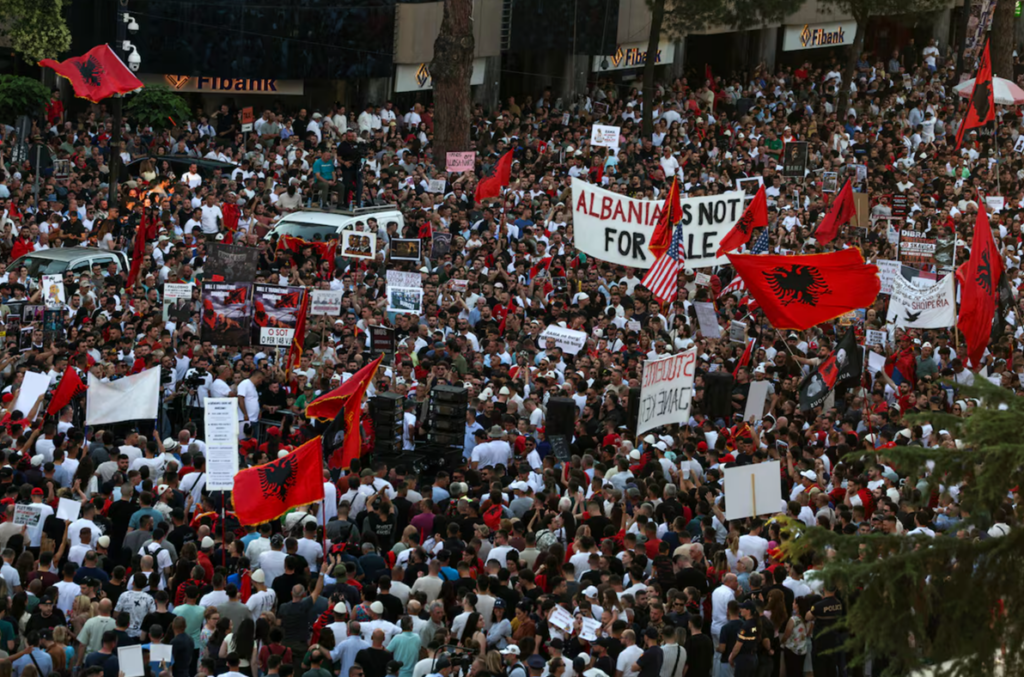
Day after day, for two weeks straight, people have gathered in Tirana’s Skanderbeg Square—every evening at exactly six o’clock, with the persistence of a nation that survived nearly fifty years of dictatorship and is still waiting for what is supposed to come afterwards.
The demonstrations are growing. So too are the calls for the prime minister’s resignation. Serbia, not so long ago, experienced much the same: mass protests that lasted for weeks. European assessments consistently point to the same pattern: environmental standards are being sacrificed, corruption persists, and the media remain under political pressure.
Both countries share a common antagonist: Jared Kushner. In Albania, his plans for luxury resorts in environmentally sensitive areas sparked an uprise. In Serbia, demonstrators forced the abandonment of plans to demolish the former army headquarters for a luxury hotel.
But Kushner is not Rama and Vučić's biggest problem. They have a more fundamental one: their own citizens no longer trust them; they have more faith in the EU. Albania remains one of the most pro-European countries in the region—more than ninety percent of the population supports EU membership—yet only a small minority still trusts its own institutions.
Serbia reflects the same pattern: citizens distrust their national institutions while continuing to view EU accession as a national aspiration. The European Union has become the anchor precisely because everything domestic has come loose.
Meanwhile, the political theatre surrounding enlargement continues unabated. At European summits, Rama presents himself as Albania’s great European champion. “There is no alternative,” he recently declared in Montenegro. “Albania belongs in the European Union.” Vučić plays a different game, keeping one eye on the EU and the other on Moscow. Both leaders are undermining the very standards required for accession while dismissing warnings from the European Commission.
Rama has described the protests as a “hybrid war” orchestrated by foreign enemies. The thousands gathering every evening in Skanderbeg Square will no doubt find comfort in that explanation. He has denied any meaningful developments in the Kushner affair and has become increasingly confrontational toward journalists. History suggests that politicians who begin treating the press as an enemy are usually displaying not strength, but vulnerability. Rama’s recent interviews with CNN and Albania's Top Channel fit neatly into that pattern.
Beneath the theatre lies a political strategy with nowhere left to go. For years, these leaders thought that a slow accession process might serve them better than a completed one. Full EU membership would impose a binding regulatory framework and drastically limit their political room for manoeuvre—procedures neither leader appears fully prepared to accept. Candidate status, by contrast, keeps all options open. It allows them to choose political allies opportunistically while using the promise of Europe as a source of legitimacy without ever having to fully deliver on it. For Rama, who secured his fourth term in part on a platform of European integration, the promise itself is the product. Actual membership could well erode the very power that promise helps sustain.
But every political strategy has an expiration date. Theirs is approaching. Slow accession may buy time, but it does not freeze the societies they govern. In both countries, young people have been at the forefront of the protests. They grew up surrounded by departures—friends, relatives, and neighbours leaving because they saw no future at home. They have waited for educational opportunities and jobs that never arrived. Their patience is exhausted and, unlike the generation before them, they no longer place their faith in domestic politics.
Rama and Vučić still have a choice—although one may wonder whether it is already too late. They can align themselves with the EU standards they once pledged to uphold, or they can continue down their current path until the political bill comes due. That bill will arrive. The only question is when.
The accession process may grind on for years. But on the streets, Albanian and Serbian citizens are already holding their governments to European laws and values. The fact that this pressure comes from below is no small signal for a Union whose publics are divided on EU enlargement.
