
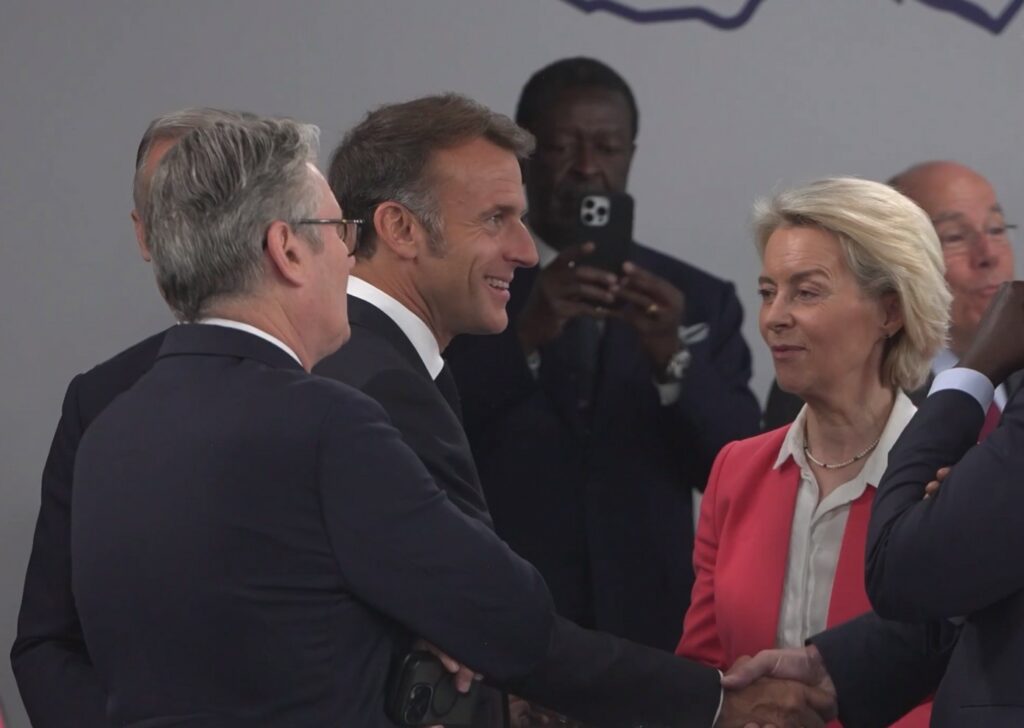
G7 leaders meeting in Evian, France, said they would step up military support for Ukraine, tighten sanctions on Russia’s oil and gas sectors, and back a US-Iran deal intended to prevent Tehran acquiring a nuclear weapon.
The group said it remained “unwavering” in its support for Ukraine’s “freedom, sovereignty, and territorial integrity”, and expressed solidarity with Ukrainians facing attacks on critical infrastructure and cultural heritage, according to joint statements from the summit released on Wednesday.
It stated that members had agreed to increase deliveries of air defence capabilities — including additional systems and interceptors — as well as “long-range capabilities” for Ukraine, and said they were ready to consider extending licences to allow more military production inside Ukraine.
The leaders also said they would provide further support to help Ukraine with “energy resilience” and get the country “through next winter”, based on needs identified by Ukrainian authorities.
They committed to “increase the pressure” on Russia’s war economy by strengthening sanctions, including measures targeting the oil and gas sectors.
Strait of Hormuz and the Middle East
On the Middle East, the leaders said they welcomed the announcement of a deal between the United States and Iran, describing it as an opportunity to prevent Iran from acquiring a nuclear weapon, while also addressing what they called threats linked to Iran’s regional and ballistic activities.
They endorsed the principle of unrestricted transit passage “without restrictions or tolls” as central to international trade, and said a multinational, independent and defensive initiative led by France and the UK could help the resumption of maritime traffic in the Strait of Hormuz by protecting merchant vessels and supporting verification that mines are removed.
The statement said the G7 backed a further diplomatic agreement to follow a Memorandum of Understanding secured by President Trump, and added that any negotiation should involve relevant regional and international partners, including the International Atomic Energy Agency — the UN body responsible for nuclear inspections.
On Lebanon, the leaders said they supported an “immediate robust ceasefire” and the Lebanese leadership’s efforts towards the disarmament of Hezbollah and a monopoly on arms, alongside “appropriate international security guarantees”.
On Gaza, they said they would accelerate humanitarian and reconstruction efforts and called for violence in the West Bank to end, according to the summit text.
The group also declared it would accelerate diversification of energy supply routes to reduce global vulnerability to disruption in the Strait of Hormuz and increase energy stocks, and said it welcomed the potential for Canada to deliver additional capacity to global markets in coming years.
In the Indo-Pacific, the leaders said they opposed unilateral attempts to change the status quo “by force or coercion” in the East and South China Seas and across the Taiwan Strait, and said those disputes should be resolved peacefully through dialogue.
They also expressed “deep concern” about North Korea’s nuclear and ballistic missile programmes, reaffirmed support for complete denuclearisation in line with UN Security Council resolutions, and urged North Korea to resolve the abductions issue, the G7 said.
