

The EU is being tested on tech yet again. A robust EU budget, and delivering investment in democratic resilience is the way to unlock Europe’s way forward.
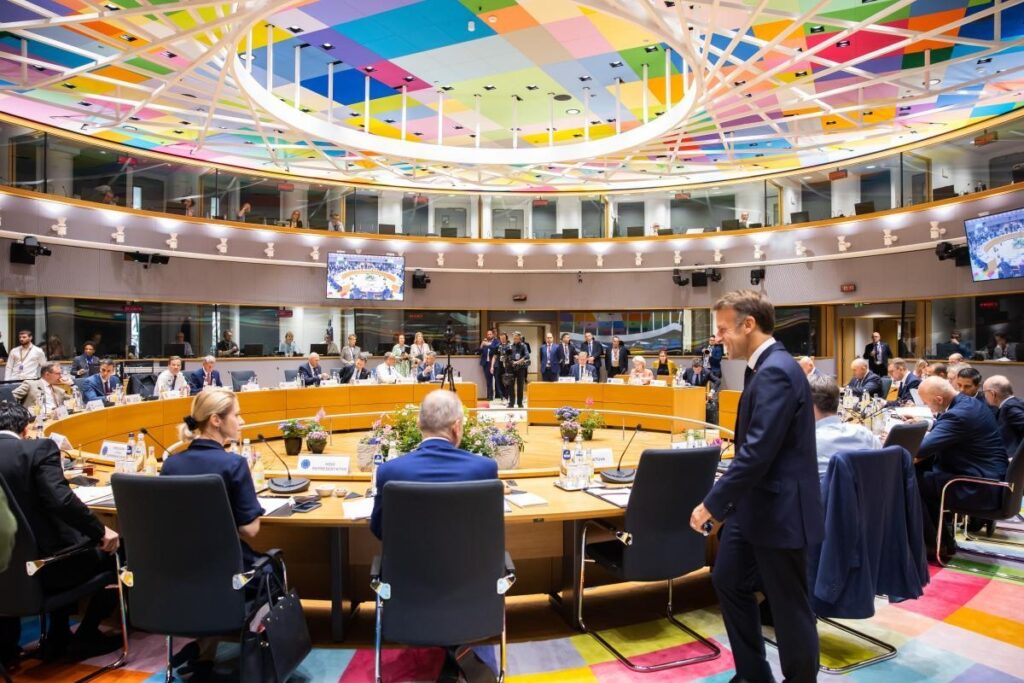
The European Council summit this week in Brussels is another milestone in the high stakes geopolitical game Europe has found itself locked into. The question is, as it is with every European Council meeting, will national leaders step up to the plate. In this case, what’s on the plate is the European budget - the notorious MFF (Multiannual Financial Framework), a routine bone of contention.
The European long-term budget is a key that turns Europe's ignition on or off, and will determine whether European leaders will be able to deliver on their existential stated priorities - sovereignty, defence, competitiveness. Within that budget, strategic funding for democratic resilience will be the central factor.
Over the past week we have seen powerful illustrations of Europe's existential choices. First, Elon Musk took SpaceX to the stock market and became a trillionaire, partially at least by getting unusually favourable treatment from financial institutions. In the process, this one man who routinely and consistently supports far-right politics in the US and Europe, has taken forward position on the future of space exploration, satellite communications, and AI development.
The EU finds itself contending with an economic actor in the shape of one individual with assets currently valued at an amount roughly equivalent to a large fraction to the entire EU multiannual budget, who has a chokehold on essential platforms and technologies, and who has publicly stated on his own social media platforms that he would like to see the EU dismantled, and far-right nationalist forces run European countries.
Then, just as the news cycle was moving on from one tech billionaire, another so-called hyperscaler flashed in the headlines, as the US government banned non-nationals from access to Anthropic newest AI models, cutting off Europe and Europeans. This put Europe's decision-makers into a dilemma everyone could see coming, but many chose to ignore, disregard, or underplay. It is plain and clear that the US administration could at any moment shut down any digital services any American company provides at any moment, at the drop of a hat. That could include cloud services, satellite connectivity, email access, payment platforms, or any other digital service.
Big Tech’s grip on Europe
It goes without saying that European companies and governments will no longer have access to frontier AI models. US Big Tech companies and business leaders on both sides of the Atlantic may want to equivocate on this so as to avoid panic, or have some contingency plans in a drawer - but the reality is what it is. This is the Titanic iceberg we can see ahead in broad daylight. The reasonable thing to do is steer the boat to avoid hitting it.
Given the track record this US administration has for doing things that would have been considered outlandish and unacceptable, the likelihood of some kind of cut-off scenario seems not unlikely at all. If it were to happen, a 'cut off' scenario is likely to come alongside or in the context of increasing US support for authoritarian anti-EU politics and potential interference to derail the EU's own efforts, increasing pressure against enforcing European laws, and accelerating withdrawal from NATO.
This is where the issue of democratic resilience comes in as the hinge Europe depends on. It is a term that packs in efforts to prevent information manipulation and interference, secure freedom of expression and information, investing in media pluralism and media literacy, and enabling citizen engagement and participation. That resilience is crucial for defending European public space from being captured by autocrats, and giving elected decision-makers across the political spectrum the breathing room to be able to take the decisions that have to be taken based on facts and authentic free public debate and participation.
Civil society, journalists, academics, and businesses then have a clear role in supporting the implementation of laws and policies creating a safer, more trustworthy and democracy-enabling digital environment. Without those elements, there can be no meaningful action towards sovereignty, defence, or competitiveness. The Commission has put together the Democracy Shield as a programme to get this done. The question is whether this will be funded to be carried out, or whether it will just be a lost opportunity.
The MFF is Europe’s democratic sovereignty test
In all of this, the notorious MFF, technical or boring as it might sound on the surface, is in fact of monumental significance. The MFF will decide whether Europe has a chance to develop its own self-reliant tech infrastructure quickly enough, whether it will be able to invest in new European business models, leveraging the EU's core values of human rights and democracy as a real competitive advantage, producing reliable, trustworthy, human centred tech that enables freedom and well-being, rather than toxicity, abuse, and slop.
For that, the MFF needs to be robust and ambitious - as the European Parliament outlined it should be, for example, with additional funds levied from taxes on Big Tech platforms, and additional financial instruments and joint borrowing. Now enough national governments need to outline a plan for robust investment in democracy and sovereignty.
The crucial question is whether the MFF will provide for sufficient democracy resilience funding to enable Europe to take those steps towards sovereignty, defence, and competitiveness. In context, the amounts of funding required are small. In concrete terms, including democratic resilience funding across programmes, including via defence spending, competitiveness, and cohesion funding should all be plenty. There has to be a Democracy Shield Funding Initiative that outlines and oversees where in the large sprawling MFF all of the budget lines are, and then make sure they are spent strategically.
EU prime ministers and presidents are discussing all this in the Summit this week, and in months to come. There will be drama, posturing, debates, and proverbial arm wrestling. Now is the time for European media, national parliamentarians, tech and business leaders must make noise to make sure their prime ministers in the Council know what to do.
