

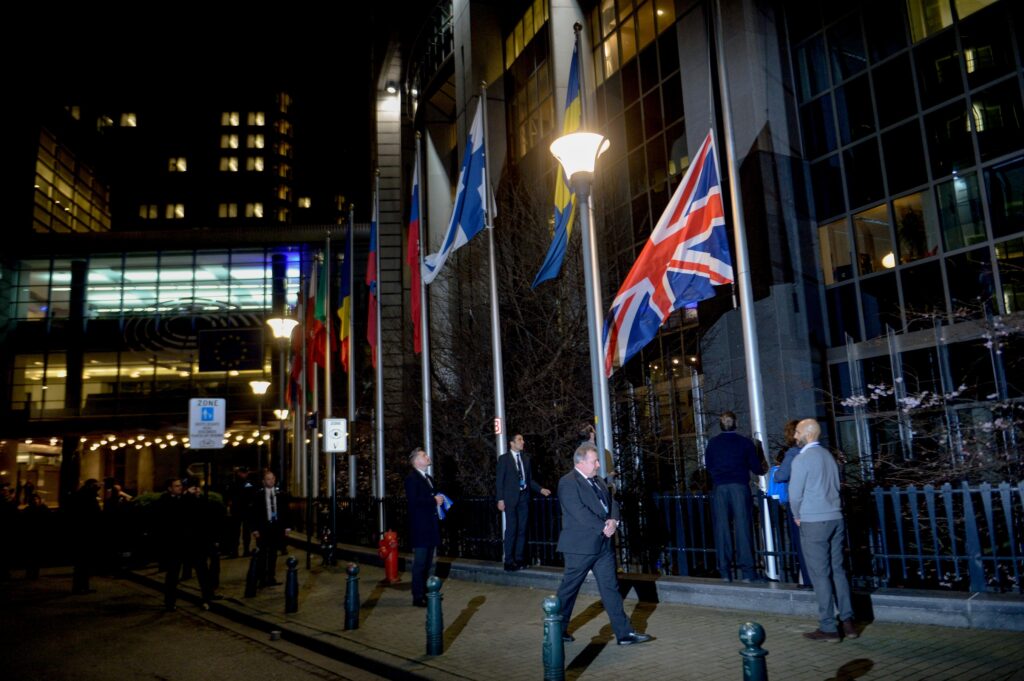
As a scientist and a former professional astronomer, I have always relied on observation and measurement to understand the world. But Brexit challenged even my most fundamental beliefs. I was in textbook denial. I could not believe my eyes.
24th June 2016, the morning after the UK’s Brexit Referendum.
It was like yesterday that ill-fated Friday morning. I was staying in Milan for a meeting. The images still linger of that strange hotel with a weird mixed maritime James Bond theme I’d booked last minute. It was a little run down and the harsh naked filaments of the bedroom lights hurt my eyes; it was old, but it was comfortable and clean.
It was early, light spilling in through the ill-fitting curtains. I awoke with a start and reached for my phone. Instinctively trusting what I saw. Yet, the headline on the screen refused to align with my understanding of the world: “UK votes to leave the EU.” I’m a scientist. I believed in what could be seen. What could be measured. But what I saw was wrong. How could this be?
“UK votes to leave the EU. 52% to 48%.”
There was something wrong with the screen. Something wrong with the light. Something wrong with my eyes; they were not working properly! I blinked; I rubbed my eyes. The headline was still there. Must be a fake BBC website? No, the web address was correct! I rubbed my eyes again; the words did not change. Reality had shifted.
I phoned my Belgian wife back in Brussels. I gasped to her that “they” had voted to leave. Her calm reassurance, “You won’t die”. I gasped again. She didn’t understand. The conversation did not last long.
I had grown up in the English Midlands during the 1960s, a time when Britain played a peripheral role on the world stage, overshadowed by the Cold War superpowers. From an early age, I believed Britain’s future lay within a united Europe — a belief that shaped my life as I thrived in the EU, outside the UK.
But now only confusion. And silence. A loud kind of silence inside. A profound sense of loss. Numb. I pulled on my business suit stunned, ate breakfast and zombie-walked to my Milan meeting. There we spoke in quiet huddles about the foolishness. Non-Brits shook their heads in disbelief. One or two Brits were pleased, unaware of what they had lost.
When I returned to my English hometown a few weeks after the vote. It was not the same. Some clowns celebrated, but they did not know into what a dark trap we had fallen. Others stayed quiet. Conversations were dangerous things. Loyalties were not written on their faces. British families, including mine were split. Angry rows were not uncommon.
Having lived abroad most of my life, I’d picked up a non-British accent and it was not unusual to be asked where I lived. To avoid confrontation, I’d ambiguously respond, “Brussels. The heart of the evil empire.” Some laughed. Many did not.
In a local Birmingham shop, the assistant asked me where I lived. I gave her my usual line with a smile, “The heart of the evil empire”. She winced. “I don’t think of it like that at all!”, she said. “I cried for six months when the vote went the wrong way.” So, we were friends. I made many like that.
Back in Brussels, some thought the vote was democracy. They thought that the people had chosen. But I knew better. The numbers were wrong. The numbers deceived.
It had been announced that the vote was 51.9% to 48.1%. But only 72% turned out. British citizens who lived abroad, like me, were not allowed to vote. We were locked out. Previously, Theresa May, then British PM had referred to people like me as “Citizens of Nowhere”. The Guardian wrote that her speech had “shades of Hitler”.
In the end, only 37.5% of those registered to vote had chosen to leave. That was not a majority. That was not a mandate. And yet, the government acted as if it were law. Democracy drowned. A huge constitutional change made by minority.
Today, in 2026, the world begins to shift once again. Britain, recognizing the economic and political imperative of closer ties with the EU, is making tentative steps back towards Europe. The echoes of Brexit — its false promises, its illusions — resound as a cautionary tale. Britain's place remains at the heart of Europe, not on its periphery. Brexit was an illusion; a lie we must learn from.
The question now is whether Europe can forge a future rooted in unity and mutual respect, learning from the past to build a stronger, more resilient continent. The journey toward that future begins with acknowledgment of the truth — and the hope that, someday, belief in a united Europe will once again be unwavering.
