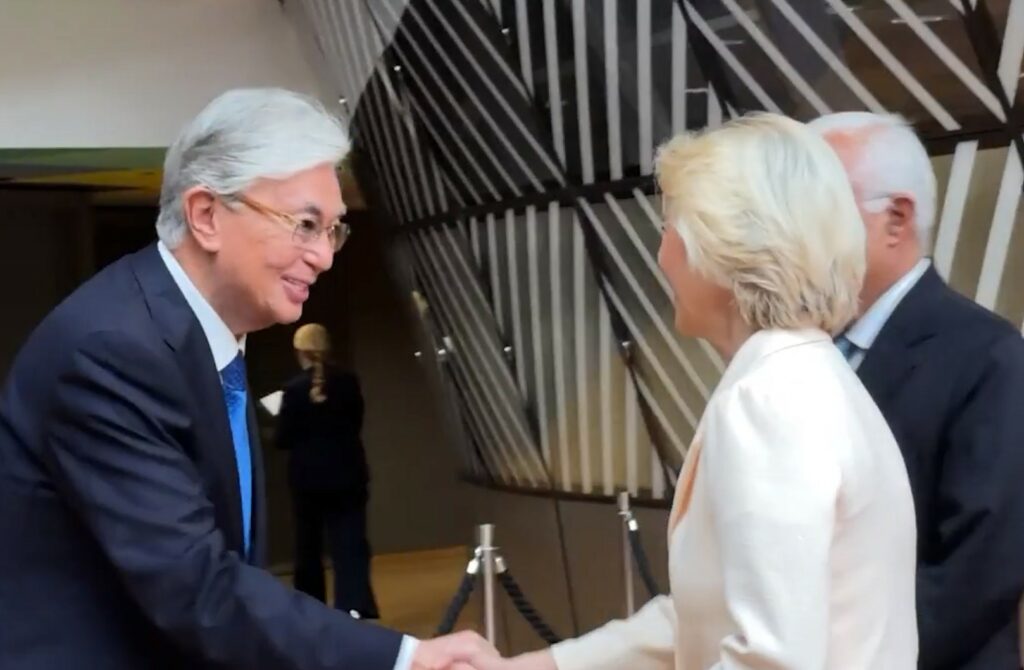
Kazakhstan’s President Kassym-Jomart Tokayev visited Brussels on Monday for talks with EU leaders on trade, transport links, energy cooperation and closer political ties, according to a joint statement from the European Union and Kazakhstan.
Tokayev met António Costa, President of the European Council, and Ursula von der Leyen, President of the European Commission, during the visit on 23 June 2026.
The leaders declared they would deepen cooperation under the Enhanced Partnership and Cooperation Agreement — a framework governing EU–Kazakhstan relations — which marked its 10th anniversary in 2025.
The EU and Kazakhstan described the EU as Kazakhstan’s leading trade and investment partner and said they had agreed to strengthen cooperation in sectors including critical raw materials, energy, transport, digitalisation and emerging technologies.
They also underlined the importance of the Trans-Caspian Transport Corridor, a route linking Central Asia to Europe via the Caspian Sea.
The leaders welcomed the signing of a Horizontal Aviation Agreement and said negotiators had concluded discussions on Visa Facilitation and Readmission Agreements.
Investment and industry deals
The EU and Kazakhstan said they would advance a roadmap for cooperation on sustainable raw materials, batteries and renewable hydrogen value chains.
They also cited Kazakhstan’s role as an oil and uranium supplier to Europe and referred to potential cooperation in renewable energy and civil nuclear energy.
The leaders also welcomed agreements involving European lenders, including an European Investment Bank deal supporting transport connectivity worth €150 million and a European Bank for Reconstruction and Development memorandum on developing an internationally accredited national chemical-analytical laboratory in Kazakhstan.
The opening of an EIB office in Astana was encouraged, as set out in the 2025 EU–Central Asia Summit Declaration.
Air Astana and Airbus signed a certificate agreement covering up to 50 A320neo and A321neo aircraft worth €7.145 billion, the EU and Kazakhstan said.
The statement also referred to continued dialogue on sanctions.
On domestic politics, the EU recognised Kazakhstan’s political reform agenda and acknowledged the adoption of a new Constitution through a nationwide referendum in March 2026.
The leaders also referred to dialogue on human rights, the rule of law and anti-corruption, including cooperation with the Venice Commission.
The statement said the leaders reaffirmed support for principles in the UN Charter, including sovereignty, territorial integrity and the peaceful settlement of disputes, and referred to efforts on disarmament and non-proliferation.
The EU also took note of Kazakhstan’s initiative to establish an International Water Organization within the UN system.
