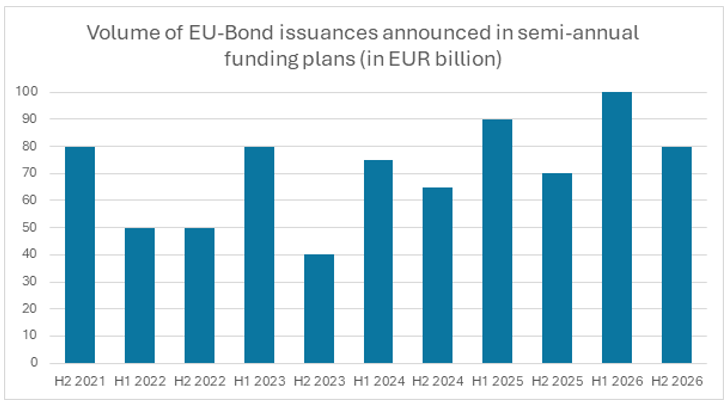
The European Commission plans to raise up to €80 billion by issuing EU-Bonds in the second half of 2026, taking its total planned borrowing for the year to €180 billion.
The proceeds will fund EU programmes that are financed through borrowing on capital markets, including payments to member states under NextGenerationEU and other initiatives, the Commission informed on Wednesday.
NextGenerationEU is the EU’s post-pandemic recovery programme, and includes the Recovery and Resilience Facility — a pot of funding that provides grants and loans to member states for agreed plans of reforms and investments.
Part of the borrowing will also support Ukraine, including payments under the Ukraine Facility and a separate €90 billion Ukraine Support Loan.
The funding will also cover disbursements under the Security Action for Europe (SAFE) instrument, which provides loans to member states to help finance defence-related procurement.
Borrowing, green bonds and past disbursements
The Commission said it will continue issuing debt under its “unified funding approach”, using a mix of long-term EU-Bonds and short-term instruments.
It also plans to keep issuing NextGenerationEU Green Bonds, which are backed by reported green spending by member states under the Recovery and Resilience Facility, and said €84.3 billion has been raised through those green bond sales so far.
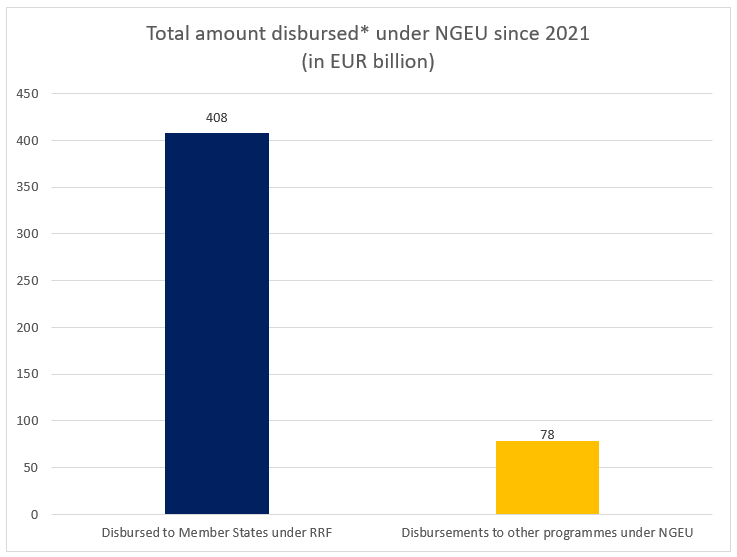
Since mid-2021, the Commission has disbursed more than €241.8 billion in grants and €166 billion in loans to EU member states under the Recovery and Resilience Facility using funds raised from EU-Bonds and NextGenerationEU Green Bonds.
It added that up to €78.4 billion has been allocated to other EU programmes that benefit from NextGenerationEU funding.
For Ukraine, €25.6 billion has been paid out under the Ukraine Facility from a total envelope of €33 billion.
In the second half of 2026, the Commission plans to carry out the EU-Bond issuance through four syndications — sales arranged by a group of banks — and six auctions.