

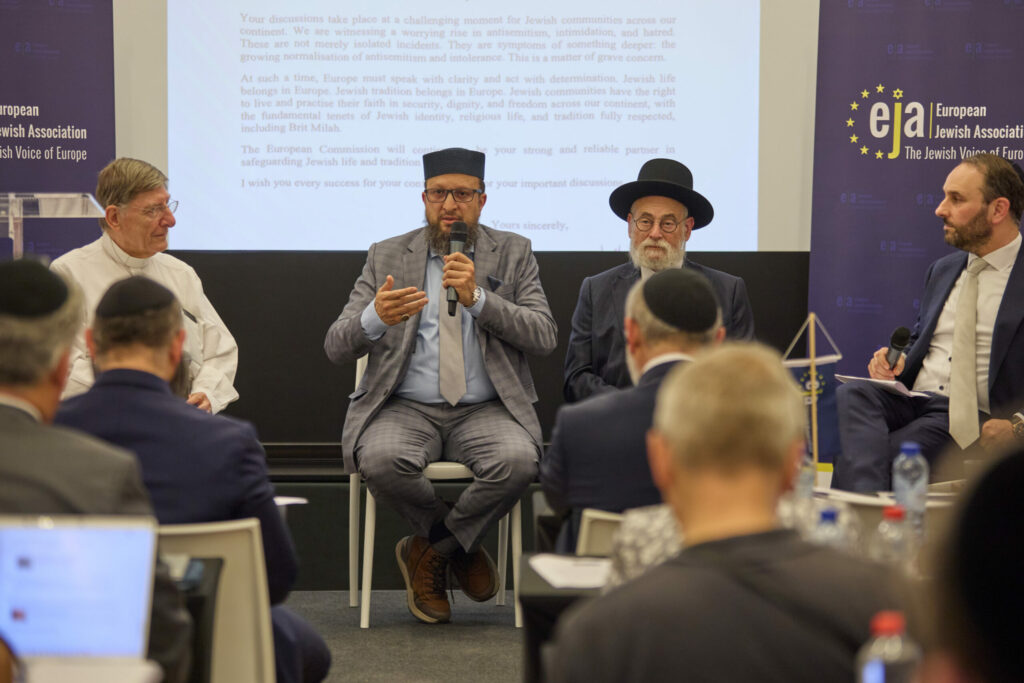
The European Jewish Association (EJA) warned at a conference in Brussels on Wednesday that the ongoing legal case against Jewish religious circumcision practitioners has become a defining test of religious freedom, minority rights and the future of Jewish life in Belgium.
In Judaism, circumcision or brit milah (covenant of circumcision) for religious reasons of newborn boys is performed by specially-trained practitioners who do not necessarily have to be physicians. As previously reported, the Antwerp Public Prosecutor’s Office decided last April to indict three persons, known as mohels, who perform circumcision according to Jewish practice.
The indictment was seen as a threat against the future of Jewish life in Belgium and an escalation in a legal-medical dispute that erupted a year ago after police raided the homes of the circumcisers in the local orthodox Jewish community.
The conference aimed at filling a knowledge gap about circumcision for religious reasons. It gathered medical and legal experts and for the first time representatives of Jewish, Muslim and Christian communities in an interfaith dialogue about freedom of religion.
“This is not really a debate about circumcision but about the limits of freedom in Europe.,” said Rabbi Menachem Margolin, chairman of EJA. "The real question is whether democracies protect minority rights only when they are convenient. What happens in Belgium will be watched far beyond Belgium. We are asking for understanding before judgment and legislation that might affect every religious minority.”
While circumcision is most common in Israel and Muslim countries, an estimated two billion men worldwide have undergone circumcision for religious reasons or preventive health reasons.
At the conference, a panel of medical experts underlined that complication rates are reportedly low. Published literature places overall complication rates at below 0.4%, with infection rates of less than 0.06%.
In Israel, 70% of all circumcisions are performed by specially trained and certified practitioners who have to renew their exams every five years, explained Dr Michael Ben Akon, member of Israel's Ministry of Health Committee for the Certification of Mohalim.
“The is always a risk in surgeries and what matters is to control the risk,” said Dr Sas Ben-Moshe, a Belgian urologist. “Circumcision for religious reasons is simpler than medical circumcision but it has to be performed by a specially trained person with experience.” He has never had to treat complications after such circumcisions.
The problem in Belgium is the lack of a public body supervising circumcision or agreed self-regulation.
The EJA has issued a new position paper setting out what it says is a fundamental democratic choice faced by Belgium: Should religious practice performed safely by Jewish and Muslim communities for centuries face criminal prosecution?
For Jewish families, Brit Milah is a central religious obligation and one of the oldest foundations of Jewish identity. For Muslim communities, circumcision is also an important religious and cultural practice. The EJA believes that child welfare, medical safety and religious freedom can and must coexist.
According to the paper, circumcision should be performed safely, hygienically and by competent practitioners. It should not be treated as a criminal matter when regulation, training, certification and oversight are more appropriate tools. The paper calls for legal certainty, recognition of trained practitioners, safeguards and standards, and dialogue rather than criminalisation.
How this should be implemented in practice in the EU, where everything related to health is a Member State competency, was left outside the paper. The EJA has reportedly submitted a proposal to European Commissioner Olivér Várhelyi, responsible for health, on enabling EU Member States to allow male circumcision for religious reasons without infringing on their health competency.
The EJA and the European Commission declined to reply to questions about the state of play of this proposal.
The Commissioner did not attend the conference but sent a letter where he assured the Jewish communities in the EU that they have the right to live and practice their faith in security, dignity and freedom, with the fundamental terms of Jewish identity, including circumcision, fully respected.
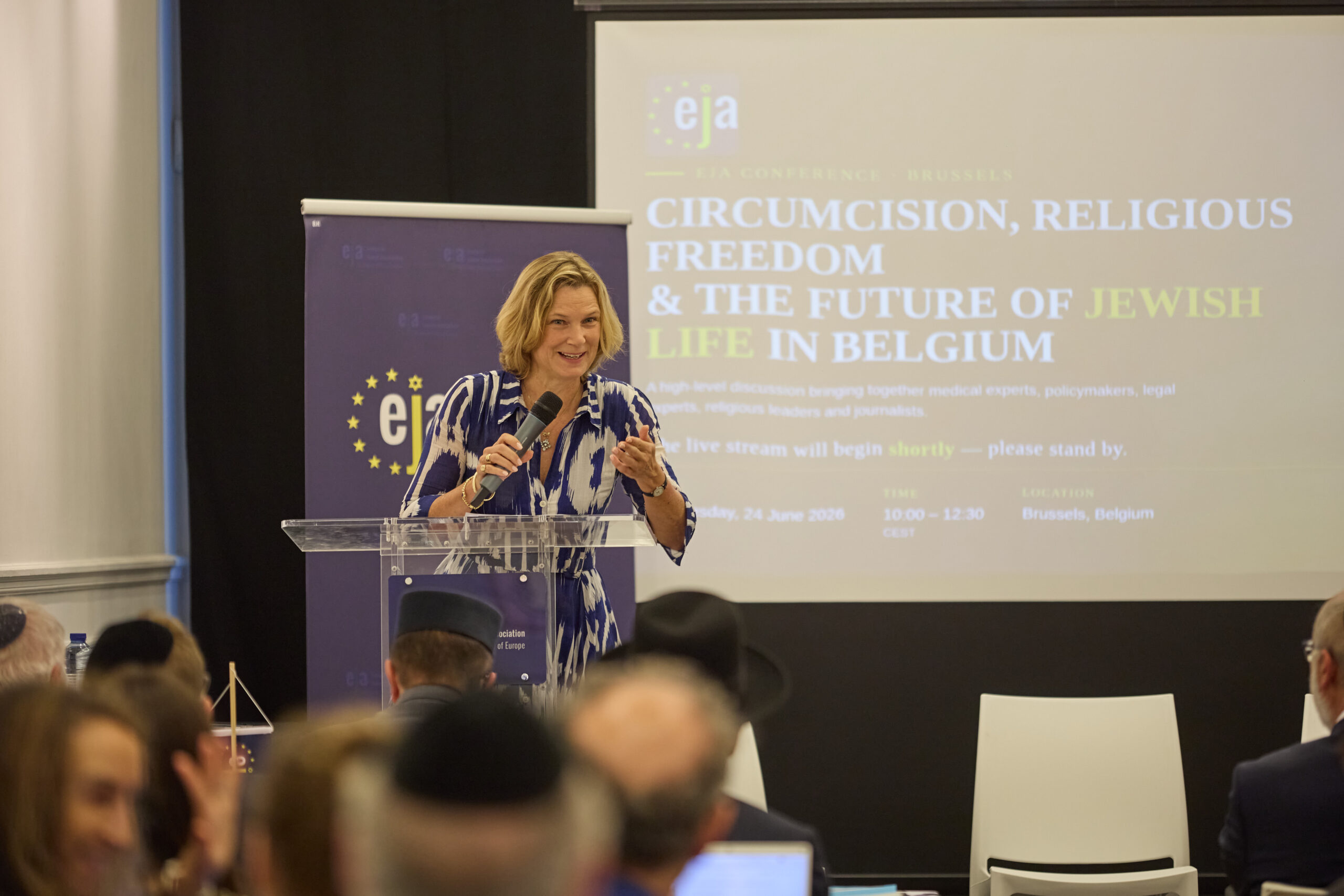
Katharina von Schnurbein, EU Coordinator on Combating Antisemitism and Fostering Jewish Life, speaking at the conference, credit: EJA
In a key note speech at the conference, Katharina von Schnurbein, EU Coordinator on Combating Antisemitism and Fostering Jewish Life, expressed strong support for the right to circumcision while admitting that the EU has limited competence in health matters. She gave also examples of the importance of Brit Milah in Europe’s recent history.
“At the European Commission we are very much aware that banning the ancient practice of circumcision would in effect ban the possibility of Jewish life to flourish in any Member State. We acknowledge the threats and difficult public discussion, and we do not underestimate its effect on European Jews.”
Until now, the Commission has said that it has no competence to intervene in health matters. In fact, it has recently shown political will to solve other health-related issues. Responding to the European Citizens’ Initiatives on abortion rights and conversion practices, it proposed non-binding and innovative solutions without harmonizing EU legislation.
