

A veteran Brussels hand observed to me recently that the EU's pain threshold when it comes to criticism was about skin deep.
"It's like a dictatorship," he insisted, arguing that the "empire" had been purpose-built to strike back at its detractors with force.
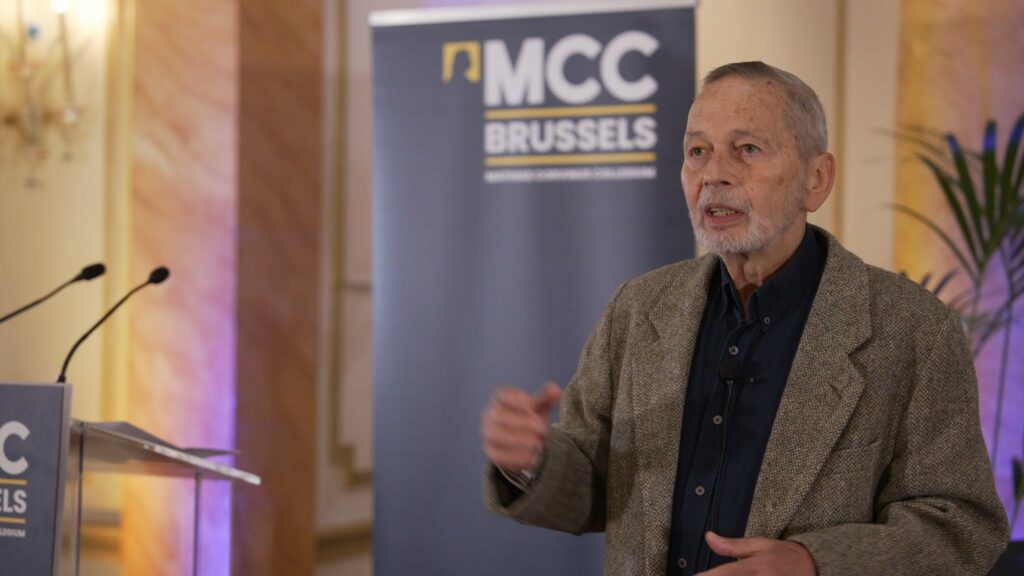
MCC Brussels, a conservative think tank, discovered that reality the hard way last month when the European Transparency Register – the de facto gatekeeper for anyone seeking to lobby the European institutions – suspended its registration on what might charitably be called specious grounds. The decision effectively paralysed MCC's ability to meet key European decision-makers, including commissioners and senior MEPs.
On one level, the move was not a surprise. Around Brussels, MCC, which relies on the Mathias Corvinus Collegium Foundation – a Budapest-based network of educational and research institutions – for funding, was widely regarded as a tool of former Prime Minister Viktor Orbán's political machine.
Though MCC vehemently rejects that characterisation, its image among Brussels elites as an Orbánite vehicle designed to undermine the EU persists. As a result, the organisation has many detractors and even outright enemies, including Antifa activists, whose supporters have loudly disrupted a number of MCC events. (Full disclosure: I appeared onstage at one MCC event which was paid by the organisation).
It should therefore come as little surprise that news of the think tank's suspension from the Transparency Register unleashed a wave of schadenfreude. Some influencers sensed an opportunity to pursue some of the bloc's other perceived enemies and called for more de-listing.
Should the register simply ban any organisation that runs afoul of the left-wing orthodoxy that drives Brussels' powerful NGO sector? Why not?
If one strips away the fine print surrounding the Transparency Register and its ruling on MCC, it quickly becomes clear that the case concerns another issue – or rather another fundamental right – entirely: free speech.
The ostensible reason for the suspension was that MCC Brussels had violated the register's "single registration" rule. Under its rules, organisations are not permitted to maintain separate entries for parent organisations and subsidiaries.
The high priests of the Transparency Register determined that MCC Brussels was effectively part of MCC Hungary and should therefore be covered by a single registration. MCC Brussels argued that it is a separate legal entity with a mission distinct from that of the Budapest-based organisation.
Even if one accepts the Transparency Register's "the rules are the rules" argument, it is striking that a number of other organisations listed there maintain multiple entries.
These include environmental lobby groups such as the World Wildlife Fund, BirdLife and Friends of the Earth; advocacy organisations such as Open Society and the International Lesbian, Gay, Bisexual, Trans and Intersex Association (ILGA); charities including Caritas; and corporations such as Allwyn, Casinos Austria, Schwarz Group and VELUX.
Some of these organisations have not merely two registrations but several, including the WWF, which has at least a dozen.
There is a simple reason that the Transparency Register has not suspended any of these organisations for holding multiple entries: they are the "good" guys.
Who doesn’t like panda bears, gay rights, George Soros or charity work?
MCC, on the other hand, is a different story. Hungary. Orbán. Bad hombres.
What is revealing is that the register first began investigating MCC following a complaint from a group called Corporate Europe Observatory (CEO), whose stated aim is "to expose and challenge the privileged access and influence enjoyed by corporations and their lobby groups in EU policy making".
CEO alleged that MCC had violated the register's code of conduct by improperly reporting the sources of its funding. After investigating, the register concluded that MCC had not violated the funding rules but then seized upon the single registration issue.
The register recalls the country sheriff who pulls someone over for suspected drink-driving, discovers that they are sober, and then issues a ticket anyway for a broken tail light. The legal term for this is harassment.
The precedent, however, matters far beyond one conservative think tank in Brussels.
MCC's influence in the European debate remains modest, which makes the determination to marginalise it all the more curious. If an organisation can be excluded from the institutions because it is politically unfashionable, the question quickly becomes not whether one agrees with MCC, but who comes next.
Today's target may be a Hungarian conservative institution associated – fairly or unfairly – with Viktor Orbán. Tomorrow it may be another group that falls out of favour with the prevailing orthodoxy.
That is why this case is ultimately not about transparency rules or administrative procedure. It is about whether Brussels is confident enough in its own democratic values to tolerate dissenting voices.
