
Academic freedom needs to be firmly protected against interference by those who hold political and economic power. But it also needs to be deserved by those who claim it. This requires them to constantly search for the true answers to the questions they address and to say publicly what they believe to be the truth even if no one likes to hear it, not even themselves. It also requires them to listen and talk to people with whom they deeply disagree.
Philosopher Philippe Van Parijs reflects on current events and debates in Brussels, Belgium and Europe
May 1993. I was in Beijing at the invitation of the Institute of Marxism-Leninism of the Chinese Academy of Social Sciences. Before giving my first lecture, I asked my main host: “May I speak freely, without running the risk of getting you into trouble?” I shall never forget his reply: “Do you really think that we made you come all this way for you to tell us what you think we would like to hear? No, we invited you so that you can tell us what you think.”
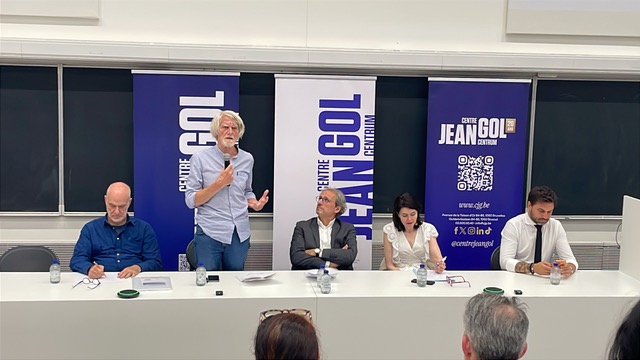
May 2026. I was invited by the Centre Jean Gol — the think tank linked to the MR, the francophone liberal party — to a debate on academic freedom to be held at UCLouvain St Louis in Brussels. I did not deem it necessary to ask a similar question. Instead, I took it for granted that I had not been invited to say what the MR would be delighted to hear, but to take part in an open discussion worthy of the venue hosting it: my university.
The panel, however, turned out to be strikingly unbalanced. It included the president of the MR, Georges-Louis Bouchez, and the MR education minister, Valérie Glatigny, and the moderator was the director of the Centre Jean Gol. Some doubt about getting common reflection to prevail over political propaganda was therefore permissible. Nevertheless, I confirmed my acceptance of the invitation to say what I had to say (and briefly restate below), just as I had agreed to go to Beijing barely four years after the Tiananmen Square massacre. I am a staunch opponent of applying a cordon sanitaire to speech.
The debate, as mentioned, concerned academic freedom, which must not be confused with freedom of expression. The latter is the fundamental freedom enjoyed by every citizen to say what they wish within legal limits that vary from one country to another. Academic freedom is the privilege enjoyed by academics to practise their profession as they see fit. It covers what they say and write. But it also covers what they do, for example the way in which they teach, organise their exams or conduct their experiments. And it purports to protect them against professional and not only criminal sanctions.
This privilege is justified by the objective of enabling academics to fulfil their three fundamental missions as effectively as possible: to provide, through their research, true answers to important questions; to transmit to their students not ready-made knowledge to be swallowed and regurgitated as dogma, but the ability to understand and evaluate what is presented to them as truth in the media as well as in lecture rooms and scientific publications; and to put their knowledge at the service of society, notably by publicly stating what they believe to be true and just and by explaining why they believe it.
Thus justified, however, academic freedom is not the freedom to say and do whatever one pleases without breaking the law. It may be legitimately restricted, for example when academic authorities determine the structure of our programmes or the schedule of our classes. But the limits one seeks to impose on it are illegitimate when they hinder the exercise of academics’ three fundamental missions rather than serve them.
On a global scale, it is political power that poses the most dangerous threat to academic freedom, because of the three instruments it has at its disposal. First, those who hold it enjoy a monopoly on so-called legitimate violence and are therefore in a position to imprison and expel. Second, they have privileged access to the media and can therefore easily incite harassment and intimidation. Third, as exclusive or partial funders, they can deprive teaching and research activities they dislike of financial support.
In Belgium, we might believe ourselves to be protected from such dangers. But some attempts at interference and what is currently happening in the United States — which I could never have imagined when I was teaching at Harvard in the 2000s — should prompt us to remain vigilant.
Can our academic freedom not also be threatened from within our universities — as was (more than) suggested in the announcement of this event? Of course, it can. Our colleagues do wield power over us. And that is mostly a good thing. It is partly the desire to earn and retain their esteem that drives us to be conscientious teachers, rigorous researchers and responsible participants in public debate. Might this pressure not also lead us to avoid topics that our colleagues deem too sensitive, or to recruit colleagues or guest speakers on the basis of political affinity rather than of their ability to contribute to the collective fulfilment of our three missions?
There is no doubt that such temptations exist. Not only owing to pressures from colleagues, but also within each of us. What must—and the only thing that may—stand in their way is our academic ethos, the sense of responsibility whose exercise justifies the trust society places in us by granting us the academic freedom we claim.
Thus, whilst it is legitimate to choose the questions our research addresses on the basis of our commitments, it is not legitimate to allow these commitments to influence the answers we provide. Whilst it is legitimate not to hide from our students the controversial positions we defend, we must be clear about their controversial character, refrain from proselytising and instead help our students understand the strongest arguments supporting positions opposed to our own. And whilst it is legitimate to venture into public debate beyond our own tiny personal expertise, it is important to do so whilst remaining constantly open to objections of all kinds.
Practising this academic ethos may require strenuous self-discipline and resistance to the expectations of those close to us. But remaining steadfastly faithful to it is now more important than ever, for three reasons. First, deviating from it may suggest, sometimes quite rightly, a blameworthy partiality and thus amplify the mistrust of part of the population towards academics, scientists and other experts. Second, those who hold political power may exploit this mistrust to threaten our academic freedom far more seriously than peer pressure ever could.
Finally and above all, to fulfil what our democratic societies are entitled to expect of us, we must dare to say what we believe to be true and just, even—indeed especially—if it displeases those in academic, economic or political power, and sometimes even ourselves and our dearest colleagues. We must also dare to welcome into our universities, both in our lectures and at public events, voices that are deeply discordant, whilst endeavouring to adopt a format that allows for mutual listening, for an exchange of arguments, for a genuine shared reflection. We must even sometimes dare to accept invitations that do not offer such a guarantee.
If we are to play fully our specific role as servants of democracy, it is important not to deploy too hastily the cordon sanitaire on speech.
