
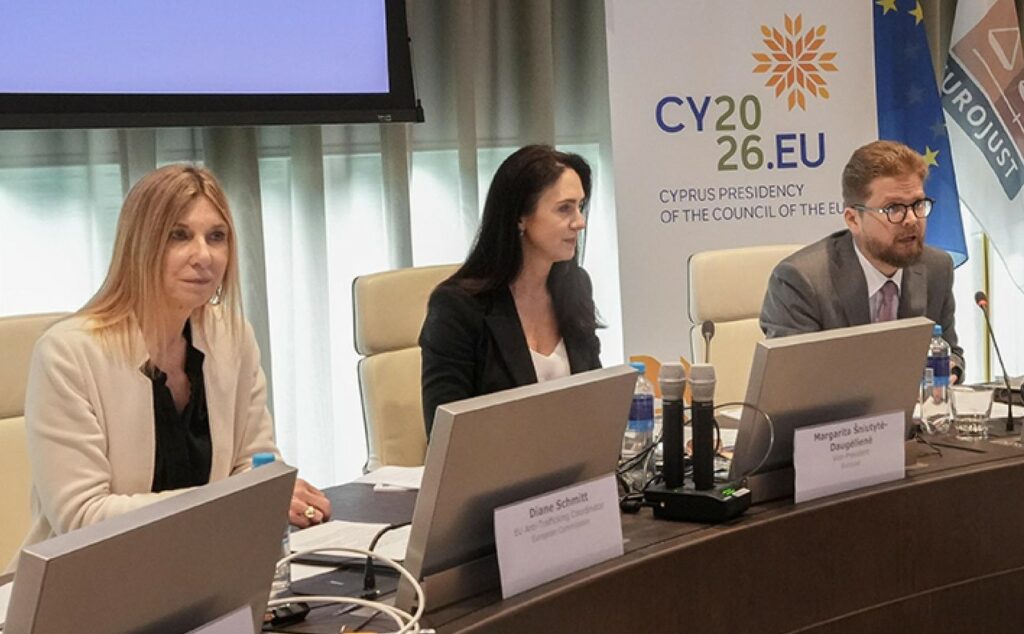
Specialised prosecutors from across Europe met at Eurojust’s headquarters in The Hague on 17 – 18 June to discuss recent developments in tackling trafficking in human beings.
The fifth meeting of the Focus Group of specialised prosecutors on Trafficking in Human Beings was co-chaired by the EU Anti-Trafficking Coordinator, the European Commission informed in a statement on Wednesday.
Discussions covered practical challenges linked to the “non-prosecution principle” — an approach designed to prevent victims of trafficking being prosecuted for offences they were compelled to commit — as well as cooperation with Latin American countries.
Participants also looked at a new operational action on judicial cooperation under EMPACT, an EU framework for coordinated action against serious and organised crime.
Child trafficking and a new EU strategy
Child trafficking in the context of institutional care was on the agenda, alongside awareness-raising efforts, the Commission said.
The meeting also included a consultation on a new EU Strategy on Combatting Trafficking in Human Beings.
Attendees included prosecutors and judicial practitioners working on trafficking cases, representatives from the European Commission, Europol and national authorities, as well as representatives from Western Balkan partner countries and Latin American countries.
“Trafficking in human beings is a crime that knows no borders and our response must be equally coordinated,” EU Anti-Trafficking Coordinator Diane Schmitt declared in the statement.
Member states are preparing for the practical application of the revised EU Anti-Trafficking Directive, and exchanges among specialised prosecutors and judicial practitioners were described as valuable for identifying challenges and sharing experience.
