

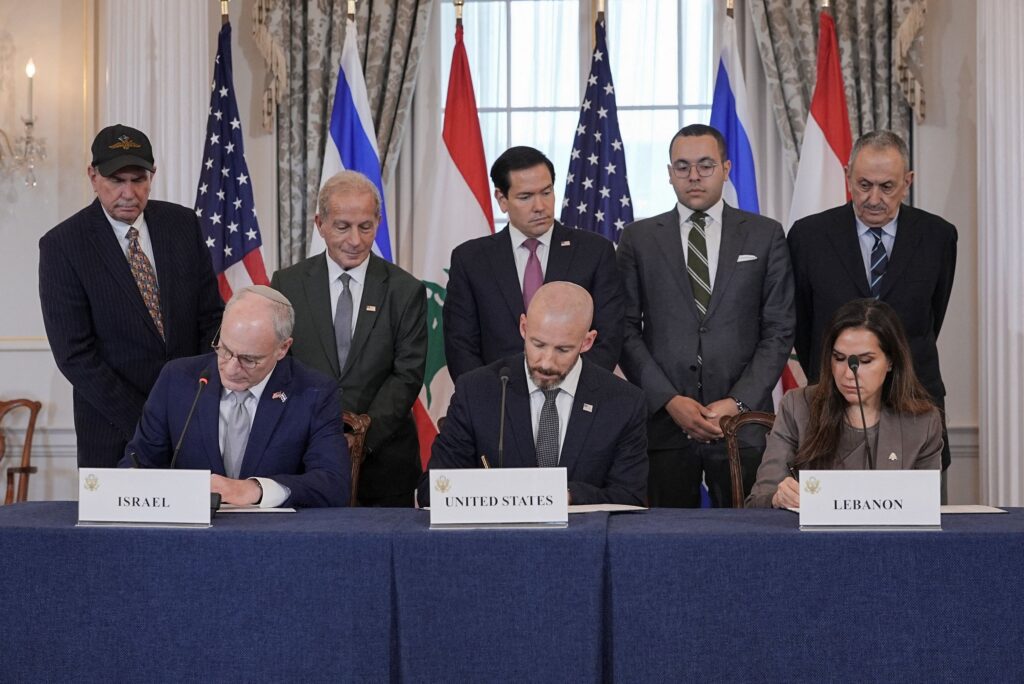
Israel and Lebanon signed a framework agreement last week mediated by the US, affirming their shared goal of achieving "lasting peace and security".
The trilateral framework agreement was first published by the Israeli journalist Barak Ravid on X and consists of 14 points.
Israel and Lebanon declared their ambition to end the conflict between them and ensure the sovereignty and security of both countries. They affirmed their intention to resolve all issues between them through direct bilateral negotiations, with the mediation and support of the US.
In the agreement, Israel and Lebanon affirm the right of each state to exist in peace, and their mutual desire to live in security as neighbouring sovereign states.
They commit to a reciprocal, sequenced process, with clear conditions, whereby the Lebanese Armed Forces (LAF) will restore effective sovereign authority over all Lebanese territory, pending the verified disarmament of non-state armed groups and dismantlement of associated infrastructure, enabling the Israel Defense Forces (IDF) to progressively redeploy out of the Lebanese territory.
The Lebanese army (LAF) will gradually assume full and effective security responsibility in pilot zones, which will serve as the mechanism for phased and verified redeployments of the IDF and the deployments of the LAF.
The Lebanese government will rebuild the State's monopoly on the use of force, achieve the complete and verified disarmament of all non-state armed groups (mainly Hezbollah), and ensure that such groups will have no military or security role and no armed capabilities anywhere in Lebanon.
Israel stresses that its military actions in Lebanon are solely a consequence of the attacks, threat posed by, and hostile intent of non-state armed groups, particularly Hezbollah.
Its government underscores that the termination of this threat, through the disarmament and dismantlement of such groups in all of Lebanon and additional security arrangements to be agreed upon between the two countries, will eliminate any future need for IDF military action or presence in Lebanon.
Importantly, Israel declares that it has no territorial ambitions in Lebanon. Until now, the Israeli far-right government was reluctant to a complete withdrawal from a security zone which kept expanding in southern Lebanon. The war resulted in mass displacement of Lebanese civilians and the destruction of their homes without providing security to north Israel.
Indirectly referring to Iran and the US-Iran MoU, Lebanon rejects the claims of any state or non-state actor to use force on its behalf without its explicit authorization, and reiterates that any claim by any state or non-state actor to exercise a military or security role is illegal per the decisions of the Lebanese Government and contrary to Lebanese national interests.
Need of interntional support
Separately, and simultaneously, the US will rally international partners to actively support the government of Lebanon in rebuilding the country, repairing infrastructure, restoring the economy, and creating opportunities for prosperity.
This is expected to include mobilizing substantial reconstruction and humanitarian assistance for Lebanon, economic recovery programs, and investment initiatives so that Lebanon can recover from years of conflict and provide a better future for all its citizens. Lebanon also explicitly commits to prevent reconstruction funds from flowing to non-state armed groups and connected entities.
The security annex to the agreement was published on Monday and specifies the conditions of a sequenced deployment of the Israeli troops from Lebanon linked to the disarmament of the Iran-backed Hezbollah starting with the immediate implementation in two small pilot zones. Israel and Lebanon will establish a Military Coordination Group for Lebanon tasked with the implementation.
Lebanon also requests the support of international and particularly Arab partners, under the leadership of the United States, to achieve this outcome.
The European External Action Service (EEAS), through its spokesperson Anouar El Anouar, welcomed the framework agreement. In a statement, he wrote that “it offers a much-needed positive perspective in the efforts towards de-escalation and peace”.
The EU also “commends the constructive engagement of all parties and urges them to implement their commitments including through the newly established trilateral Military Coordination Group”. He recalled the recently approved 100-million-euro assistance package for the Lebanese Armed Forces in support of the Lebanese government’s efforts to assert state authority and monopoly over arms.
The US has also announced that it will provide $100 million to strengthen the capabilities of the Lebanese army. The EEAS has proposed a Common Security and Defence Policy (CSDP) mission to advise and train Lebanese authorities, specifically its Internal Security Forces. The proposal requires unanimous approval from all 27 EU member states before it can be formally established.
Cancellation of links to Iran
In practice, the framework agreement cancels the linkage between Iran and Lebanon which the US accepted in its MoU with Iran above the heads of Israel and Lebanon.
The main negotiator on the American side was Vice-President JD Vance. The US and Iran declared that the MoU, once signed, will end immediately and permanently the war on all fronts, including Lebanon. Nothing was said about Iran’s interference in Lebanon and links to Hezbollah.
The spokesperson declined to reply to a question by The Brussels Times whether the EU will heed the calls in the framework agreement and increase its support to Lebanon beyond what it already has announced.
It was expected that Hezbollah would reject the framework agreement. It continues to claim that it is defending Lebanon while threating to start a civil war. The Lebanese Parliament Speaker and Hezbollah ally Nabih Berri said that the agreement will “will not pass, and it will not be implemented in its current form” because it does not preserve Lebanon’s rights.
Overall, the framework agreement was met by cautious optimism in both Israel and Lebanon as it could pave the way for Israeli-Lebanese peace irrespective of the US-Iran MoU. Crucial for its implementation will be the reconstruction and strengthening of the Lebanese army, especially as the mandate of the UN peacekeeping force (UNIFIL) will end by this year.
So far, only France and the UK have announced that they might be willing to send troops to Lebanon to support the Lebanese army. Shiia Muslims make up a significant part of the army and are unwilling to confront Hezbollah. This could change if the army would have a sufficient budget to pay its soldiers as much as Hezbollah is paying its members with Iranian money.
Another issue is the release of funds by the International Monetary Fund (IMF). The release of $3 billion bailout funds has been suspended until the Lebanese government implements long-delayed structural economic reforms. A new reform-friendly president, ex-general Joseph Aoun, was elected during the war but he would need to disarm Hezbollah, make peace with Israel and strike down on corruption.
