

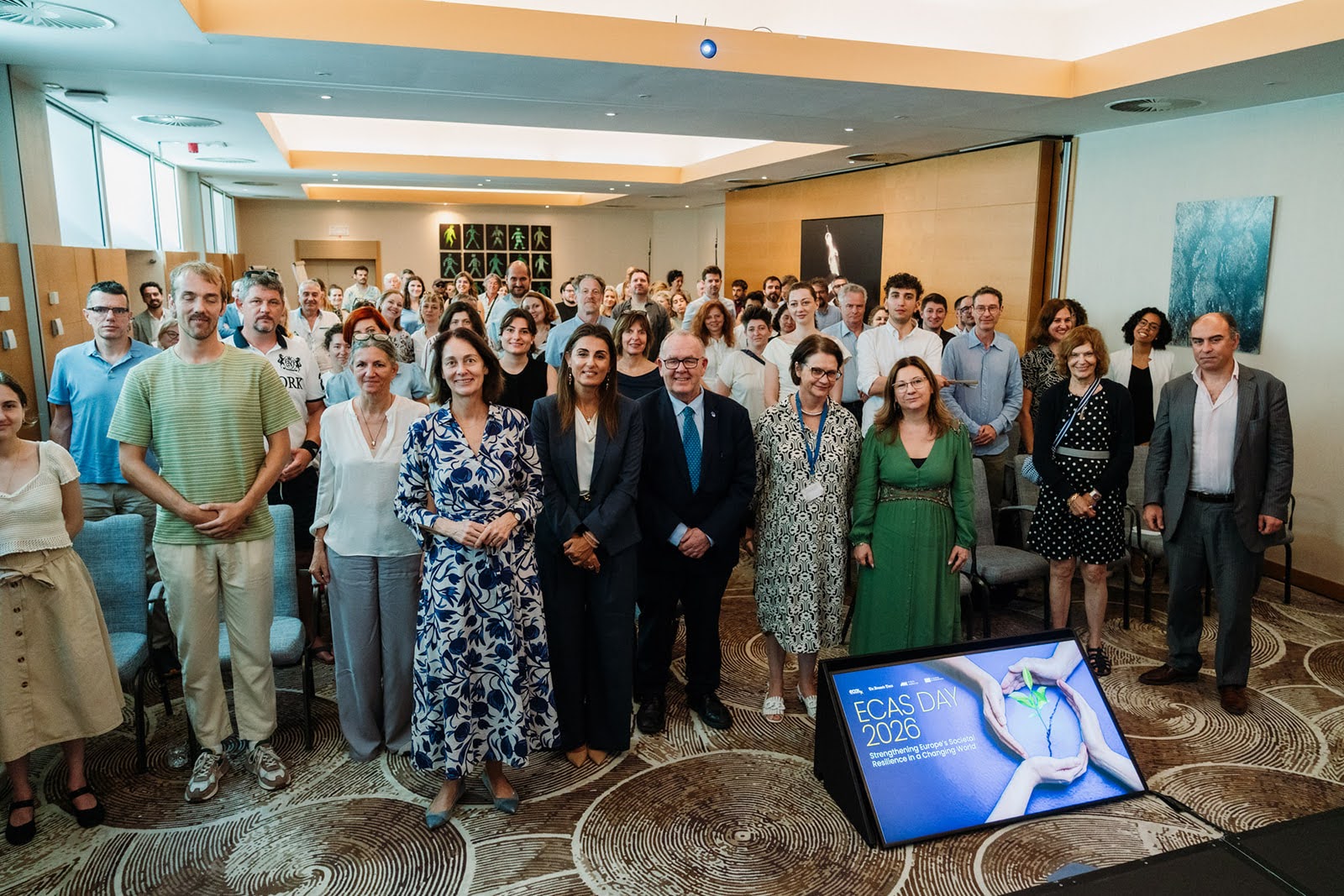
To mark its 35th anniversary, ECAS organised a flagship event at the end of June. In the heart of Brussels, the organisation brought together four important speakers for a high-level debate on what it takes to keep trust, rights and democratic participation strong in Europe.
Kicking off the panel discussion, ECAS’ Executive Director Assya Kavrakova asked the panellists how European democracies can defend themselves in today’s geopolitical and information environment, without compromising core freedoms, pluralism and fundamental rights – and where they should draw the line.
Katarina Barley, Vice-President of the European Parliament, opened the discussion by emphasising Europe’s global appeal. Many people, especially those living under autocratic regimes, view Europe as a desirable place to live, she stressed.
"We should look at this situation a bit less defensively than we tend to do,” she said. “We should be bolder sometimes. The current trend at the moment is going in a different direction – an authoritarian one – but we should say, look at us, follow our example.”
Yet, with the global geopolitical and information environments rapidly changing, critics claim that the European Union, with its sluggish regulatory processes and value-based approach, can't keep up.
For Séamus Boland, President of the European Economic and Social Committee (EESC), those European values accused of slowing down the bloc – such as freedom, democracy, equality, rule of law, and human rights – are exactly what make the EU stand out on the global stage.
"These European values are what make us unique in terms of political and social systems in the world," he said, adding that this is what attracts countries seeking EU membership.
For Boland, this shows that many countries appreciate the EU's values. "So we need to be very precious about our values. We should not compromise on them.”
Rebalancing, not compromising
Teresa Anjinho, European Ombudswoman, framed the challenge differently: the EU must not only defend its values but also dare to stand by them, especially in this new era of geopolitical instability, disinformation and the rapid advancement of artificial intelligence (AI).
Resilience, she argued, means adapting without losing sight of what defines the EU. "It is possible to adapt without losing ourselves. It is about rebalancing rather than compromising."
Still, Anjinho understands that there is anxiety within the institutions that need to adapt, as well as among citizens who fear that they will be excluded from important decisions. "At the end of the day, it is the identity of the European Union that is at stake."
However, the EU's principles and values should work as “a lighthouse”, she believes. "And lighthouses do not exist for fair-weather times; they exist for the storms. They are the ones that should guide us through the storms, so that we do not get lost."
Marie-Hélène Boulanger of the European Commission (DG JUST) underscored the need for reliable information and pluralistic sources to safeguard democracy. She introduced the European Democracy Shield, which aims, among other things, to safeguard the information space by countering foreign information manipulation and interference and disinformation, and also to empower citizens in exercising their rights freely and independently.
Therefore, she stressed, the European Democracy Shield is key to protecting democracy. “It is about really helping people to get what they need to find their way in this complex world. It is about equipping them with the right skills, such as media literacy. We also want them to feel empowered, having opportunities for meaningful citizens’ engagement, and ultimately more trust in our democracy and institutions. Maintaining a ‘of whole-of-society’ approach is key to reinforcing democratic resilience.”
From crisis to structure
With societal resilience meant to be a long-term democratic asset rather than a crisis tool, the question of how the panellists would define success in the long term arises. Is there a way for the EU to measure it, and can it ever be fully achieved?
Achieving this resilience is a “never-ending task”, for Parliament Vice-President Barley. "Democracy is fragile, precisely because we all have a say. Individuals are not always rational and can be manipulated. At the moment, democracy is being challenged as it has not been for a long time. So we will never be finished."
Ombudswoman Anjinho agreed, stressing that to invest in societal resilience, the EU must first guarantee that it has learned from the lessons of the past, particularly past crises. "We need to guarantee that we build institutions that can work efficiently and along the lines of transparency, accountability, and integrity, even in times of challenges and difficulties."
In ten years, successful societal resilience for Boland of the European Economic and Social Committee would mean that systems are not just prepared to deal with emergencies, but that they have built a systematic planning system that includes all sectors of society.
"We need a systematic putting together of a structure which allows interaction between all elements of our society, including civil society, not on a one-off, but embedded in the planning," Boland said.
Asked about what needs to change in the cooperation between EU institutions, independent media, and civil society to become more structural and sustained rather than reactive and crisis-driven, Ombudswoman Anjinho said "transparency".
"What we need is honest communication about what the institutions are and aren't able to do. Citizens have to be kept informed. We cannot make the world more predictable, but we can make institutions more reliable," she said. "That is a path for trust, and for the resilience of society that we are aiming for."
Boulanger of DG JUST, meanwhile, concluded that the European Democracy Shield’s success depends on collective action. She stressed that following a whole-of-society approach is central to its mission.
"It is a collective effort. No one can support our democratic values on their own. If we do not work together, we will not succeed. So we know what to do," she said.
Looking towards the future, safeguarding democracy and building a resilient society will almost certainly be among the most important challenges for the bloc, but the image of a shining lighthouse endured: a reminder of Europe’s commitment to navigate the storms ahead, steady and unwavering.
The coverage of this topic has been made possible with the support of the European Citizen Action Service (ECAS), while all research and writing were conducted by The Brussels Times.
