
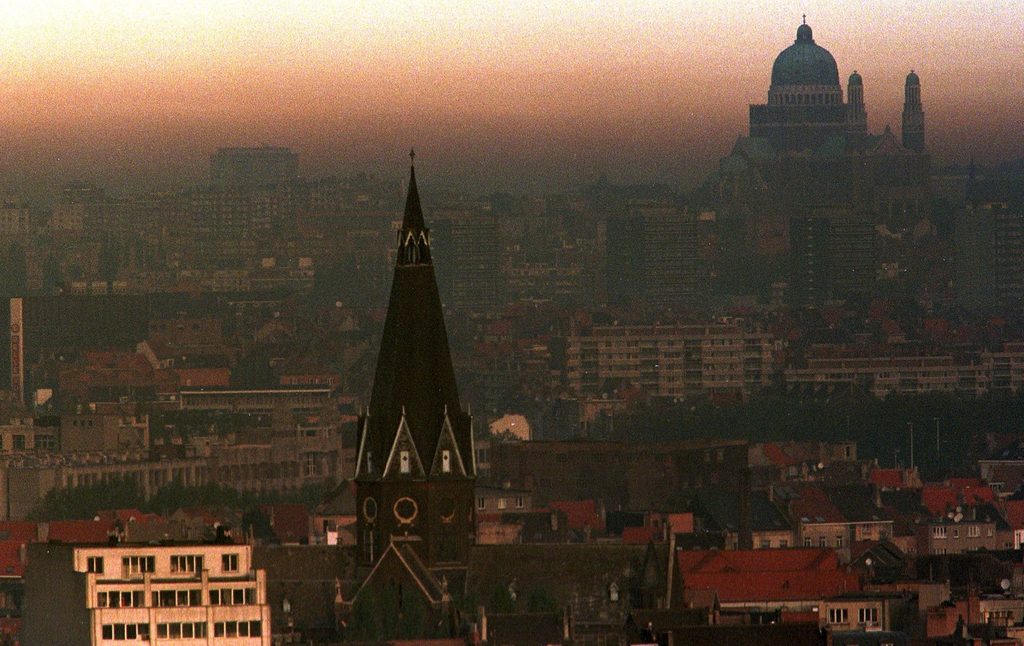
Most Brussels residents are concerned about air quality, according to a citizen survey conducted by the BRAL urban movement between 2 March and 2 April and published on Thursday.
Of the 830 people polled in four Brussels neighbourhoods chosen for their high levels of air pollution — Étangs Noirs, Porte de Flandre, Toison d’Or and the ULB-VUB area in Ixelles — 84% said they were either fairly or very worried about the air they breathe.
Their main concern was public health, followed by their own health and then children’s health.
The survey also found that 67% of respondents did not feel sufficiently informed about air quality and its consequences.
Most participants were Brussels residents aged between 16 and 50, living either in the neighbourhood where the survey was conducted or in the municipality to which it belongs.
In March, BRAL published results from measurements taken at 24 sites across Brussels with support from Brussels Environment. Those readings showed no improvement in air quality between June 2024 and June 2025, while nitrogen dioxide (NO2) concentrations rose slightly.
According to estimates by the European Environment Agency, cited in the 2024 Brussels-Capital Region Health Dashboard published by Vivalis, air pollution causes 930 premature deaths each year in Brussels and 500,000 across Europe.
Fine particles (PM10 and smaller) and nitrogen dioxide (NO2) are the two main air pollutants in Brussels. They are linked to harmful health effects, including inflammatory reactions, the development of chronic and cardiovascular diseases, and a higher risk of stroke.
These pollutants mainly come from road traffic, especially diesel engines, and from heating in buildings.
