

Over the past 12 months, one word has been buzzing across the corridors of the power triangle between the European Commission, the Council, and the European Parliament in Brussels: Omnibus.
After a first term dedicated to promoting a European Green Deal intended to reconcile environmental protection goals with economic development, European Commission President Ursula von der Leyen radically changed course in 2024 by launching a series of legislative packages — twelve so-called Omnibus packages to date.
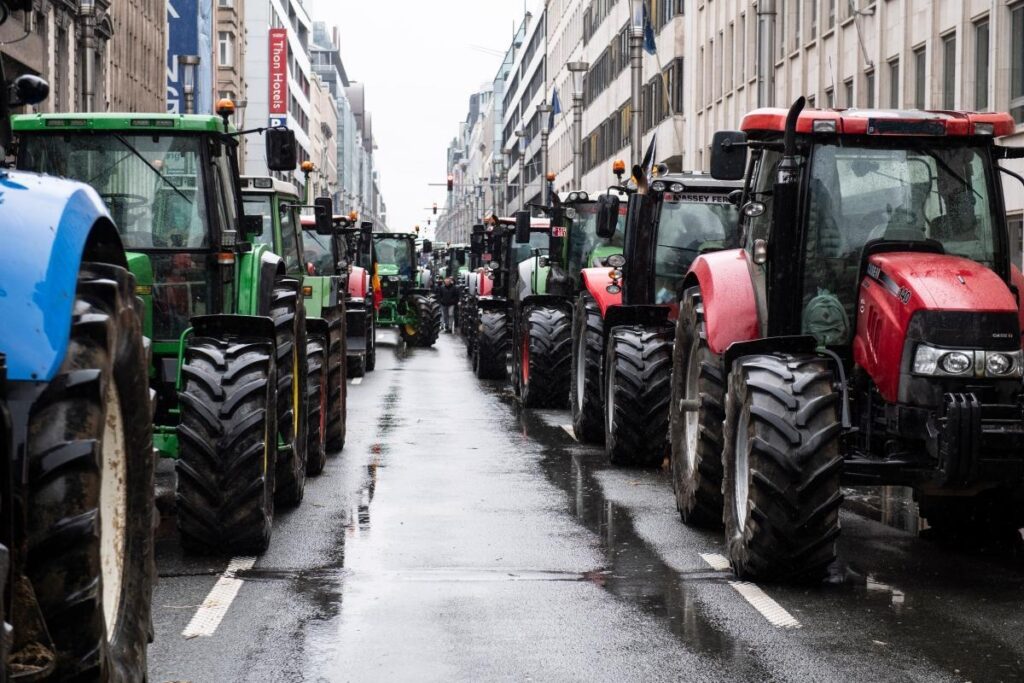
The tractors blocking Brussels and Strasbourg, followed by European election results shifting ever further to the right, likely precipitated this abrupt reversal. Laws protecting the health and environment of 500 million Europeans suddenly became obstacles to European competitiveness.
It became urgent to 'simplify.' In other words: slash regulations and focus on private interests, even if this means bypassing democratic procedures and going against essential protections. And this now also risks affecting what ends up on our plates.
The food safety turn
After defence, the automotive industry, corporate sustainability and the digital sector, to name a few, Omnibus X is now taking a toll on food-safety rules. The package proposes to open no less than 10 European regulations covering diverse areas that span from rules for putting pesticides on the markets and setting residue limits, to border controls on imports, and even the management of the bovine spongiform encephalopathy epidemic (better known as mad cow disease).
The Omnibus X is not even supported by an impact assessment, the usual prerequisite for putting forward new regulations according to the Commission’s own rules. The stakeholder consultation, which was open for barely 30 days at the end of 2025, was based on a vague one-and-a-half-page document — a parody of democracy.
Among the proposals on the table, those related to the marketing of plant protection products are probably the most shocking. They call for the elimination of periodic reviews for pesticide authorisations, more generous derogation criteria for dangerous substances, the extension of grace periods after a substance is banned, the removal of the requirement to take the most up-to-date scientific knowledge into account in assessments, and a more permissive application of residue limits.
These measures not only run counter to science — as studies linking exposure to pesticides with cancer and other diseases continue to pile up — but also to the very essence of the European food safety approach, which is based on the precautionary principle and places the burden of proof on economic actors.
Food safety at risk
While the European Commission’s change of course is concerning in many respects, the major political shift currently unfolding in the European Parliament may have equally serious consequences. Although Parliament has traditionally adopted more protective positions than the Commission on health, the environment, and consumer protection, the new amendments proposed by its rapporteurs on these issues could weaken the food-safety framework even further.
The proposal, which was leaked before its presentation in committee on July 6, is dangerous. It shamelessly prioritises private interests over public health. According to the document’s appendix, the input cited in preparing the report came exclusively from representatives of the agribusiness sector, raising questions about whether the drafting process adequately reflected the views of scientists, public-health experts, consumer organisations, and civil society.
Specifically, they propose, among other things, further expanding the scope of unlimited pesticide authorisations; including socioeconomic arguments among the criteria for exemptions for substances deemed hazardous; extending the principle of mutual recognition throughout the European Union once a pesticide is authorised in a member state; and restricting the leverage of national authorities that might wish to ban certain pesticides within their borders. Such an attack on our essential safeguards is as shocking as it is revealing of the danger threatening European democracy.
Time to defend Europe’s safeguards
An unprecedented situation calls for an unprecedented response. foodwatch, along with numerous civil society and academic actors, has been taking action on several fronts. True to our mission, we document and expose the political manoeuvring currently underway within the institutions to hold decision-makers accountable for their actions in Brussels and in national capitals.
Furthermore, we are putting our expertise and that of our partners at the service of those within the institutions who remain committed to the requirements outlined in Europe’s founding treaties regarding the protection of health and the environment.
Finally, and now more than ever, we are calling for citizen mobilisation against the dismantling of our regulations — in the area of food safety, of course, but also beyond, since the Omnibus waves spare no sector.
Nearly 100,000 European citizens have already taken action, and the numbers keep rising, with signatures being sent to Members of the European Parliament every day. For each Omnibus package, the stakes — and they are high — are the same: ensuring that the safeguards secured through decades of democratic dialogue remain in place. Yet the dams are beginning to crack.
In the face of social, environmental, and geopolitical challenges, what we truly need is more Europe — a Europe that protects its citizens, not the interests of powerful industrial lobbies.
