
The European Commission adopted last week the Livestock Strategy to ensure that Europe's livestock sector remains strong and resilient. However, it left several animal welfare issues for the future.
The strategy, the first of its kind, sets out actions to help livestock farmers address economic, environmental and market challenges. As stated in its press release, the strategy outlines five priorities:
- A resilient livestock sector prepared for crisis. The Commission is stepping up preparedness to reduce risk exposure and enable farmers to recover more quickly after a crisis.
- A competitive livestock sector – in the EU and globally. The Commission will work to boost profitability and uptake of innovation, and to bolster competitiveness and sustainability, so that the sector can thrive.
To deliver on this priority, the Commission says that it will work on greater alignment of production standards, especially on animal welfare, in line with World Trade Organisation obligations. Efforts to promote new market opportunities through agri-food diplomacy will also be strengthened.
- A sustainable livestock sector. Under this priority, the strategy will promote a tailored approach to address sustainability challenges. Referring to the European Citizens’ Initiative (ECI) on banning cages, it proposes targeted revisions for laying hens, broilers and pigs, which will be evidence-based and accompanied by adequate transition periods and financial support.
- A livestock sector fit for all farms and regions. The Commission will work with Member States on a plan to bring back sustainable livestock production to vulnerable regions, in particular those at risk of abandonment, with the support of a Land Observatory and supporting EU demography policies.
Under this priority, the Commission will also develop a roadmap for low-capacity and/or mobile slaughterhouses. This will contribute to fostering locally integrated livestock value chains, reducing animal transport and regenerating local economies. Nothing was said about the use of painful stunning methods at slaughter, e.g. high concentrations of CO2 in the slaughter of pigs.
- Excellence in livestock production. The Commission says that ‘Quality is Europe's strategic asset’. It will make the EU's excellence in production more visible and rewarding through strengthened EU origin labelling and quality recognition to boost a Buy European campaign and organic production systems.
The Livestock Strategy comes out with a Protein Action Plan. Relying less on imported inputs and reducing emissions are set out as goals in the Action Plan and the Fertiliser Action Plan. At the same time, preserving food safety and improving animal welfare remain key objectives.
In 2025, only 25% of protein from oilseeds and protein crops was sourced in the EU. The Plan aims to increase the share to 35% by 2035.
The Commission highlights statistics showing that livestock farming accounts for about 40% of EU agricultural added value and generates €400 billion in annual turnover. It has a strong social and territorial impact, employing around 7 million people on 4 million farms spread across Europe, often in areas with few other economic opportunities.
The European Citizens' Initiative "End the Cage Age" was formally submitted in October 2020 to the European Commission after it had collected around 1.4 million signatories across all EU Member States – well above the minimum number of at least 1 million signatories in at least seven Member States.
On 30 June 2021, the Commission decided to positively respond to the 'End the Cage Age' ECI. In a communication, the Commission wrote that the response would be "included in the revision of animal welfare legislation that it has committed to propose by the last quarter of 2023".
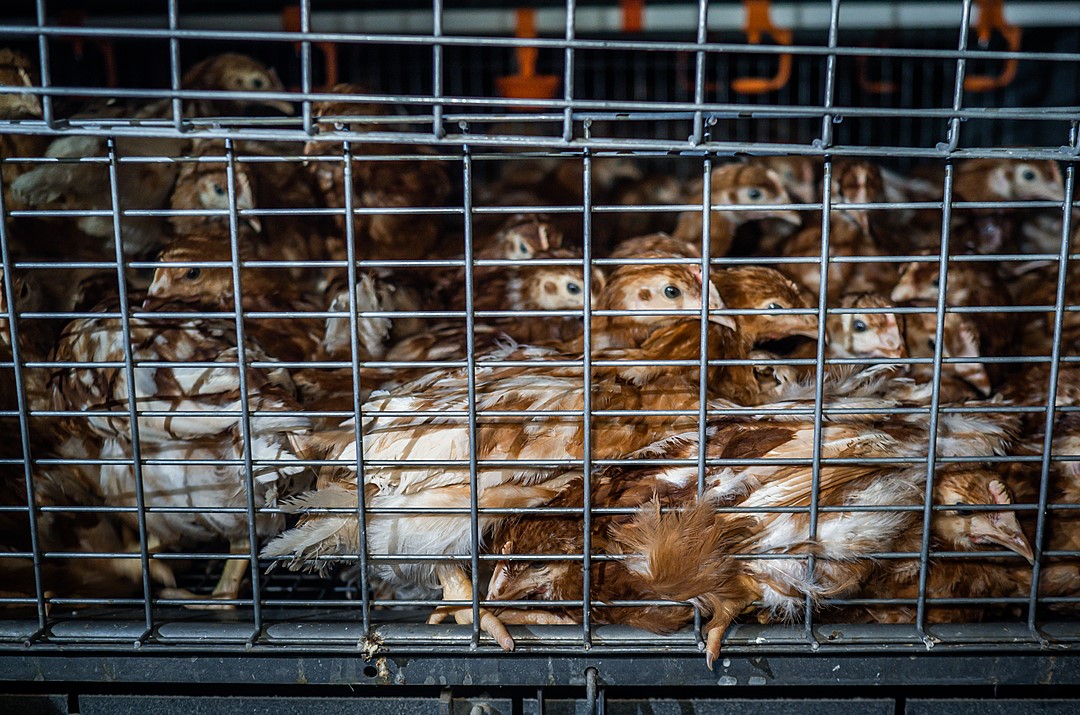
Densely housed young hens look out through the wires of the cage they live in at a farm in the Czech Republic, credit: Lukas Vincour/Zvirata Nejime/We Animals Media
Commission explains delays in legislation
At the press conference following the adoption of the Livestock Strategy, the European Commissioner for Health and Animal Welfare Olivér Várhelyi was asked why it had taken so long for the Commission to submit a legislative proposal.
He replied that he can only take responsibility for his mandate period (since December 2024). To go forward with the animal welfare rules, there was a need for outreach and dialogue with other parts of society (farmers), he explained.
In February 2025, the European Commission presented a vision for agriculture and food, which it described as an ambitious roadmap on the future of farming and food in Europe. The vision was one of the priorities put forward by the new von der Leyen Commission for the first 100 days of its mandate period. It was also a response to farmers' protests in Brussels that turned violent.
“The ECI is there to express a wish but it’s up to the Commission to judge whether it’s economically and socially feasible,” Várhelyi said. "What we tried to do with the consultation we launched in January 2025 was to find the right solutions that are working and that farmers are able to implement without jeopardising their production capacity so that they can continue to supply us with food.”
“There is a huge value in being self-sufficient in these geopolitical times so we wanted to thread very carefully but consistently,” he added. “What we put on the table is the outcome of that consultation, starting with the first sector by the end of this year, and the rest next year.”
As regards the stalemate in passing the update of the live animal transport legislation, he blamed the co-legislators (the Parliament and the Council). At this point, there is very little the Commission can do, he said, referring to the numerous amendments to the Commission’s proposal and the political differences of opinion among the Member States.
While the legislative process is continuing, the Commission is calling for the deployment of more regional and local slaughterhouses, including mobile ones, as an option. This will reduce the time and pain in transporting live animals to slaughter (provided that it will be economically feasible). It is not expected to solve all problems such as live animal transport for fattening and halal and kosher slaughter.
According to the Communication on the Livestock Strategy, the EU will foster excellence in livestock production as a distinct European approach to livestock farming that is recognised and valued by consumers, in particular when it comes to animal welfare.
The Commission will explore with the European Investment Bank preferential access to loans for farmers engaged in a transition to cage-free systems based on the outcome of the legislative revision.
By the end of 2026, the Commission intends to propose a targeted revision of animal welfare rules for laying hens and broilers, focusing on the phasing-out of cages, practical on-farm welfare indicators, ending the systematic killing of male chicks and equivalent import requirements. By Q2 2027, a similar proposal will address pig welfare, including the transition from crates to pen systems.
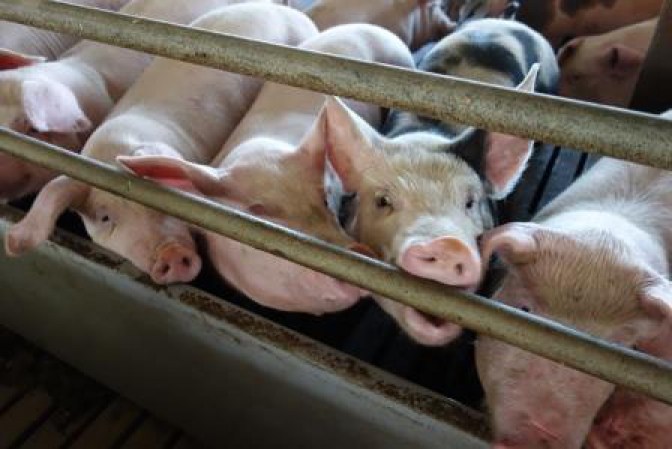
“These highly social and intelligent beings spend most of their lives in this condition, as if they were already sausages.” (Yuval Harari)
On live animal transports, the Commission will closely exchange with relevant stakeholders, civil society and destination third countries. Depending on the outcome of these exchanges, it will consider further steps, including possible alternatives to the export of animals for slaughter from the EU to third countries, while maintaining the market positions of European livestock producers.
The Commission also raises the issue of the reduction of methane emissions from livestock, which remains one of the priorities, but does not announce any new goals. To start with, the Commission will work on a harmonized methodology for livestock GHG emissions at farm level and, including developing a voluntary, on-farm sustainability compass for farmers.
NGOs react to the Livestock Strategy
A number of animal welfare NGOs provided a mix of comments, ranging from cautious optimism to concerns whether the Commission will follow through on its promises to submit the missing legislative animal welfare proposals.
“Deeds, not words, will ultimately determine whether the Commission’s strategy will lead to a genuinely sustainable and future-facing animal agricultural sector,” commented Dr Joanna Swabe, senior director of public affairs for Humane World for Animals Europe. “Achieving higher animal welfare standards is a precondition for achieving this, especially the elimination of caged confinement for farmed animals."
“In an ideal world, any ‘livestock’ strategy would propose a ban on factory farming,” said Gabriela Kubíková, the European Institute for Animal Law & Policy’s Legislative Advocacy Manager. “We can only regret how slow change is in this political context, at the expense of animals and to the benefit of dominant economic interests.”
“However, we’re glad to see concrete dates in today’s strategy, and we will be holding the Commission to those – especially in light of their past promises that are yet to be fulfilled,” she added.
“We welcome the Commission’s renewed commitments to improve animal welfare and respond to what millions of Europeans have demanded,” commented Olga Kikou, representative of the Citizens’ Committee of the “End the Cage Age” ECI.
“But after years of delayed proposals and broken promises, we must judge this strategy by the action that follows. Europe does not need another strategy promising to end cages; it needs the Commission to finally deliver the legislation it committed to following the successful End the Cage Age European Citizens’ Initiative, ending the use of cages for all species and revising outdated animal welfare rules.”
“On the protein plan, again the ambition falls short. Europe needs a plan that helps people eat more plant-based foods and supports farmers growing protein crops for human consumption, not another strategy primarily focused on feeding more animals. If the EU is serious about building a healthier and resilient food system, it must move from protecting the status quo to enabling the transition.”
“Animal advocates should remain cautious before celebrating," said Anna McGinn, Communications Officer at Animal Advocacy & Food Transition. “This is not the first time the Commission has raised expectations only to disappoint and step back from its commitments. What we are hearing today is a series of promises rather than concrete action.”
“The Commission ‘intends to propose’ a phase-out of cages, ‘will explore the possibility to’ end the systematic killing of male day-old chicks, and ‘will consider further steps’ to stop live animal exports to third countries. These are vague commitments, not a clear roadmap with timelines, targets, and an action plan to deliver the change European animals need.”
“The Livestock Strategy rightly puts animal welfare at the centre of the sector’s future,” said FOUR PAWS’s Head of EU Policy Georgia Diamantopoulou. “But two legislative proposals over the next 18 months are only a half empty to-do list. The Strategy points to an investment gap running into the billions and calls for a "stable, predictable and clear legal framework" to boost investor confidence.”
Philip Lymbery, Global CEO at Compassion in World Farming, said: “After years of delay, this could be the breakthrough Europe’s farmed animals desperately need. A ban on cages for hens and sows would transform the lives of more than 160 million animals and show that public pressure can lead to real change.
“However, this must not be where the Commission’s ambition ends. It promised to End the Cage Age for all animals. It must now maintain momentum and give a clear, ambitious timeline for banning cages for every species. The Commission must also go beyond tinkering with how factory farms operate and confront the urgent need to transform the system itself.”
“While the EU Livestock Strategy is mostly positive in terms of improving animal welfare, it shows no indication to move towards extensive farming that prioritises higher environmental and welfare standards over number of animals,” commented Eurogroup for Animals.
“It falls short on addressing animal farming as part of a broader food system change that needs to happen, and that should not purely be based on economic returns,” said its CEO, Reineke Hameleers.
“We are now seeing the first real plan by the Commission to truly listen to what matters to citizens. This is good news. However, we want more concrete plans for the other sentient beings awaiting more protection, including all animals in cages and meat chickens.”
