
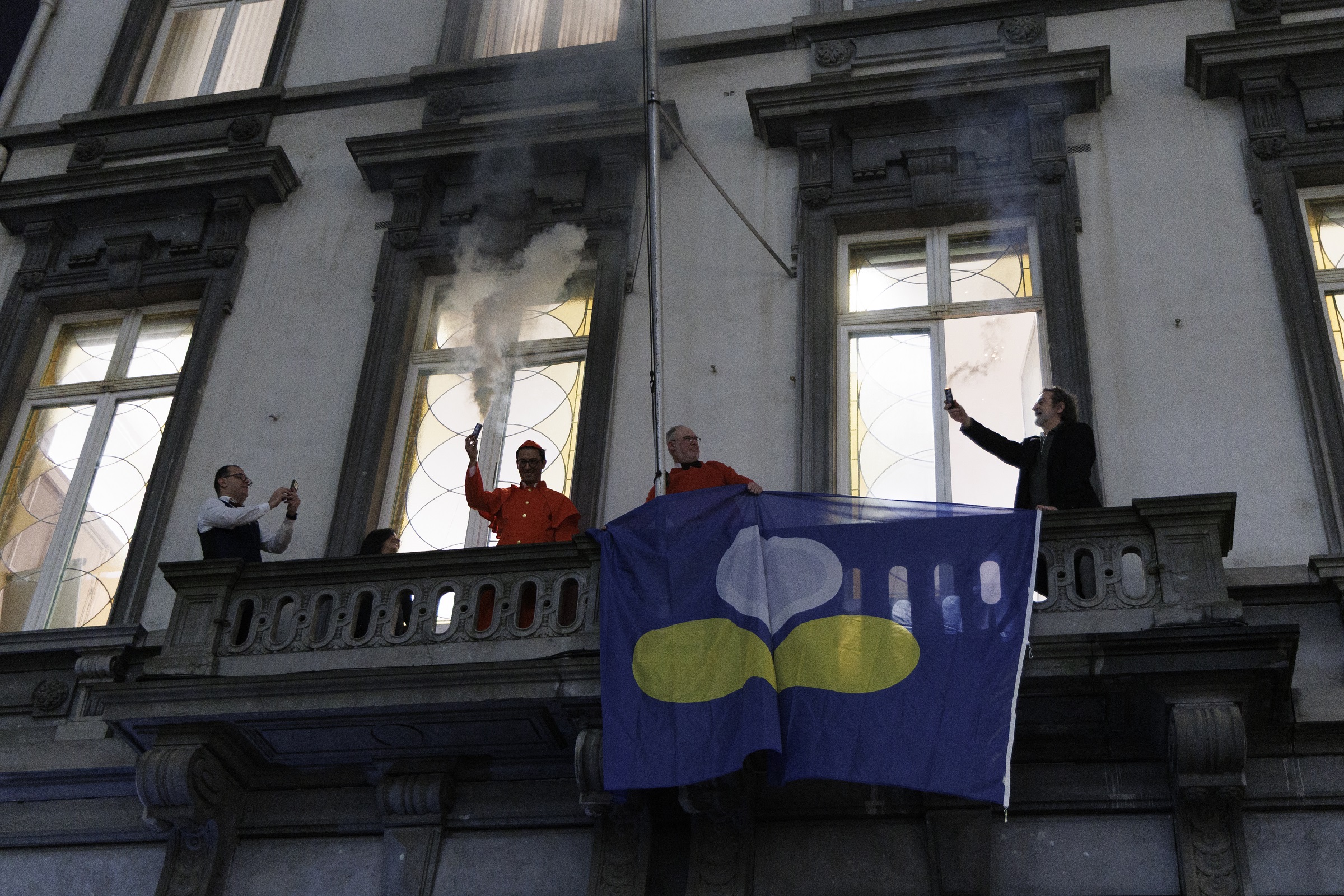
It took 613 days. A full 613 days after the June 2024 elections, Brussels' regional government was finally sworn in. Why so long? The budget deficit played its part: no party was keen to take the lead in an austerity drive. But there was a more fundamental cause: in an electoral system so fragmented that no fewer than 14 party lists won seats in the Brussels parliament, against eight in the Flemish Parliament, five in the Walloon parliament and six in Brussels' own municipal council.
The roots of this dysfunction stretch back to the 1970s and 1980s, when the fault line between Brussels' French-speaking majority and its Dutch-speaking minority dominated the city's political life. When the Brussels regional parliament was set up in 1989, the architects of the new order decided that its members would be elected in two electoral colleges: one fielding only French-speaking candidates, the other only Dutch-speaking ones, each covering the whole territory of the region.
Voters could choose freely between the two colleges, but it was taken for granted that French-speaking voters would all opt for the French-speaking college, and Dutch-speaking voters for the Dutch-speaking one. Initially, the share of seats was allocated proportionally, reflecting how many voters opted for each college. Since 2004, however, the numbers have been frozen: 72 seats for the French-speaking college, 17 for the Dutch-speaking one.
The elected members of each college form the corresponding language group in the regional parliament. These groups do double duty: they also constitute the parliaments of the French and Flemish Community Commissions (COCOF and VGC), the Brussels bodies responsible for care, education and culture in their respective communities.
For a regional government to take office, it must command a majority within each of the two language groups. Its composition is carefully balanced: a minister-president (who may in theory be of either group but is in practice always French-speaking), four senior ministers (two from each side) and three secretaries of state (two French-speaking, one Dutch-speaking). The same cast of characters also forms the governments of their respective Community Commissions.
A stalemate foretold
With this institutional backdrop in mind, the long agony that followed the June 2024 elections becomes easier to understand – though no easier to excuse.
On the French-speaking side, the arithmetic seemed manageable. The liberal MR party had topped the poll with 20 seats and was eager to replicate at regional level the partnership it had forged with the Christian-democratic Les Engagés in Wallonia and at federal level. Their combined tally, however, fell short of the 37 seats needed for a French-speaking majority. Eventually, the socialist PS, with its 16 seats, agreed to make up the numbers.
Forming a majority on the Dutch-speaking side proved far trickier. The previous coalition of the ecologist Groen (four seats), the socialist Vooruit (two) and the liberal Anders (two, now renamed from Open VLD) no longer commanded a majority. One extra seat was needed, and the Christian-democrats of CD&V could provide it – but there are only three Dutch-speaking ministerial posts to go around. The CD&V was therefore expected to support the government without being in it. It refused.
The only three-party combination that could have worked on the Dutch-speaking side would have required Team Fouad Ahidar – a new party born from a split in the Flemish socialists, which had vaulted from nothing to three seats – to join the coalition. But it was clear from the start that most of the other parties were not keen to take it on board. MR, as the party in charge of leading the formation, ruled it out from the start.
Then came an unexpected gambit from Anders: it offered to back the government without a portfolio, but only if the Flemish nationalist N-VA was included. This time, it was from the French-speaking socialist PS that exercised its veto: no government it belonged to could include a party seen as hostile to Brussels, it said.
After 20 months, with civil society movements growing restless and debt-rating agencies circling ominously, the logjam finally broke. CD&V agreed to lend support from outside, and Anders dropped its N-VA condition. On February 13, 2026, Brussels at last had a government – the same government, give or take, that had been pencilled in from the very first day of negotiations: MR, PS and Les Engagés with 44 of 72 French-speaking seats; Groen, Vooruit, Anders and CD&V with 9 of 17 Dutch-speaking seats.
Democracy subverts the system
This deadlock was no accident of personalities or bad faith. It was the product of an electoral system that grows less suited to its purpose with every passing election – corroded by a deep and irreversible transformation of the Brussels electorate.
Something has gone badly awry with the system's basic assumptions, and the numbers tell the story vividly. Surveys by the Vrije Universiteit Brussel show that the share of adults in the region whose only native language is Dutch dropped from 9% in 2000 to just 6% in 2024. Adding those who speak Dutch alongside another mother tongue – usually French – the Dutch-speaking share fell from 19% to 12%.
One might expect the vote share in the Dutch-speaking college to have tracked this decline. Instead, after falling from 15% in 1989 to 11% in 2009, it reversed course and climbed steadily, reaching a record 17% in 2024.
What explains this counterintuitive surge in the last three elections? The answer is: the rational exercise of democratic rights. The Dutch-speaking college holds 17 seats – 19% of the total – while drawing at most 17% of vote. That means each vote cast there carries fractionally more weight than its equivalent in the French-speaking college. Moreover, voting Dutch gives electors a second ballot: the right to elect the six Brussels members of the Flemish Community Parliament, whose remit covers all Dutch-language education in the capital.
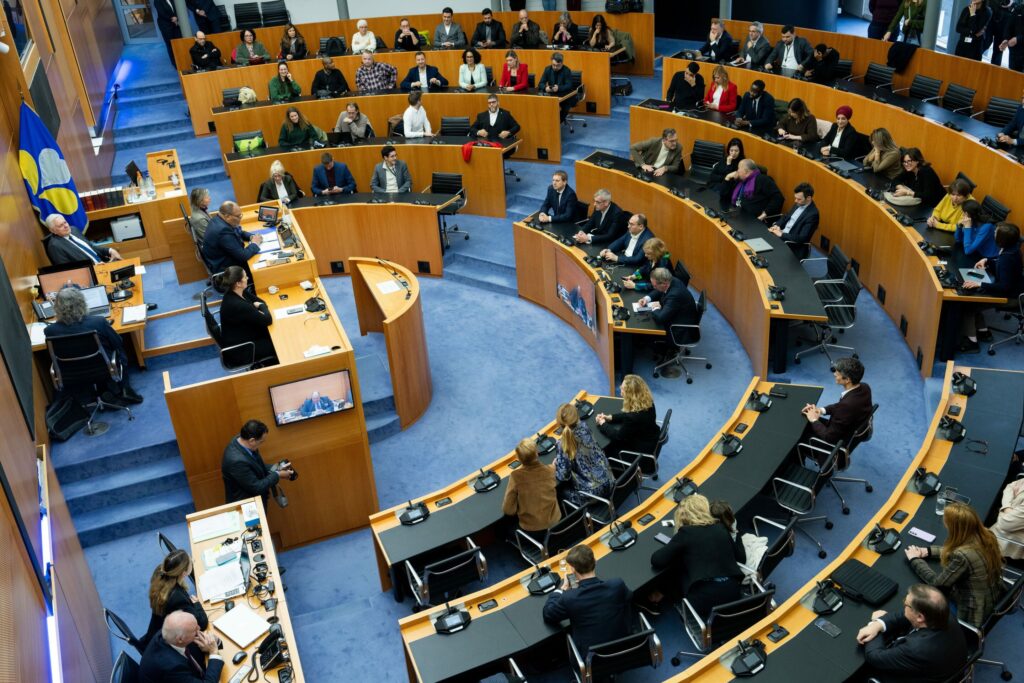
The Parliament vote on the new government
More decisive still is the 5% electoral threshold, which is applied separately to each college. In 2024, clearing the bar in the Dutch-speaking college required roughly 4,000 votes; in the French-speaking college, it took nearly 20,000. Little wonder, then, that eight of the 14 lists in the current Brussels parliament ran in the smaller college.
Team Fouad Ahidar garnered 18,345 votes – most of them from French speakers – and won three seats in the Dutch-speaking college. Had it stood in the French-speaking college, it would have won none.
As language identity fades as a political organising principle, growing numbers of voters who speak little or no Dutch have perfectly sensible reasons to cast their ballot in the Dutch-speaking college. They include admirers of the outgoing Dutch-speaking mobility minister, Muslim voters who identified strongly with Fouad Ahidar, and – above all – parents of children in Brussels' Dutch-medium schools.
In 1989, 21% of pupils in those schools had no Dutch at home. Today, the figure is 73%. That parents should wish to elect the bodies responsible for their children's schooling is entirely logical.
None of this constitutes an abuse of the system. It is a perfectly rational exercise of democratic rights by the Brusselers of today – a city that bears little resemblance to the one for which this system was built. In the 1980s, fewer than 20% of Brussels residents with Belgian nationality were of recent foreign origin.
Today, the figure is 66%. Even among Belgian nationals, we are now a long way from the neat mental picture of two mutually exclusive and jointly exhaustive tribes, each firmly anchored to its own language and its own ballot box, and unable to conceive of voting for someone in the other tribe.
The French-Dutch divide is no longer the cleavage that defines Brussels' political life. It has now been superseded by new fractures: car drivers against cyclists, landlords against tenants, laïcs against Muslims. The dual-college system served a purpose in its time: it helped pacify the old linguistic conflict. But it has now become a handicap for Brussels’ democracy. It is time to let it go.
Bilingual lists
Replacing the dual-college system with a single-college means, in essence, allowing "bilingual" electoral lists – French and Dutch-speaking candidates standing side by side. The dual-college arrangement guaranteed Dutch-speaking representation by reserving 17 seats for monolingual Dutch lists. A single-college system can achieve the same guarantee by other means.
Why preserve that guarantee at all? For two reasons. It provides a quid pro quo for the guaranteed representation of the French-speaking minority in Belgium’s federal government. And it ensures the presence in Brussels’ decision-making bodies of “bi-directional ambassadors” who can facilitate mutual understanding and cooperation between the capital and the Flemish region that entirely surrounds it and a federal state in which Dutch speakers are the majority.
To achieve this guaranteed representation, several formulas are possible. The most promising one starts with a proportional distribution of the 89 seats between the lists, bilingual or monolingual, and an allocation of the seats to the candidates within each list, using the rules currently in force. Each candidate must be explicitly identified as either French-speaking or Dutch-speaking, using a criterion that can be the same as now: the language of their identity card, chosen once and for all.
If the resulting distribution deviated from the prescribed ratio – say, the existing 72/17 split – a correction mechanism would kick in. The seat allocated to the last candidate elected from the overrepresented language group would be transferred to the first electable candidate from the other language group on the same list or, if there is none (the list being monolingual) on another list, namely the list first in line to get an additional seat.
With such a single-college system, the requirement for a double majority – government endorsed by a majority in each language group – could in principle be dropped. No equivalent requirement exists for forming the federal government, and dispensing with it would ease the formation of a government considerably.
But this requirement is indispensable at the regional level as long as the parliaments and governments of the two Community Commissions (COCOF and VGC) coincide, as mentioned above, with the corresponding linguistic segments of the regional parliament and government. Each Community Commission needs a majority in their respective parliaments, which logically entails that the regional government needs a double majority.
However, with a single-college system, the formation of the regional government would not be hindered by the double-majority to the same extent as it is now. With the 5% electoral threshold maintained, far fewer lists would be represented in the parliament, and fewer lists would be needed to build a coalition. (Seven lists are currently needed to provide Brussels’ regional government with the required majority, whereas two, both bilingual, suffice for the City of Brussels’ municipal majority.)
Moreover, the French- and Dutch-speaking wings of each political family would run joint lists – as they have long done at the municipal level and as, for the first time, they all did in the Brussels constituency at the June 2024 federal elections. Any contentious linguistic questions would be settled within those joint lists before the campaign, not across the table during government formation.
A feasible reform?
Does any of this stand a chance of happening? The early signs are mildly encouraging. Since the new government took office, both of its leading figures – Minister-President Boris Dilliès of the MR and Ahmed Laaouej of the PS – have declared their support for a single-college system with bilingual lists.
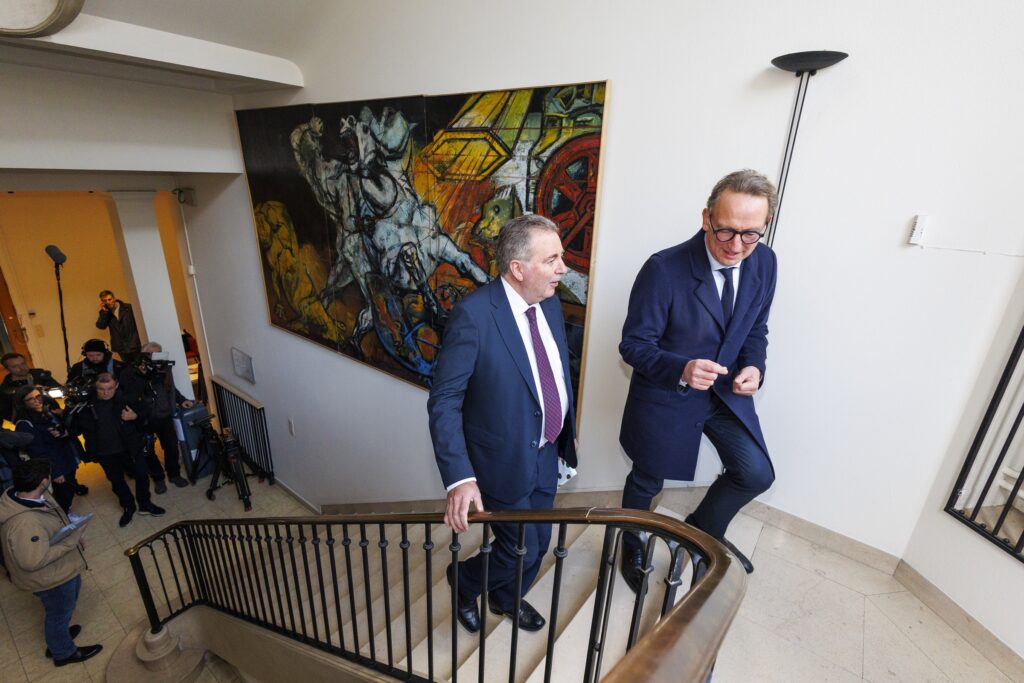
Minister-president Boris Dilliès with his predecessor Rudi Vervoort
Brussels' third-largest party, PTB-PVDA, already fields candidates in both colleges and would be the last to object. The three remaining French-speaking parties in the regional parliament are likely to follow suit. Together, it amounts to roughly 80% of seats in the Brussels parliament.
The harder problem lies in the federal arena. Changing Brussels' electoral system requires amending the special law of 1989, which can only pass with a two-thirds majority in the federal parliament and a majority within each of its language groups. That makes the position of the Flemish parties pivotal.
In 2024, the strongest managed only 3.9% of the total regional vote. With a 5% threshold, those that have French-speaking sister parties would have a strong incentive to merge into joint bilingual lists. Some, however, may worry that as the junior partner in such an arrangement, their leverage over candidate selection and programme would be weak. That anxiety would be sharper still for parties without a French-speaking counterpart – N-VA and Vlaams Belang, which took 2% and 1.8% of the regional vote respectively.
One way to alleviate the fears of the Flemish parties with French-speaking counterparts would be to require bilingual lists to be composed of two autonomous monolingual sub-lists, each formed independently. Appeasing parties without a francophone counterpart is trickier, yet the support of at least one of them would be needed for the federal supermajority.
An obvious concession would be to lower or scrap the electoral threshold – but that would open the door not only to Flemish parties but also to a proliferation of ethnic (Moroccan, Turkish, African?), and single-issue lists (pro-animal, pro-Palestine, pro-car, anti-airport?), fragmenting the parliament still further. The formation of governments would become even more laborious than now.
The Flemish parties' dilemma
It might seem, therefore, that Flemish parties – particularly those without a sister party – have every reason to cling to the current system, defects and all. But the transformation of the Brussels electorate presents them with a dilemma.
Under the present dual-college arrangement, they must be prepared for the following scenario. Team Fouad Ahidar, having avoided the unpopularity of governing, could grow from three seats to five or six at the next elections, buoyed by a rising share of voters of recent foreign origin.
Other single-issue parties will keep colonising the Dutch-speaking college, lured by its lower threshold. The only rational response for the established Flemish parties would be to campaign ever more aggressively beyond the small Dutch-speaking population – thereby accelerating the very subversion of the logic they rely on.
There is one conceivable alternative: tighten the dual-college rules. Stricter criteria could be imposed on who may stand as a candidate or vote in the Dutch-speaking college. Only "true Flemings," properly certified, would be admitted. But this path would collide with constitutional principles and with one of the founding commitments of the Brussels institutions: the refusal to create a "sub-nationality" – a distinction between Belgian citizens enjoying different rights.
More fundamentally, the idea is democratically indefensible given Brussels' demographic reality. The share of native Arabic speakers in the Brussels region is nearly the same as the share of native Dutch speakers. If a certified Flemish party can win seats by clearing 5% of certified Flemish votes – less than 0.1% of the total electorate – why should the same logic not apply to a Belgo-Moroccan party clearing 5% of Belgo-Moroccan votes? What might have been acceptable when Brussels was imagined as a city with a single linguistic minority has become untenable in today's superdiverse capital.
Reconciling with reality
Sooner or later, the Flemish parties in Brussels are bound to realise that the only way of escaping from this dilemma — the only strategy with a future — lies in presenting lists that appeal to the whole regional electorate. Those with sister parties can do this naturally, through merger. But Vlaams Belang and N-VA could do so too, by deliberately recruiting non-Dutch-speaking voters and candidates.
Fanciful? Hardly. Vlaams Blok – Vlaams Belang's predecessor – was the first Flemish party to campaign systematically in French, enabling it to seize six of the 17 Dutch-speaking seats at the 2004 regional elections. At the 2024 federal elections, the N-VA fielded candidates across all five Walloon constituencies. If it could win over 40,000 votes in Wallonia, a well-targeted Brussels campaign with the right candidates could surely outperform the 9,500 votes it managed in the most recent regional contest.
Adopting a single-college system that accommodates bilingual lists is the necessary condition for reconciling Brussels' electoral rules with Brussels' reality. It means setting aside an outdated vision of a city divided between two ethnic blocs. It does not mean abandoning the legitimate guaranteed representation of Dutch speakers in parliament and government, nor the requirement for a double majority – both of which can survive the transition intact.
The current dual-college system may need to degrade further before the political will to replace it finally crystallises, at both the regional and federal level. The parties most likely to resist reform are, for now, those most alarmed by the growing weight of citizens of non-EU origin among Brussels voters.
But they will eventually see that the only credible response to that concern is the removal of the region's most glaring democratic deficit: the disenfranchisement of nearly 40% of its adult population, most of them citizens of the European Union. When that realisation takes hold – or even when it is merely expected to take hold – the perversity of Brussels' dual-college system will be impossible to ignore, and its abolition all but inevitable.
