

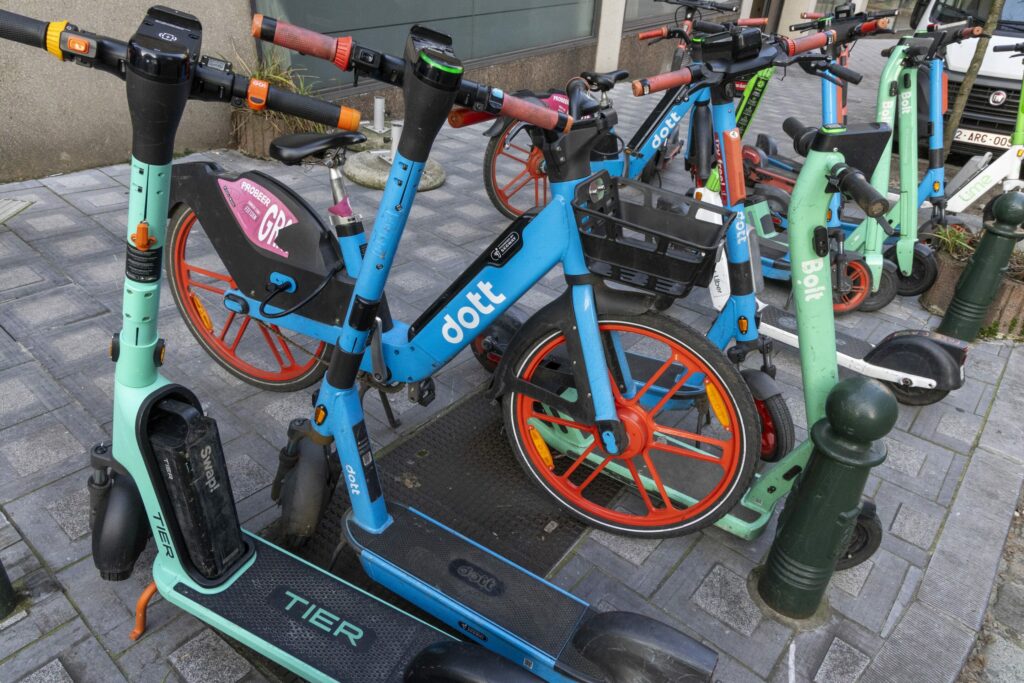
The Brussels-Capital Region announced last month that the licences of Bolt and Dott, the city’s two remaining shared e-scooter operators, will not be renewed when they expire at the end of 2026. From January 2027, shared scooters disappear from Brussels streets.
I should declare an interest, twice over. I was head of EU affairs at Bolt, so I know how this industry works from the inside: the good, the bad and the ugly (I no longer have any professional or financial connection with any scooter company). And I ride a shared scooter almost every day, because for the journeys I make, nothing else comes close.
So together with some other riders, we’re asking the Brussels government to think again: if you live here, please sign the official petition (you’ll need to sign in with itsme).
Filling the gaps
Brussels’ public transport network, for all its strengths, is built on radial spokes feeding the centre. If your journey follows a spoke, STIB serves you well. If it doesn’t, you are in transfer purgatory.
Schuman to Place Flagey, two of the busiest destinations in the European Quarter and Ixelles, has no direct line. Allow 20 minutes and walk to Maelbeek to get the 60. Seven minutes on a scooter.
Want to get from Parc du Cinquantenaire to Tour & Taxis? A five-minute walk, then metro, then bus, then another five-minute walk: 40 minutes in total. Less than half that on a scooter. Châtelain to Sainte-Catherine? Tram and a bus with a walk either side and 35 minutes if you’re lucky. A scooter does it in 15.
These are just some examples I looked up on Google Maps. Multiply them across every cross-municipal pairing that doesn’t pass through Arts-Loi, Rogier or Gare du Midi, and you have the demand scooters serve.
The case falls apart
Brussels’ Minister-President Boris Dilliès and Mobility Minister Elke Van den Brandt say they’ve based their decision on two factors: safety and crime. Neither argument stacks up.
The government uses a 26% increase in accident numbers from 2024-2025 to justify the ban, but doesn’t mention that the number of shared scooter trips also increased by 26%. The accident rate per trip didn’t move. If anything, the true rate for shared scooters is lower still, because the accident count includes privately owned scooters while the trip count only covers shared scooters.
And only shared scooters are being banned: the ones whose speed limits are locked by the operator. Private scooters are easily and routinely derestricted.
4,303 people were injured on Brussels roads in 2024 across all modes according to Brussels Mobility, including 951 cyclists. Of the nine people killed, six were pedestrians, and none of them were struck by a scooter. Nobody proposes banning bicycles, and nobody proposes banning cars.
What of the argument that shared scooters are a mainstay of organised crime? I can’t find any public source that substantiates the government’s claim that 25 scooters were involved in shootings. Even if they were involved, that’s no proof they were somehow responsible for the assault: it might just be that the police made enquiries about a scooter they saw on CCTV in the vicinity of a crime. I’m told by industry sources that’s not uncommon.
If the Brussels government truly believes that 25 shooters got away on rental scooters, as they seem to be implying, they should substantiate it. Shared scooters are the single most traceable vehicle on Brussels roads. Every trip is logged to a verified account, with GPS positioning accurate to a few metres, payment details attached, and data available to police on request.
Destroying what works to rescue what doesn’t
So why is Elke Van den Brandt – the Mobility Minister who brought in the current (very effective) regulation now proposing to set it all on fire? She seems desperate to save the ailing concession Villo!
There’s only one problem with Villo! It’s rubbish. The bikes are too heavy, there’s never sufficient capacity at peak locations at peak times, the app is terrible and the payment system frequently crashes. Van den Brandt knows all of this. In fact she posted most of it on Instagram as I was writing this.
The concession is currently held by JCDecaux and paid for in advertising space around the city: an arrangement the EU investigated under state aid rules, clearing the bike scheme but ordering JCDecaux to repay the city €2.5 million over billboards it had kept running without paying rent or tax.
It expires in September 2026 with the operator staying on until September 2028 to ensure continuity of service. No successor has been identified, no tender has been announced, and Brussels Mobility’s own comparative study scored the current system at 0.7 rentals per bike per day against a European benchmark of three to seven.
So when Van den Brandt says she’s giving Villo a ‘long awaited update’, the reality is that her solution is little more than a press release promising to do something about Villo 18 months after the scooter ban comes into effect.
By all accounts, the current system works. Way To Go – part financed by the Brussels Government to encourage shared mobility – praised how ‘well thought-out regulations lead to more efficient use’ of shared scooters. The city hasn’t had many wins recently: just look at the state of its finances or the Schuman roundabout debacle. They’ve got shared scooters right, but their reaction to this success is to burn it all down.
It makes no sense. Please sign the petition. Help save them from themselves.
