

Hidden behind the trees in Woluwe-Saint-Pierre lies one of Brussels’ most surprising royal connections – a forgotten court-in-exile linked to a dynasty that once helped shape the fate of Europe.
Taking tram 39 from Montgomery down Avenue de Tervuren, you pass the site on the right soon after the line splits from the 44 route and turns towards Stockel: a small chapel and iron gates marking the former entrance to Manoir d’Anjou.
Today it belongs to the Fraternités du Bon Pasteur, a community dedicated to hospitality, prayer and social projects. Yet for much of the 20th century it was something rather different: a court without a kingdom, home to French royal pretenders who still dreamed of returning to the throne.
The connection survives in the landscape. Square de Guise curls around one corner of the former estate. Avenue du Manoir d’Anjou runs towards Avenue Alfred Madoux. Inside the manor itself, visitors can still find royal heraldry, fleurs-de-lis and traces of a family that once considered itself France’s legitimate ruling house.
Few passers-by realise they are walking beside one of the stranger chapters of European history.
For centuries Brussels has attracted political exiles, dethroned rulers and ambitious dreamers. Victor Hugo found refuge here. Karl Marx passed through. Successive waves of aristocrats, dissidents and pretenders have used Belgium’s capital as a safe haven between Europe’s competing powers.
Among them were members of one of France’s most famous dynasties: the House of Guise.
A family that challenged kings
The Guise family emerged from the House of Lorraine, one of the great aristocratic families of late medieval Europe. Their rise began in earnest after the Battle of Nancy in 1477, when René II, Duke of Lorraine, helped defeat Charles the Bold and bring an end to Burgundy’s ambitions of establishing a powerful kingdom between France and the Holy Roman Empire.
His younger son Claude became the first Duke of Guise, establishing a branch of the family that rapidly accumulated wealth, influence and prestige.
Over the next century the Guises became among the most powerful figures in France. Francis, Duke of Guise, achieved national fame after recapturing Calais from England in 1558. His brother Charles, Cardinal of Lorraine, emerged as one of the kingdom’s most influential churchmen and political operators.
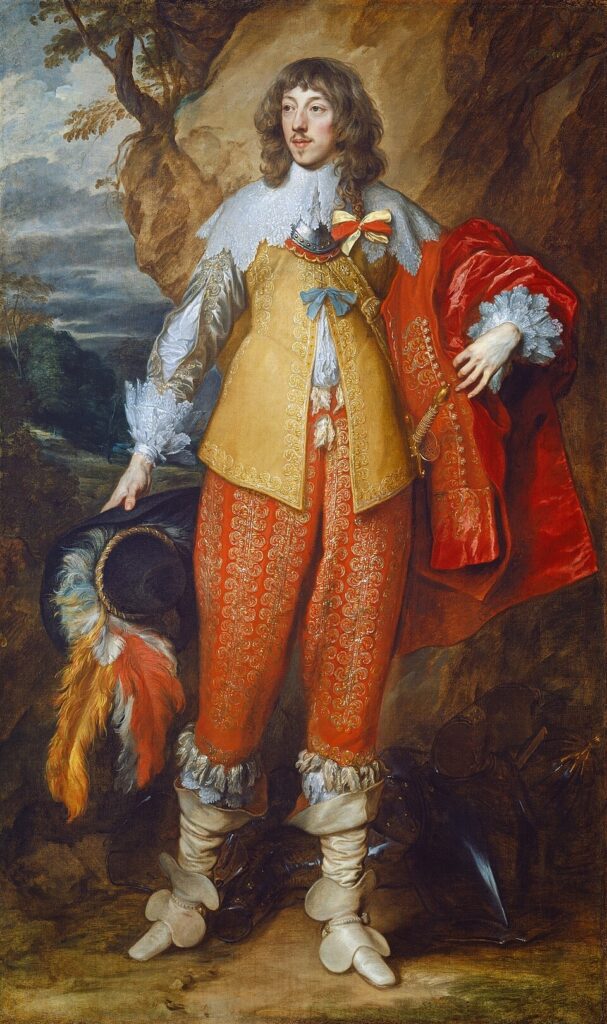
Henry II, Duke of Guise, painted by Anthony Van Dyck
The family’s influence reached beyond France. Through Marie de Guise, Queen Consort of Scotland, they became closely linked to Mary, Queen of Scots and the dynastic struggles that shaped relations between France, Scotland and England.
But it was religion that truly defined their legacy.
During the French Wars of Religion, the Guises became champions of militant Catholicism, leading the Catholic League and positioning themselves as defenders of the old faith. To supporters they were heroes. To critics they were dangerous extremists who sought power at the expense of national stability.
Their influence eventually faded, but not before they had left an indelible mark on European history.
And, unexpectedly, on Brussels.
Brussels: refuge for fallen princes
The city’s connection with the family stretches back much further than the avenues and street names of Woluwe-Saint-Pierre.
In 1641, Henri II, Duke of Guise, became involved in a rebellion against Cardinal Richelieu and the French crown. Condemned to death, he escaped to Brussels, then part of the Spanish Netherlands.
The episode established an enduring link between the family and the city. Brussels occupied a unique position: close enough to Paris to remain politically relevant, yet safely beyond the reach of French authorities. For generations it served as a refuge for nobles, princes and political exiles.
Nearly three centuries later, another branch of the same extended dynasty would once again find itself living in Brussels – not as fugitives, but as royal pretenders.
A French court in Woluwe
The modern story begins with Alfred-Casimir Madoux, the newspaper magnate who built a grand country residence on the site of the former Château de Putdael.
In 1913, several years after his death, the estate was leased to Prince Philippe d’Orléans, the Count of Paris and Orléanist pretender to the French throne. French law at the time barred former ruling dynasties from residing in France, forcing many members of the Bourbon and Orléans families into exile.
Belgium offered an attractive alternative.
Philippe was not arriving in unfamiliar territory. He and King Albert I were both descendants of Louis Philippe I, France’s last king. The proximity to relatives and fellow exiles, combined with the tranquillity of Woluwe-Saint-Pierre, proved irresistible.
He purchased the estate and renamed it Manoir d’Anjou.
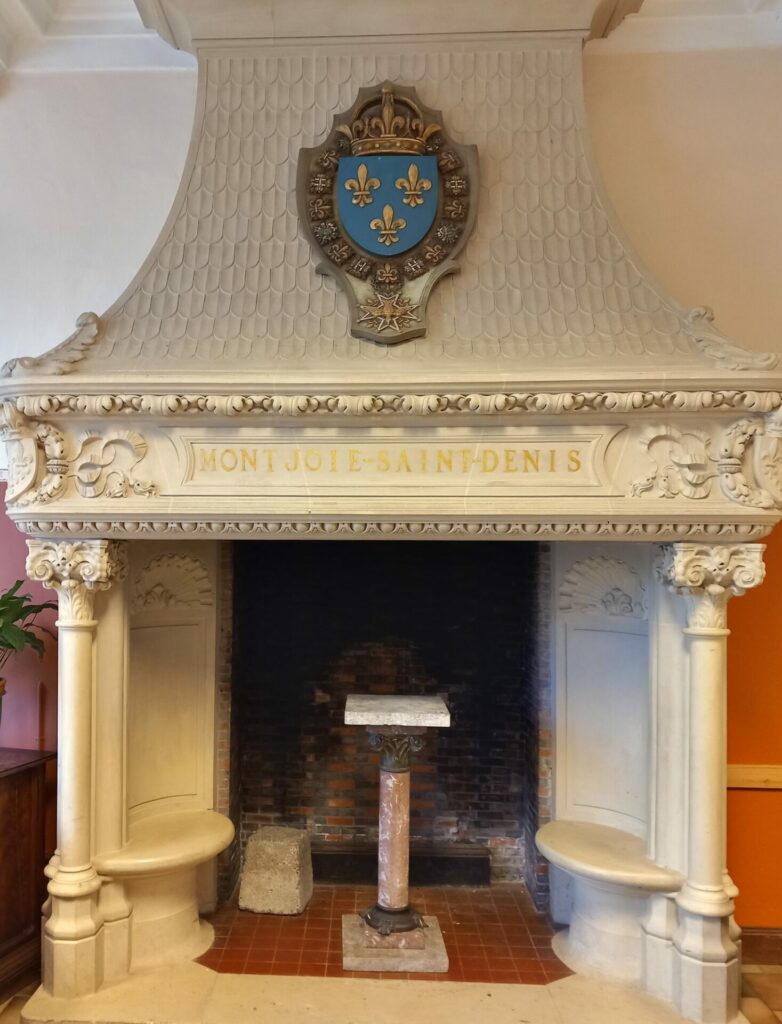
Fireplace bearing the House of France coat of arms and the inscription Montjoie-Saint-Denis, the traditional war cry of French kings
The property soon evolved into something far grander than a suburban residence. Philippe transformed the grounds into a princely domain, complete with ornamental landscaping, hunting grounds, water features and a museum devoted to his hunting trophies and polar expeditions. According to historian Marie-Thérèse Gelders-Michel, it housed one of Europe’s largest collections of mammals.
When Philippe died childless in 1926, the estate eventually passed to his nephew Jean d’Orléans, Duke of Guise and now head of the House of France.
Under Jean, Manoir d’Anjou became a de facto royal court-in-exile. While France remained a republic, supporters of the Orléanist cause continued to dream of restoration. From Woluwe, the Duke maintained contacts with monarchist intellectuals and political supporters while raising his family in surroundings that deliberately evoked a lost royal world.
The project was increasingly anachronistic. Yet it persisted.
In the 1930s, Jean sought to modernise the movement. Publications such as Courier Royal promoted a more liberal and socially conscious vision of monarchy. He issued political manifestos from Brussels and gradually distanced himself from the more extreme currents associated with Action Française. The House of France, he argued, should stand above partisan politics and represent all French people.
Events would soon overtake those ambitions.
War comes to the Manoir
As war approached, the family fled Brussels and eventually found refuge in Morocco.
The estate they left behind entered one of the darkest chapters in its history.
German forces requisitioned Manoir d’Anjou shortly after the invasion of Belgium. According to Gelders-Michel, a swastika was raised above the dome on July 1, 1940. The property became an important site for the Reich Labour Service, or RAD. Dormitories and mess halls were constructed, roads reinforced and military facilities added to the grounds.
The Duke never recovered. He died in August 1940.
Four years later the tide turned.
On September 3, 1944, British forces advancing through Brussels arrived at the estate and reportedly caught German personnel in the middle of their evening meal. Some escaped; many surrendered. The swastika and portraits of Hitler were replaced by the Union Jack and photographs of Field Marshal Montgomery.
The British subsequently transformed the estate into a transit camp and training centre. For a period after the war, Belgian recruits to the Royal Air Force passed through the grounds.
Like Europe itself, Manoir d’Anjou was reinventing itself.
A different kingdom
The post-war years brought another transformation.
After a period of neglect, the estate was acquired by the Sisters of the Good Shepherd before eventually passing to the Fraternités du Bon Pasteur, which continues to occupy it today.
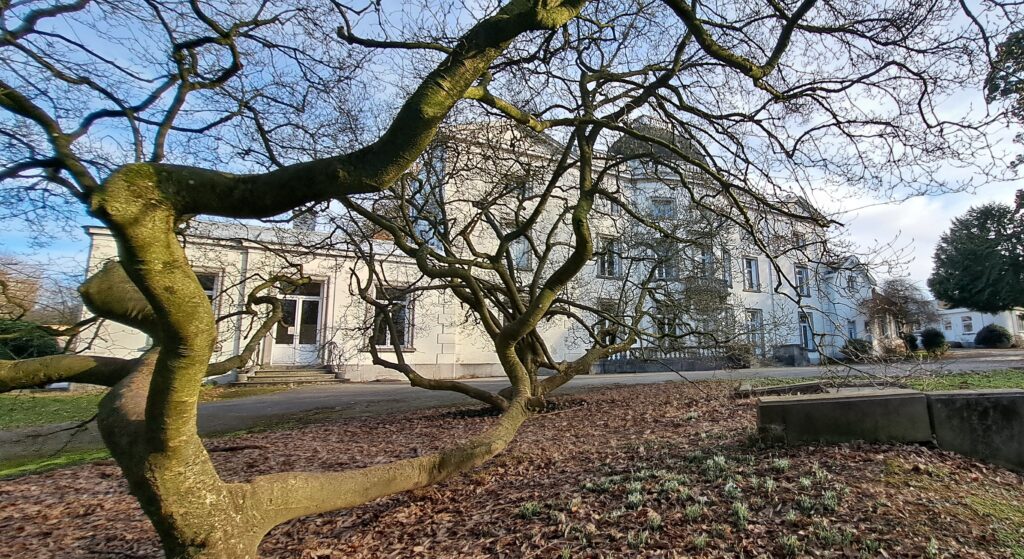
View from the rear
The contrast with its princely past could hardly be greater.
Where royal pretenders once plotted political futures, community volunteers now tend gardens and maintain biodiversity projects. The estate has become a Natura 2000 site, home to beehives, educational initiatives and social programmes. The Artos bakery and day centre supports people with intellectual disabilities. La Ferme d’Anjou introduces children to farming and environmental stewardship.
The manor itself remains busy. Its grand rooms host meetings, celebrations and community events.
“Fraternity members know they live in a unique place from a historical, environmental and social perspective,” Emanuele Caminada, president of the community’s non-profit association, says. Yet the organisation’s priorities lie elsewhere. “It is not the self-proclaimed kings of this earth, but the poor and the most vulnerable who are at the centre of our attention.”
Still, the past is impossible to miss.
Inside the refectory stands a large fireplace bearing the House of France coat of arms and the inscription Montjoie-Saint-Denis, the traditional war cry of French kings. Outside, the avenues and squares preserve echoes of the estate’s aristocratic past.
If the political ambitions of the House of Guise and their Orléans descendants ultimately came to nothing, their Brussels legacy proved unexpectedly durable.
The princes departed long ago. The court-in-exile disappeared. The dream of restoration faded into history.
Yet behind a set of gates glimpsed from a passing tram survives a reminder that Brussels has long been a city of exiles, pretenders and reinvention – a place where even fallen dynasties can leave their mark.
