

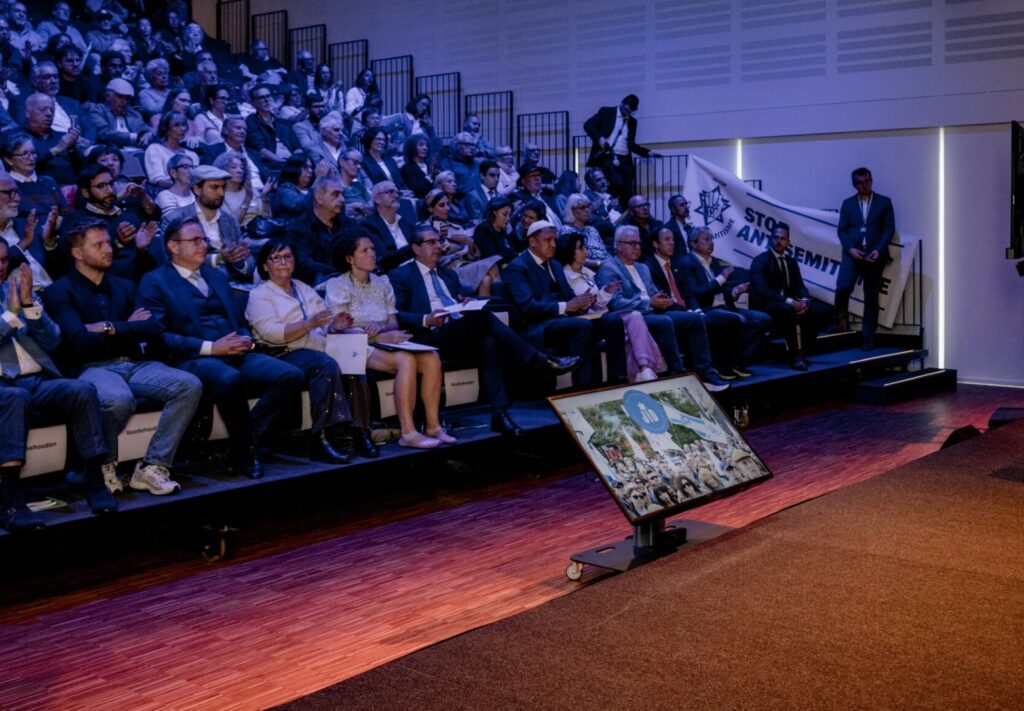
'Too politically sensitive.' With those three words, the event venue Vestar in Antwerp informed us last week that the Jewish Information and Documentation Centre (JID) was no longer welcome as a client.
Last year, we held a conference there on combating antisemitism and the future of Jewish life in Belgium. It was not a protest. It was not a political rally.
It was a conference where a rabbi and an imam spoke side by side, where political leaders from different parties—including Prime Minister Bart De Wever—were present, and where the discussion focused on dialogue, coexistence, and living together.
Security was entirely organised and financed by our own organisation, in close coordination with the police. There was not a single incident. Yet we have now been informed that future bookings by the JID will no longer be accepted. Our event is now considered 'too politically sensitive.'
I read those words several times and even called the venue to understand. Since when has fighting discrimination become political? Since when has defending a threatened minority become controversial?
The legal test
This is not merely a question of bad judgment or moral cowardice. It may also raise serious legal questions. Belgian anti-discrimination law protects equal access to goods and services offered to the public, including against discrimination based on religion or ethnic origin.
We are therefore examining whether refusing a Jewish organisation as a client constitutes unlawful discrimination. If it does, we will challenge it not only for the JID but also for other organisations. No peaceful organisation should be denied access to a venue because of who its members are or what they lawfully represent.
A recent Brussels judgment offers an important warning against allowing vague security concerns or anticipated protests to become an excuse for exclusion.
In January 2026, the French-speaking Court of First Instance in Brussels condemned the municipality of Saint-Josse-ten-Noode for unlawfully attempting to prevent a conference from taking place. The court found that the authorities should have considered measures to protect the peaceful event rather than suppressing it because opponents might disrupt it.
The legal circumstances are not identical: that case concerned a public authority, while Vestar is a private venue. But the democratic principle remains relevant. Those who threaten disruption must not be rewarded with a veto over peaceful assembly.
Lessons learned from WWII
My grandparents, during the Second World War, needed no explanation when they saw a sign reading 'No Jews allowed.' The message was unmistakable.
We like to believe those days are behind us. Such signs no longer hang on the doors of hotels, concert halls or conference venues. The signs have disappeared. The logic behind them has not; the message has merely become a bit more sophisticated.
This recent cancellation was not an isolated incident. In Antwerp in 2024, the publicly funded Monty cultural centre refused to rent its premises to a Jewish school for a celebration, explicitly referring to the war in Gaza. This was not an Israeli government event or political rally. It was a Belgian Jewish school seeking a venue for its pupils.
In Ghent in 2025, the Flanders Festival cancelled a concert by the Munich Philharmonic because its Israeli conductor, Lahav Shani, had supposedly not taken a sufficiently explicit position against the Israeli government. A musician was subjected to a political loyalty test based on his nationality.
Similar cancellations have also happened in other EU Member States. The cases differ, but together they reveal a disturbing pattern: Jews, Jewish schools, cultural organisations and Israeli artists are increasingly treated as interchangeable with the policies of the Israeli government. That confusion is itself discriminatory.
What once appeared exceptional is becoming disturbingly familiar. Other Jewish organisations tell similar stories: hotels withdrawing, conference venues suddenly becoming unavailable and locations deciding they would rather not host 'sensitive' events.
Today, nobody writes 'No Jews allowed' on a door anymore. Thankfully, such a sign would provoke national outrage. But for those who receive a carefully worded email declining their booking, the feeling is often exactly the same.
History rarely changes overnight. It changes through small decisions that, taken individually, appear reasonable. A venue prefers to avoid risk. A business owner finds it easier to say no than to defend a principle—not necessarily out of ideological conviction, but out of fear. And that is precisely where the danger lies.
The canary in the coal mine
Extremists no longer need to close the doors themselves. Fear does it for them. For centuries, Jews have been described as the canary in Europe’s coal mine. Miners once took canaries underground because the birds were more sensitive than humans to poisonous gases. When the canary stopped singing, everyone knew danger was imminent.
Not because the bird mattered more than the miners, but because it was the first to reveal that something was fundamentally wrong. The same is true of antisemitism. It is rarely just a Jewish problem when Jews no longer feel safe, begin hiding their identity or wonder whether they still have a place in public life.
It is often the first warning that a society is losing its moral compass. European history has demonstrated this repeatedly. The way a society treats its Jewish community says a great deal about the health of that society itself. Anyone who believes this concerns only Jews is mistaken.
Today, a Jewish organisation is turned away. Tomorrow, it may be another minority. The day after, anyone who falls outside what is deemed acceptable.
I am not writing these words to seek sympathy. I want my children and grandchildren to grow up in the same Belgium my non-Jewish friends want to inhabit: a country where nobody wonders whether they are welcome because of who they are. What frightens me most is that the question within the Jewish community has changed.
It is no longer simply whether we can rent a venue. Young parents wonder whether their children will be able to walk through the streets wearing a kippah without fear or whether they must hide their identity or name for their own safety. More families are beginning to say aloud what once seemed unthinkable: 'Perhaps we should leave.'
Not because they no longer love Belgium, quite the contrary. But because they are beginning to wonder whether Belgium still loves them. That breaks my heart.
My grandparents survived Auschwitz and, despite everything taken from them, believed their grandchildren would one day live freely in Europe. We were promised 'Never Again.' We were promised that the words 'No Jews allowed' would belong to history forever.
Ultimately, this article is not about one venue, concert, school celebration or film festival. It is not even about Vestar. It raises a more fundamental question: Are we still aware of what is happening when Jews once again begin asking whether there is still a place for them—not merely in a concert hall, but in Belgium itself?
The real problem is not when the canary stops singing. The real problem is when the miners decide that it is no longer worth listening to.
