

Europe is on a military spending spree, but will it spend its money wisely?
Europe’s leaders are starting to ask themselves hard questions after four years of war on Europe’s eastern flank have shaken governments from complacency and toward serious investments in defence.
Last week, as NATO leaders gathered in Ankara, the two most important figures setting Europe’s security agenda - Ursula von der Leyen and Mark Rutte - argued that the future of European security would depend on a European defence industry capable of producing “at scale and at speed.”
They’re right. But one of the biggest mistakes Europe could make would be spending these new resources on systems designed to fight the last war, rather than prevent or win the next one. Compared to a decade ago, modern warfare depends much more on agility, adaptation, interoperability, and – increasingly – a military’s software and technology capabilities.
Alongside the traditional investments in planes, tanks, and vessels, the challenges of today’s security environment will require Europe to invest in new and innovative ways of building up its defence capacity, particularly in the digital domain.
The War in Ukraine has taught Europe several of these lessons already. Scale still matters, for example, but speed has become a true differentiator for military readiness. Militaries used to equate capability with volume: more tanks, more ships, more planes.
Today, the advantage lies in the ability to innovate faster than competitors. Procurement timelines in Europe - constrained by national sign-off chains, incompatible rules, and lengthy requirements - are measured in years. Meanwhile the Ukrainian military has reduced the time from concept to contracting to a matter of months.
Traditional hardware such as artillery, armoured vehicles and air defence still matters, but those systems now operate inside a digitally enabled environment. The base layer of a new generation of military systems isn’t wheels or axels or engines, but software. The ability enabled by software to continuously adapt and improve capabilities, rather than waiting years for the next generation of hardware, has become a defining factor in a state's competitiveness.
What does that mean for European investment?
For one, defence software development must become a focus, and it cannot keep being developed in silos. Interoperability and interchangeability need to be a design principle, not an afterthought.
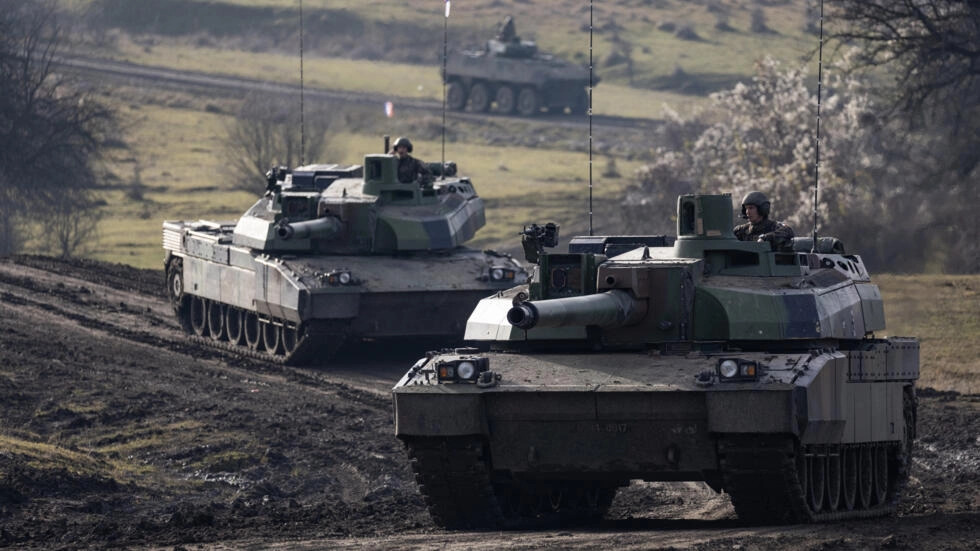
In 2022, a convoy of French Leclerc tanks was stopped at the German border: German roads limit axle load at twelve tonnes, and the French tank-transporters didn't have enough axles to distribute it. A trivial-sounding mismatch, and a preview of the problem Europe will have with software if it doesn’t adapt - systems built nationally that don't talk to each other.
One way to close that gap is for Europe to build important layers of defence software collaboratively, on a shared foundation, so that national systems can become interoperable without ceding control to any single vendor. Open-source platforms have had the greatest success in achieving this kind of collaboration, even in an industry as competitive as defence. For years now, BMW, Bosch, Mercedes-Benz and a host of software developers have been jointly building modular platforms with the Eclipse Foundation to speed the development of software systems inside vehicles.
The same success could be repeated in European defence to create a software infrastructure that bolsters sovereignty and cuts dependence on foreign licences and suppliers-one of the chief ambitions of the EU's Tech Sovereignty Package.
For industry players, open-source collaboration would mean an ecosystem that rewards early, sustained contribution with real influence, and systems that work for multiple European militaries. For the more than 230 European defence-tech start-ups founded since Russia's 2022 invasion, it would mean access to a market historically walled off by complex procurement and entrenched incumbents.
The defence world and “open source” might sound like an imperfect match, but with the right governance structures in place, an open-source platform provides the transparency to audit the unclassified infrastructure layer that classified proprietary systems sit on top of.
A more collaborative approach lets European actors move faster, learn from each other, and build interoperable capability without duplicating time, effort and money. If the base layer is developed together, governments and industry are freed up to invest more in the systems built on top of it.
Europe has already made the political decision to invest more in its defence. The emerging challenge is translating government investments into capabilities that can evolve as quickly as the threats they are designed to counter. That requires thinking differently about collaboration, procurement and innovation.
Von der Leyen and Rutte understand this point: “The only way to get [to credible deterrence],” they said, “is through cooperation: combining the efforts of countries and industries, allies and partners.” In an era in which software increasingly determines military advantage, the strongest foundation Europe can create is one that allows its nations, industries and innovators to move faster together than they ever could apart.
