

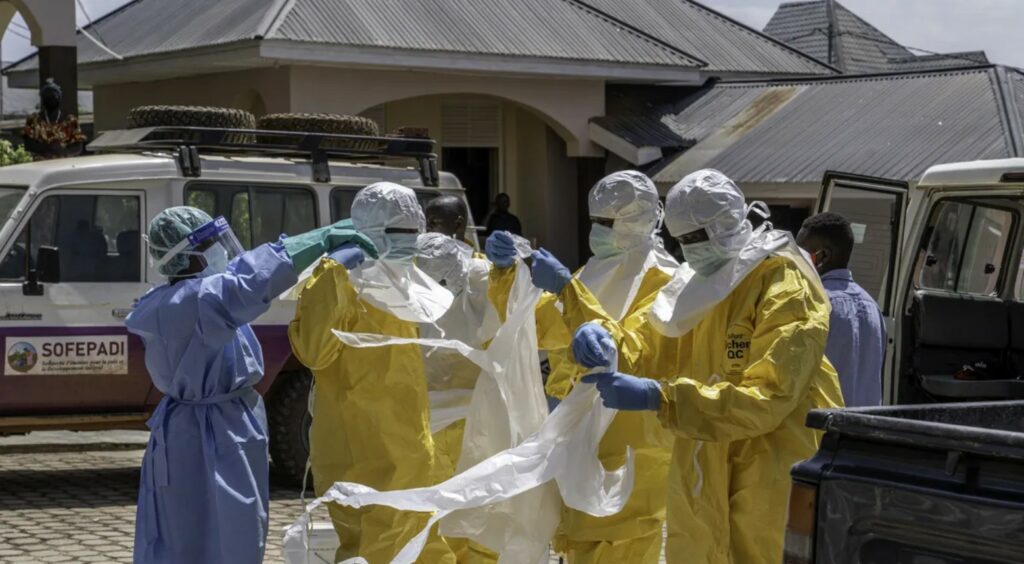
On April 24, a health worker in Bunia, in the Ituri province of the Democratic Republic of Congo (DRC), fell ill with fever and haemorrhaging. He died shortly after.
Three weeks passed before laboratories confirmed what his colleagues had feared: Bundibugyo ebolavirus, a rarer and less studied cousin of the Zaire species that reached Madrid and London in 2014.
By the time the World Health Organization (WHO) declared a public health emergency of international concern on May 17, the outbreak was already the DRC’s third-largest Ebola surge since the turn of the century. By July 20, the European Centre for Disease Prevention and Control was counting 2,423 confirmed cases and 967 confirmed deaths.
The gravity of this outbreak has far less to do with pathogen behaviour than with how the systems meant to catch it early have been left to collapse. That failure traces, with uncomfortable precision, back to financing decisions made by donor countries’ bureaucrats thousands of kilometres from Bunia.
The early-warning system that disappeared
Three weeks between a death and a diagnosis is not, in the end, a verdict on the virus. The Bundibugyo ebolavirus is no more lethal today than it was when it last surfaced in the DRC in 2012. What has changed is everything around it. An early-warning system can be a public health worker trained to spot an unusual cluster of symptoms.
It can be a laboratory technician certified to package infectious material safely. It can be a phone call between two community health workers from neighbouring towns. All of these pieces are needed for the system to work and, in the region, many of them rely on foreign assistance.
The problem here is that prevention successes generate no headlines, no political reward, and no institutional memory of the investment that made them possible. Strip out the funding and the pieces start to vanish, quietly, until a health worker in Bunia dies of a disease that should have been flagged weeks sooner.
The funding cuts behind the crisis
In 2025, the United States government effectively dismantled its foreign aid agency, USAID. American development assistance to the DRC fell from nearly $1.2 billion in 2024 to $715 million in 2025. Within that year, the collapse kept accelerating, with just $67 million arriving in the final three months.
The International Rescue Committee, which had covered five health zones across Ituri, could sustain only two once the funding disappeared. This is the first major epidemic to test what global health security looks like now that USAID has effectively left the room.
With health aid from European countries now sitting 63% below its 2022 peak while key donors like France, Germany, and the United Kingdom break their almost uninterrupted 25-year upward trend in development funding, it has become increasingly clear that no one is coming to fill the gap.
Why Europe’s current approach is insufficient
In fact, Brussels' answer to the health security question, very much rooted in the experience of the COVID-19 pandemic, has been to storm-proof its own house. HERA, the EU's Health Emergency Preparedness and Response Authority, was created in 2021 to secure Europe's own capacity to manufacture and access vaccines and medicines.
While the Commission is not entirely wrong to speak proudly of this mechanism, such an inward-looking approach has a worrisome blind spot. It ultimately fails to account for the inherently global nature of health crises, where no single region can truly isolate itself from cross-border threats. Investing in Ituri's laboratories, trained personnel, and cold-chain logistics is self-interest correctly understood, not charity.
The outbreak in Ituri will eventually be contained, at a cost measured mostly in lives whose stories will never travel far from Bunia. But the argument it makes travels further, and it comes down to three elements.
First, there is no real health security, for EU member states or for anyone else, without an effective system to detect outbreaks and respond before they cross borders. Second, the regions most vulnerable to the next viral jump from animals to humans are precisely the ones where public health systems rely on foreign aid, which most domestic budgets cannot yet replace. And third, Europe cannot keep treating health aid as discretionary while other donors play Russian roulette with it, standing by as a silent witness to the demise of a global health architecture that took decades to build.
If Brussels wants to be serious about health security, it must step up to anchor the global health system and fund the sometimes invisible, unceremonious threads that keep it together.
