
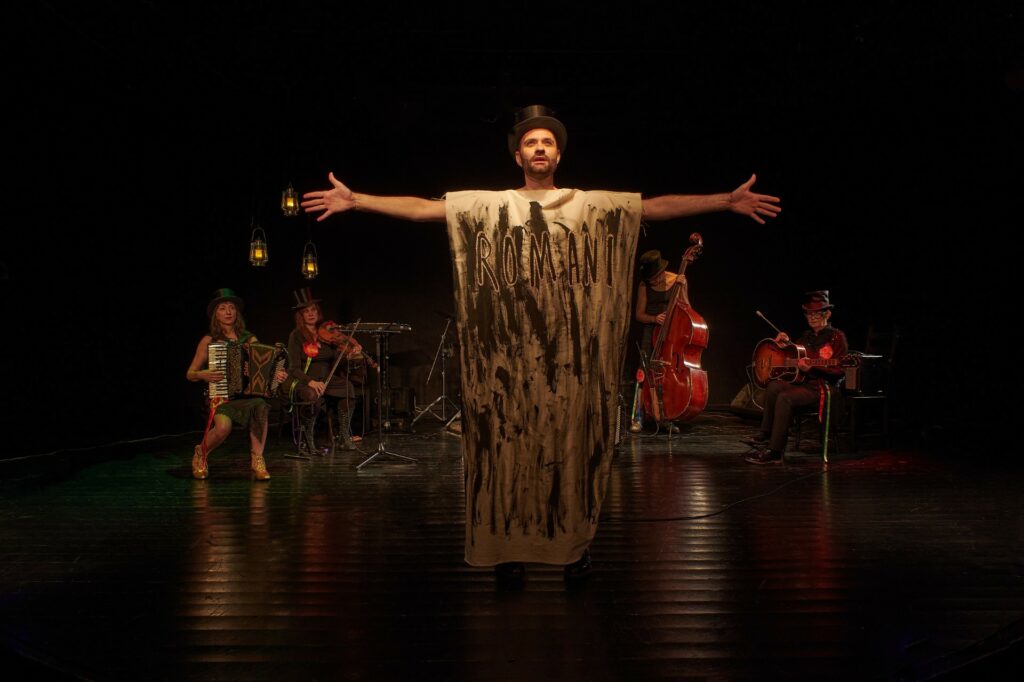
In connection with this year’s Roma Holocaust Memorial Day, the European Roma Institute for Arts and Culture (ERIAC) opened the exhibition “You Are All Our Children in One” at its premises in Berlin. The exhibition will run until 13 November 2026.
Nazi-Germany enacted the “Law for the Prevention of Genetically Diseased Offspring” in July 1933, allowing for forced sterilisations. The exhibition examines how racial classification, forced sterilisation, and biological determinism that underpinned the Nazi genocide of Roma and Sinti did not end with the war but continued to shape policy, science, and public attitudes even today.
After the war, coerced sterilisation of Romani and Traveller women continued in some countries, e.g. former Czechoslovakia, as part of population-control policy. In Sweden, which managed to stay out of the war, an Institute for Racial Biology was set up already in the 1920-ies. It targeted Roma and other groups deemed "racially inferior" or “anti-social”. Coerced sterilisation was abolished only in 1976.
“Fascism is never simply a chapter in history books. It begins with words, stereotypes, indifference, and the gradual erosion of democratic values,” said Anna Mirga-Kruszelnicka, Executive Director of ERIAC. “Honoring those who were murdered is not enough. We must also recognize how quickly democratic societies can unravel when prejudice, dehumanization, and political extremism become accepted.”
Through the work of artists Lindy Larsson from Sweden, Emília Rigová from Slovakia, and Zsófia Takács from Hungary, the exhibition brings together three distinct artistic practices to confront this history and its contemporary echoes.
The Brussels Times asked Lindy Larsson about his autobiographical performance Tschandala – The Romani Version.
How have your experiences in Sweden influenced your identity and inspired your artistic career?
I come from a very proud Traveller family and have always been proud to belong to the Romani minority. But that pride was something we kept within the family. I knew that other people thought it was something shameful and bad to be a Traveller. All of us siblings were bullied and singled out when we were children because we were Travellers.
I had a very tough time at school, but when I was 13, we moved from southern Sweden to northern Sweden. To a place where no-one knew who we were. And I remember it was such a relief that people didn't know us as that "Gypsy family".
As an adult, I have always been open about my background. I have talked about it in several interviews, written articles in newspapers and participated in various anthologies. My background in the Traveller community has influenced my artistic work a lot. With my band Lindy & Bon Bon Band, we sing and play a lot of music with roots in the Traveller and Roma tradition.
And after 2017, when I went to Berlin and participated in the performance Roma Armee at the Maxim Gorki Theater, it became even clearer.
I know that there are people who feel limited when they are described as Roma artists or when their art is put in a specific compartment. I can really understand that. As an artist, you want to be able to move between different expressions, contexts and layers, and therefore such labels can sometimes feel problematic.
For me, it’s different. When I say that I am an artist who belongs to the Romani minority, I do not feel limited – I feel bigger.
Your autobiographical theatre performance Tschandala has attracted a lot of attention. In it, you deal with the racist prejudices in a short story from 1889 by the well-known Swedish author August Strindberg. How would you describe your message?
I think it’s important that each group has its own voice. That everyone gets to tell their own story. When I made the performance Tschandala - The Romani Version, the goal was to make the Traveller people and our history in Sweden visible, since it was a blind spot that almost no one knew about. It felt important that we Travellers were allowed to speak out and tell what happened.
The reception has been overwhelming and very positive. Many people only vaguely knew about the forced sterilizations and the forced care of our children, which have hit our group particularly hard, and most were both outraged and deeply moved by it.
We premiered at Strindberg's Intima Teater in Stockholm and the performance was a success with fantastic reviews and completely sold-out performances. It has been awarded several prizes. Tschandala has been performed in Berlin, Vienna and Budapest. This autumn it will be staged at the Royal Dramatic Theatre (Dramaten) in Stockholm.
Has the situation for Roma and their integration in Sweden improved in recent years compared to other minority groups?
The Roma minority in Sweden consists of different Roma groups. So, the challenges look different for the different groups. The biggest problems today for us Travellers are not really about what is happening today, but about our history.
In the past, the goal of the authorities was to divide and wipe us out and in a way they succeeded. We still suffer from this trauma. It will take many generations to heal an ethnic group that has been abused as ours. We have lost much of our language and many of our traditions because we had to adapt, or risk being locked up or sterilized.
It’s difficult to want to become part of a society that has never really accepted us. But we ARE also part of the majority society - the problem is that we are not visible. For some, there is still a stigma to being a Traveller. But something has happened in recent years. More and more people are open about their origins and that is so important for our group.
