

The financial arrangements between Jordan and an international consortium for the construction of the Aqaba-Amman Water Desalination and Conveyance Project (AAWC) were recently finalised. Despite the project’s possible impact on the Red Sea, no formal consultation with Israel has taken place.
The desalination plant will be built in Jordanian water at the northern tip of the Red Sea. Besides its strategic importance, the Gulf of Aqaba or Gulf of Eilat is known for its marine system with the world's northernmost shallow-water coral reefs.
The project is Jordan's primary response to its severe water scarcity and is planned to supply 30% of Jordan’s overall water demand and 40% of its municipal drinking water needs. It is valued at close to USD 6 billion and co-financed by the EU and other international partners.
It is designed to produce 300 million cubic metres (MCM) of drinking water per year. A 438-kilometer underground pipeline system will transport 250 MCM water from the south to Jordan’s capital Amman and other governorates. 50 MCM will supply Aqaba.
After the closure of the financial arrangements, the consortium led by French companies Meridiam and Suez will start the works this year. The consortium will design, construct, finance, operate and maintain the AAWDC project for 30 years.
In fact, ground preparation and preliminary construction on the marine works and pipeline tracks have already kicked off, according to the European Bank for Reconstruction and Development (EBRD). The bank has provided a senior loan of up to USD 475 million.
The project was originally planned to be finalised in 2030 but has reportedly been delayed and a more realistic deadline is 2032. Contrary to the “Red Sea–Dead Sea Project”, which involved Israel and the Palestinian Authority, no water will be diverted to tackle the sink holes and shrinking sea level in the Dead Sea and save if from an ecological disaster.
The AAWDC project uses the same technology as other desalination plants. To achieve the required output, with a recovery rate of 40 – 50%, the plant will have to process 600 – 750 MCM of sea water. The plant is much bigger than the “mega-size” desalination plants along the Mediterranean coast that supply most of Israel’s fresh water.
“The discharge of brine back into the sea is a cause for concern,” commented Eli Raz, a well-known Israeli geologist living in kibbutz Ein Gedi opposite the Dead Sea. “Apart from the AAWDC target of 300 MCM of fresh water, the amount of discharge is not clearly stated.”
“I can only estimate that with the reverse osmosis method (the leading technology for modern water desalination) about 750 MCM of seawater must be pumped from the sea and about 450 MCM of brine concentrate discharged to the sea.”
The coral reefs in the Gulf of Aqaba are important from both ecological and tourist viewpoints. They are also known to have a higher tolerance to climate change than other coral reefs.
This is another reason why they need to be protected as they also serve as a “genetic warehouse” for other less resilient coral reefs such as the Great Barrier Reef in Australia. In a recent report, the UNESCO World Heritage Committee recommended against listing the reef as in danger despite concerns over widespread coral bleaching.
Crucial impact assessment
Asked if an environmental impact assessment has been carried out, a European Commission spokesperson referred to the Environmental Social Impact Assessment (ESIA) by the European Investment Bank (EIB) in 2022. According to the Commission, the assessment was conducted in line with international best practices and EU environmental and social standards.
The report, which was updated last year, states that the AADWC project will use a high-velocity multi-port diffuser system to quickly dilute and dispose the brine, so that it will have minimum effect on the salinity in the gulf. The project also incorporates a dedicated 281-megawatt solar power facility to directly feed the desalination plant.
“The Jordanian government is aware of the importance of the coral reefs,” commented a researcher at the Arava Institute, a joint Israeli-Jordanian-Palestinian institute for environmental studies.
"The gulf receives direct, high-level attention during official visits to Aqaba," he added. "State leaders actively champion coral protection by participating in sea cleanups, launching preservation projects, and engaging in global advocacy. Protecting these reefs is vital for Jordan, which is precisely why the country enforces a zero-discharge policy in Aqaba."
“Based on the impact assessment of the AAWDC Project, yes, there is a risk to coral reefs and fish species in the Red Sea,” commented EcoPeace Middle East, “but the assessment concluded that the project has been designed with significant mitigation measures to reduce these risks to negligible or low levels.” EcoPeace brings together Jordanian, Palestinian and Israeli environmentalists.
While regulatory bodies in Jordan have approved the impact assessment report, inquiries indicate that Israel has not yet been officially consulted although the desalination plant will affect neighboring Eilat and the Red Sea. Jordan has gone at some length according to a Project Stakeholder Engagement Plan to engage domestic stakeholders and vulnerable groups that might be affected the project.
Israeli authorities including the ministry of foreign affairs declined to reply to questions whether Israel has been consulted on the AADWC project and whether it plans to revive cooperation with Jordan on restoring the Dead Sea.
“Regarding the desalination plant in Aqaba, this is a Jordanian project aimed at supplying water to Jordan,” a spokesperson of the ministry of Energy and Infrastructure commented. “The restoration of the Dead Sea and the area is a national mission, and Israel periodically examines ways and steps to help preserve the area and the sea.”
Political tensions
According to EcoPeace, the prospects for renewed Israel-Jordan water and energy cooperation remain uncertain, shaped by a complex mix of geopolitical tensions and evolving public sentiment. “The problem lies in the Israeli-Jordanian relations,” Eli Raz, the Israeli geologist, commented.
“While the two countries have a history of collaboration, recent regional events have strained relations and fueled widespread opposition to normalization among the Jordanian public, making any revival politically delicate,” EcoPeace explained. “At the same time, Jordan's persistent water challenges create an underlying rationale for continued dialogue.”
Water cooperation was part of the 1994 Israel-Jordan peace treaty. It included provisions for Israel to supply Jordan with 50 MCM yearly water from the Sea of Galilee. However, political relations between the two countries have been strained during Benyamin Netanyahu’ years in power and in particular after 7 October 2023.
In 2021, the short-lived Israeli “government of change” agreed to double the amount of fresh water to Jordan. That agreement has expired without being renewed in July. A meeting between Prime Minister Netanyahu and King Abdullah could have solved the issue but neither side was keen to meet.
Another project is currently on hold. The "Blue Green Prosperity" project was agreed in 2022 and involved Israel, Jordan and the United Arab Emirates. The core idea was a water-for-energy exchange. The Emirates would finance the building of 600 MW of solar power capacity in Jordan for export of energy to Israel. In return, Israel would supply Jordan with 200 MCM of desalinated water annually.
A third project, the Red Sea-Dead Sea Water Conveyance project, was abandoned in 2021 following obstacles in both countries. The primary goals of Red Sea-Dead Sea project were to stabilize the shrinking Dead Sea and to provide desalinated water to the region by building a pipeline between the two seas.
The Jordan river has in the past been a major supplier of water to the Dead Sea but this is not the case any longer because of the massive diversion of water from the tributaries to the river. Any plan to save the Dead Sead must come up with an innovative solution how to replace that missing water flow.
Another problem is the extraction of minerals in the southern basin of the Dead Sea by both Israel and Jordan. According to geologists, the extraction is responsible for over 40% of the annual water loss in the northern basin. This figure will continue to increase because water is pumped from the northern basin, which gets smaller, while the industrial evaporation ponds in the south stay the same.
“Jordan understands the need of water cooperation, both in the Red Sea and the Dead Sea,” added the Arava Institute. “Cooperation would create interdependencies between the two countries and strengthen the peace treaty between them.”
Options for the Dead Sea
The shrinking water level in the Dead Sea continues to raise serious concerns about the sea and the future of surrounding local communities. During the latest years, the level has dropped by 1.15 meters on average and is now down to about 440 meters below the surface level of the world’s oceans. The shores of the Dead Sea are the lowest point on Earth.
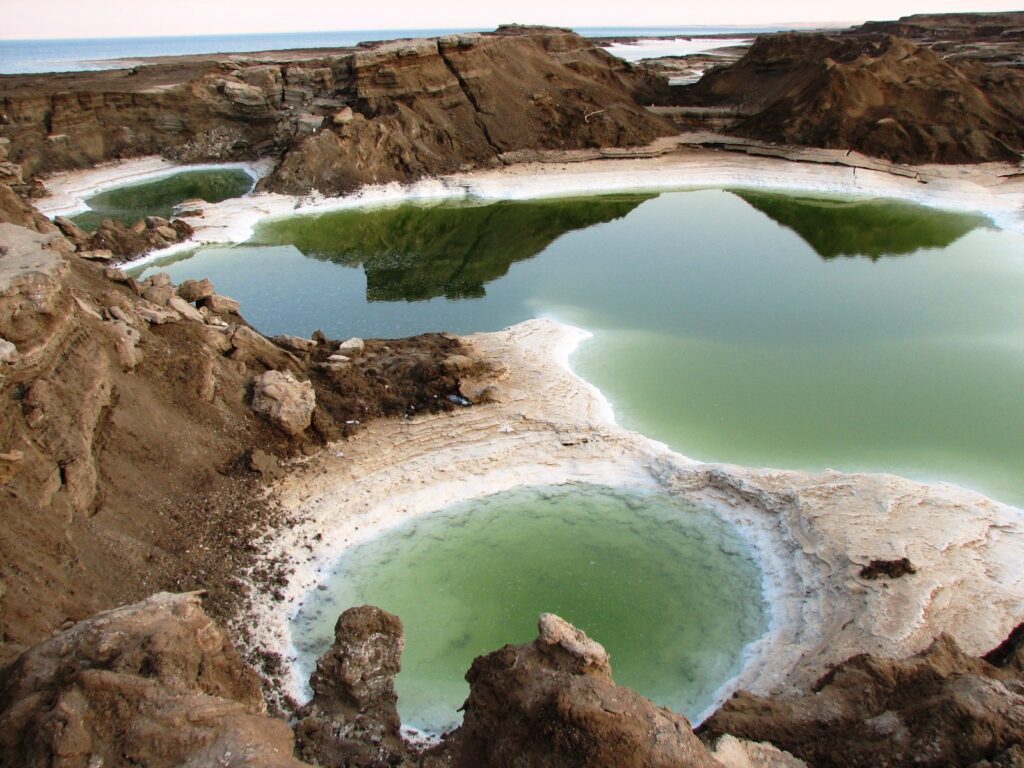
In the northern part of the Dead Sea, the falling water level has led to the appearance of sinkholes on both the Jordanian and Israeli sides of the lake.
The first sinkholes appeared in the 1980s and have since become more numerous. The number of holes is estimated at 6,000, some of which are 15 meters deep and 25 meters wide. Bridges and roads have collapsed and large areas have been blocked off.
Experts are divided on the most suitable solution but it is obvious that it requires Israeli-Jordanian-Palestinian cooperation. The sinkholes are a shared Israeli-Jordanian environmental problem, but the Palestinians are also affected because the northern part of the Dead Sea area belongs to the occupied West Bank.
One option was to bring desalinated fresh water from the Mediterranean Sea to the Lake of Galilee and from there down the Jordan river to the Dead Sea. Eli Raz does not believe any longer in this solution.
“The numerous desalination plants emitting brines and air pollutants along the Mediterranean coast threaten the carrying capacity and the ecology of the coastal and marine environment, limit alternative uses, some of which are important for human well-being. It is not certain that it is possible, and perhaps not even appropriate, to rehabilitate the Dead Sea at the expense of the overburdened coastal plain.”
The main option was the Red Sea-Dead Sea Project. The World Bank financed a feasibility study using dozens of researchers and experts to understand the scenarios expected in the Dead Sea as a result of implementing the project.
The project would have included desalination as well as conveyance of reject brine from desalination with or without additional volumes of seawater to the Dead Sea. The project also envisaged generating hydroelectric power utilizing the 430-meter drop in elevation between sea level and the Dead Sea basin.
“Clean and renewable energy for desalination of seawater, and the use of their by-products to stabilize the level of the Dead Sea, are significant environmental benefits of the project but the feasibility of its implementation is subject to agreements between the entities sharing the Dead Sea basin, more than to their financial capabilities.”
The final report was submitted to the partnership in 2021, along with a recommended outline for implementation. However, an agreement on its implementation was never signed by the parties. The Red Sea-Dead Sea project requires cross-border cooperation that may promote peace and stability.
EU support to Jordan
Such cooperation would be in line with EU’s declared policy to use its economic and political toolbox and leverage to promote peace in the region by supporting common infrastructure projects and management of critical resources such as energy and water. That was also one of the overriding objectives of the Pact for the Mediterranean which the EU launched last year.
The Pact is expected to provide a new impetus to the EU engagement in the Mediterranean region. It includes ten Southern and Eastern Mediterranean partners, among them Egypt, Israel, Palestine, Jordan, Lebanon, and Syria. So far, the Commission has not updated its action plan to include Israel-Arab water and energy cooperation.
In fact, the Commission is showing lukewarm interest for such cooperation. Instead, the EU is currently focusing on strengthening its cooperation with Jordan . During a round-tour to the Arab countries in the region last January, EU leaders and King Abdullah met in Amman for their first ever bilateral summit since the signature of a Strategic and Comprehensive Partnership.
Jordan’s minister of investment met recently EU ambassadors to prepare the Jordan–EU Investment Conference on 19 November. Both King Abdullah and European Commission President von der Leyen will attend the conference.
The conference will take place at a convention centre off the eastern shores of the Dead Sea. The location of the conference could offer an opportunity to revive the talks on saving the Dead Sea but this is not on the agenda.
Is the public opinion in Jordan ready for a renewal of Israel-Jordan water-energy cooperation? “Regional events have fueled widespread opposition to normalization among the Jordanian public, making any revival politically delicate,” commented EcoPeace.
“At the same time, Jordan's persistent water challenges create an underlying rationale for continued dialogue, even as the government explores alternative sources to reduce external dependencies.”
