

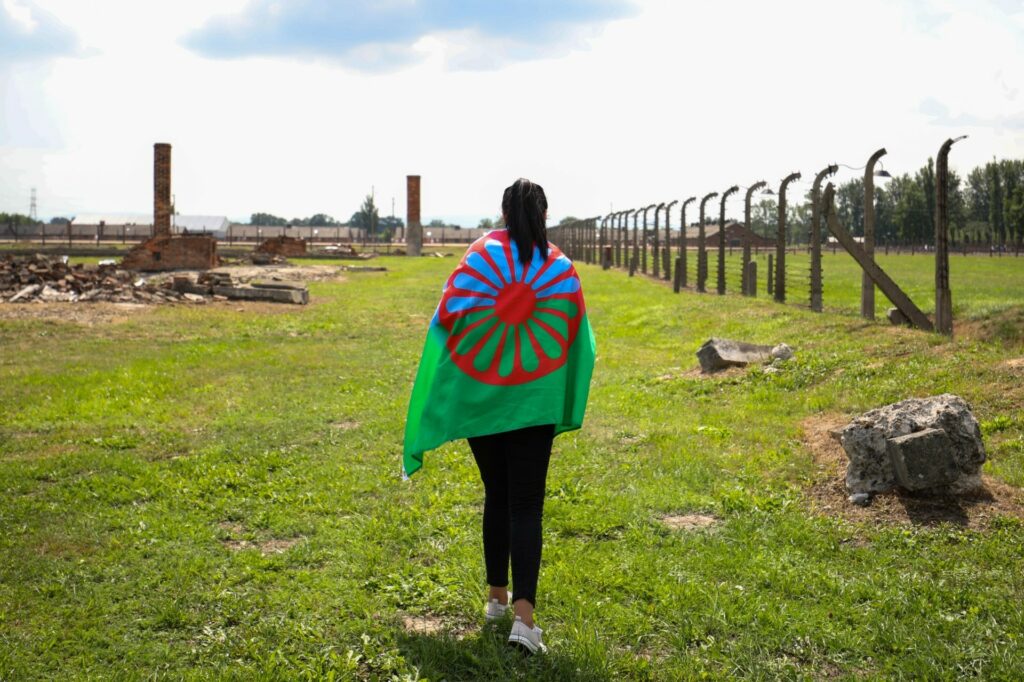
'I'm afraid that Europe is forgetting its past and that Auschwitz is only sleeping. Antigypsyist threats, policies and actions worry me greatly and make me very sad,' said Ceija Stojka, a Roma Holocaust survivor and artist (1933 – 2013).
Ceija Stojka knew what she was taking about. She was not imagining the future in an abstract way. She was reflecting on the reality of what she knew. Deported as a child, she survived Auschwitz-Birkenau, Ravensbrück and Bergen-Belsen. She knew that what made Auschwitz possible can be repeated in different forms and narratives.
Roma communities have carried that warning alone for almost 80 years. On the night of 2 August 1944, the Nazis liquidated the so-called 'Gypsy family camp' at Auschwitz-Birkenau. About 4,300 Roma and Sinti men, women and children were murdered in a single night. It took Europe seventy-one years to give that night a name.
After the war, Roma Holocaust had no real name. It remained at the margins of Europe's collective memory, because postwar Europe spent decades refusing to classify Roma Holocaust as racially motivated at all. Roma survivors were rarely believed, rarely compensated, and almost never asked to testify. Their persecution was overlooked in public education, historical research and political commemoration.
Governments were slow to even call it what it was and in the end the recognition never came automatically, it was fought for. It took years for Roma-led organisations to advocate before it became recognised. That fight to get the Roma Holocaust recognised uncovered something bigger, antigypsyism didn't end in 1945.
Remembering the Roma Holocaust means confronting the same racism which still is shaping Roma lives across Europe today.
Recognition of Roma Holocaust not enough
In 2015, the European Parliament finally recognised the Roma Holocaust and called for a day to remember it as European Roma Holocaust Memorial Day, celebrated on 2 August. But unfortunately, we are still witnessing the ongoing denial and lack of recognition of Roma Holocaust, mainly because parliamentary recognition did not automatically become political recognition across Europe.
The memory rests on a very thin archive: few recorded interviews, fewer published memoirs, fewer trials that ever took place. It leaves a gap in public understanding of our shared history. These missing stories are not incidental They reveal a deeper pattern of exclusion. Simply put: if no one records what happened to you, no one has to reckon with it. And if you're not named, no one has to answer for what happens to you.
Right now, as we light candles for 2 August, Europe is entering a period defined by war, geopolitical instability, economic uncertainty and growing pressure on democratic institutions. Defence, competitiveness and security increasingly dominate political debate. Across the Union, funding for equality, fundamental rights and civil society is under growing pressure.
Programmes are being consolidated, priorities redefined and organisations working on human rights increasingly asked to justify their continued relevance. In this landscape, Roma rights are once again becoming easier to overlook, not because discrimination has disappeared, but because other priorities are pushing them aside.
Earmarked funding to Roma missing
The EU is negotiating its next long-term budget, the Multiannual Financial Framework (MFF) for 2028–2034. It is, by design, one of the least visible fights in Brussels. This is where rights get funded or quietly disappear.
In the current draft of AgoraEU, the programme meant to cover EU funding for culture, media, and democratic participation, antigypsyism is not named at all. Although the European Commission has long recognised it as the specific form of racism directed against Roma, the term is absent from the proposed programme.
ERGO Network and its member organisations have asked for change: to explicitly name antigypsyism. If antigypsyism is left out of the text, Roma organisations will predictably be deprived of EU funding. Not through any single decision, just through the ordinary mechanics of a seven-year funding cycle running exactly as written.
Historical atrocities should never be used as casual analogies for contemporary policy debates. But the underlying pattern deserves attention, because it has the same failure mode: If you are not named, no one has to answer for what happens to you.
The Roma Holocaust was possible in part because, long before Roma were deported and murdered, they had already been excluded from public life, criminalised, stigmatised and denied equal protection. Exclusion came first. Violence followed and recognition came much later.
Naming a specific form of racism is not just about terminology. It's about recognising a distinct pattern of discrimination, so institutions can actually track it and act against it.
For decades, Europe failed to fully recognise the Roma Holocaust as part of its own history. Now it faces a similar test: whether it is willing to recognise antigypsyism not just as something from the past, but as happening now that needs real political action.
Memory only means something if it changes what a government is willing to commit to do. Otherwise, 2 August is just a date tbat the EU is comfortably observing because it was an atrocity committed in 1944 and only requires remembering and honouring the victims. Without influencing today's political choices, such commeration weakens what the remembrance was supposed to protect.
