
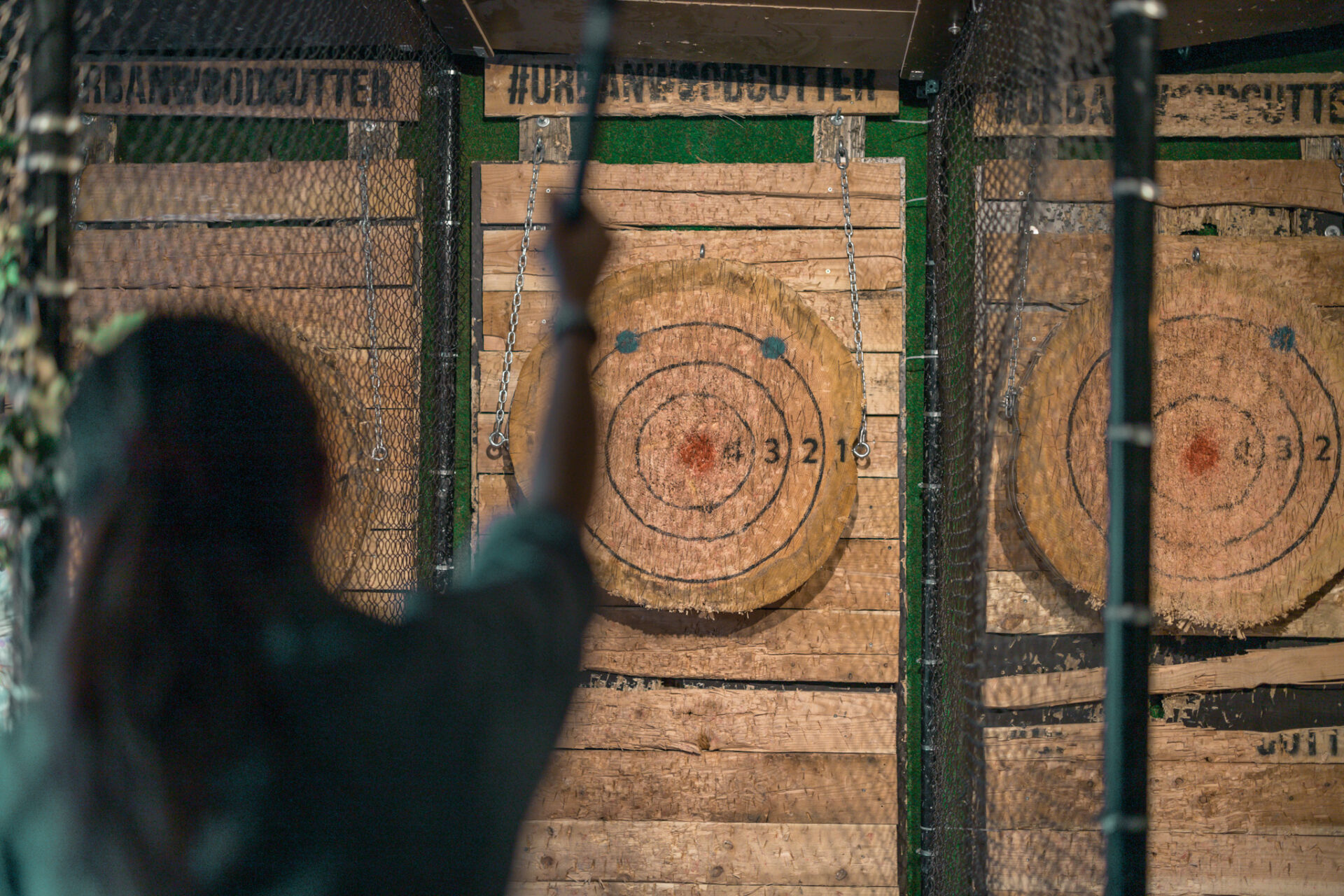
Brussels has spent decades defined by its beer, its bureaucrats and its chocolate. That image is crumbling. Across the capital and its surroundings, a new generation of leisure venues is offering experiences that are louder, sharper and considerably more cathartic than anything a praline can provide.
This is a city where you can hurl a steel axe at a pine target, fire a replica Navy SEAL assault rifle between cocktails, or spend 45 minutes smashing bottles against a wall until the grief or fury or low-level frustration you've been carrying around for months finally has somewhere to go.
The entrepreneurs behind these ventures – among them serial leisure founder Julien Vandenitte, whose portfolio now spans axe-throwing and a shooting-range bar, and former Belgian military man Gregory Rassios, who built his own complex from a derelict tram depot – are betting that locals are hungry for something more visceral. The evidence suggests they are right.
Axe-throwing: finding your inner lumberjack
Belgium came late to the global axe-throwing craze. When Julien Vandenitte opened Woodcutter in Brussels in 2019 – the country's first axe-throwing bar. He had already founded an escape room and was actively hunting for activities that pull people away from their screens and back into their bodies. A reconnaissance trip to Lille with his friend and future business partner Romain was all the convincing they needed: five minutes into their first-ever session, they looked at each other, high-fived, and that was that.
The venue reflects Vandenitte's instinct for the tactile. There is a lot of wood and metal in the interior – rough surfaces, a Japanese burned-wood element with a smooth leather-like finish at the bar – and a deliberate absence of digital gloss. Many axe-throwing venues elsewhere lean into gamification: projected targets, augmented reality, digital scoring systems.
Woodcutter does none of this. Players learn to throw axes, calculate their own scores in their heads, and write them in white chalk on a black wooden board. "We wanted to stay true to the idea of axe-throwing as a meditative, social connection, a physical fun and rediscovering our physical power," says Vandenitte. The one-hour format works well: most people need about ten minutes to find their rhythm, though everyone progresses at their own pace.
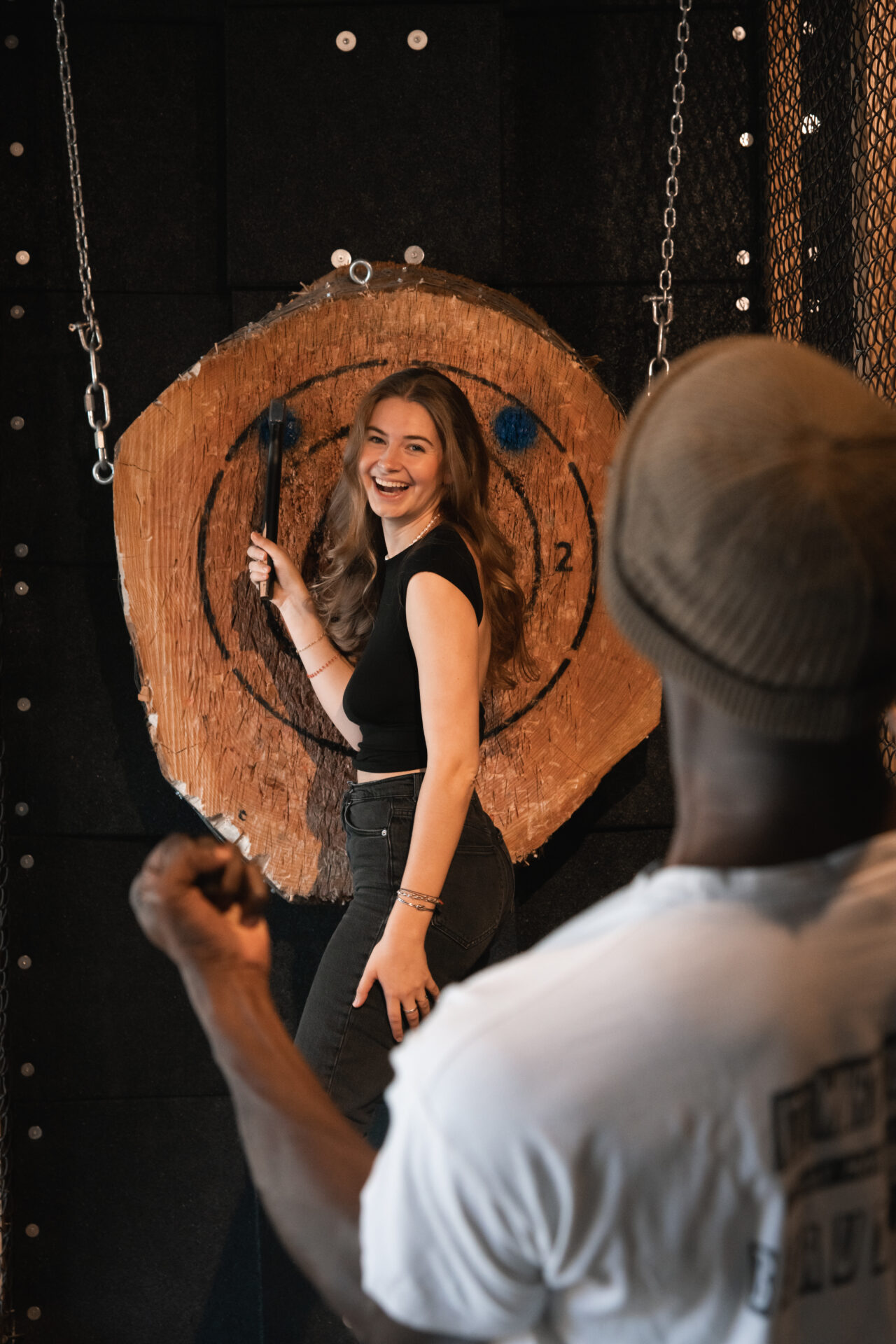
Women are apparently amongst the most enthusiastic axe throwers
Success in axe-throwing is less about brute strength than technique and what physiotherapists call proprioception – the body's awareness of its own position and movement. The throwing motion resembles a volleyball spike in terms of footwork and body engagement, but differs crucially in wrist action: where a volleyball spike demands a snapping wrist, axe-throwing requires the wrist to stay completely firm.
The venue’s staff spend much of their time helping newcomers overcome the awkward initial learning curve. Athina Chryssolouris, one of the managers, explains that success depends less on physical power than on coordination and body awareness. Some visitors understand the technique within minutes. Others need much longer.
Chryssolouris says that students from Brussels School of Circus were the fastest learners. Years spent developing balance and spatial awareness translate surprisingly well into axe-throwing. But appearances can be deceptive. Muscular athletes sometimes struggle, while smaller participants quickly develop impressive accuracy.
There are, it turns out, emotional stakes in learning to throw an axe in public. Participants regularly experience moments of self-consciousness when their technique breaks down, and for some – particularly those accustomed to being competent in front of others – the exposure of vulnerability in front of a group can be genuinely destabilising.
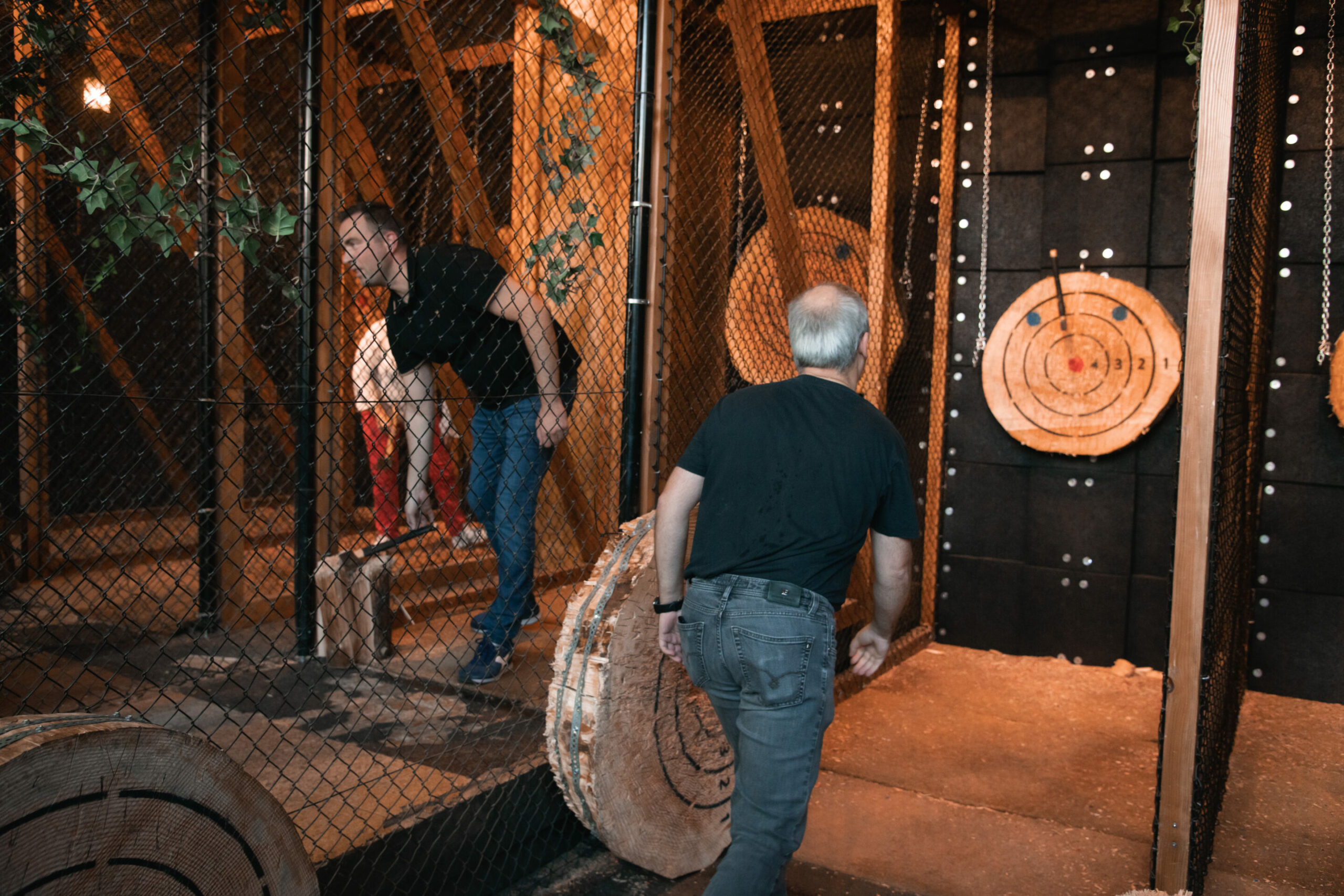
Woodcutter in Brussels
Under Belgian law, the axe is classified as a tool rather than a weapon, which is what makes venues like Woodcutter legally possible. Knives, by contrast, are classified as weapons – which is why knife-throwing bars cannot exist in Belgium, even though they can in Germany, where Vandenitte has since expanded. Woodcutter now has locations in Antwerp, Berlin, Cologne, Frankfurt, Hamburg and Leipzig; at the German sites, knife-throwing is also on the menu.
Locating the original Brussels venue in the heart of the city, three minutes' walk from Manneken Pis, struck even its founders as a mildly irrational decision, given the logistics of regular wood deliveries and the management of guests handling sharp tools. But they took the risk. Every Sunday, the Brussels Woodcutter also hosts an axe-throwing tournament open to regular participants – part of Vandenitte's longer-term ambition to assemble a Belgian national axe-throwing team capable of competing at the World Championship in the United States.
Simulated shooting: James Bond with a cocktail
Vandenitte's most recent Brussels venture, opened in December 2025, occupies different aesthetic territory entirely. The Shooters – marketed as the world's first shooting-range bar – sits on the fashionable Rue Dansaert, and its interior announces itself as a place that takes design seriously. The entrance has the feel of a baroque sanctuary: enigmatic, playing with contrasts of the overt and the covert, dominated by a deep emerald green. Armoured saints gaze beatifically from human-sized icons on the walls.
The concept is accessibility over simulation. Visitors don't handle live ammunition: the weapons are replicas of the M4 and AR-15 used by US Navy SEALs and Special Forces, firing plastic bullets at virtual targets – cards, bottles, ducks – generated by what Vandenitte describes as 100% Belgian programming technology. The system handles scoring and target changes automatically; all that's required of the shooter is to pull the trigger and reload manually. Unlike axe-throwing, there is no steep learning curve to conquer, no technical threshold to cross. The draw is social, and the atmosphere – cocktails, ambient music, groups competing across adjacent lanes – is closer to an upmarket bar than a military training facility.
This accessibility is largely the point. Couples, birthday parties and bachelorette groups are the typical clientele. The bar fills up quickly on evenings, with lane neighbours trading scores and self-appointed nicknames. For those who have experienced real shooting ranges, the virtual targets may feel like a lighter experience; for the majority who haven't, the combination of replica weapons and cocktails delivers a novelty that lands somewhere between James Bond fantasy and social entertainment.
Rage rooms: permission to break things
About 15 kilometres north of Brussels city centre, in the industrial zone of Vilvoorde, Gregory Rassios has built something considerably more ambitious in scale – and more complex in spirit. Rassios is a career Belgian military man who also practises martial arts; the Warrior Factory, which he opened around a year and a half ago, now houses ten axe-throwing lanes, a rage room, a karaoke stage and a bar, all inside a vast, former tram depot on the Schaarbeek line that had been abandoned for roughly half a century.
The restoration was not a modest undertaking. The roof was partly missing, partly full of holes. Grass had grown through the floor. A new roof had to be installed; the floor had to be laid; the old garage door was replaced with a large window. Rassios rents the depot from the city at a reduced rate in exchange for carrying out the repair work. The investments have not yet paid off – the central Brussels location of Woodcutter draws more tourists – but the Warrior Factory targets a different audience: locals who prefer space and relative quiet to the density of the capital's centre.
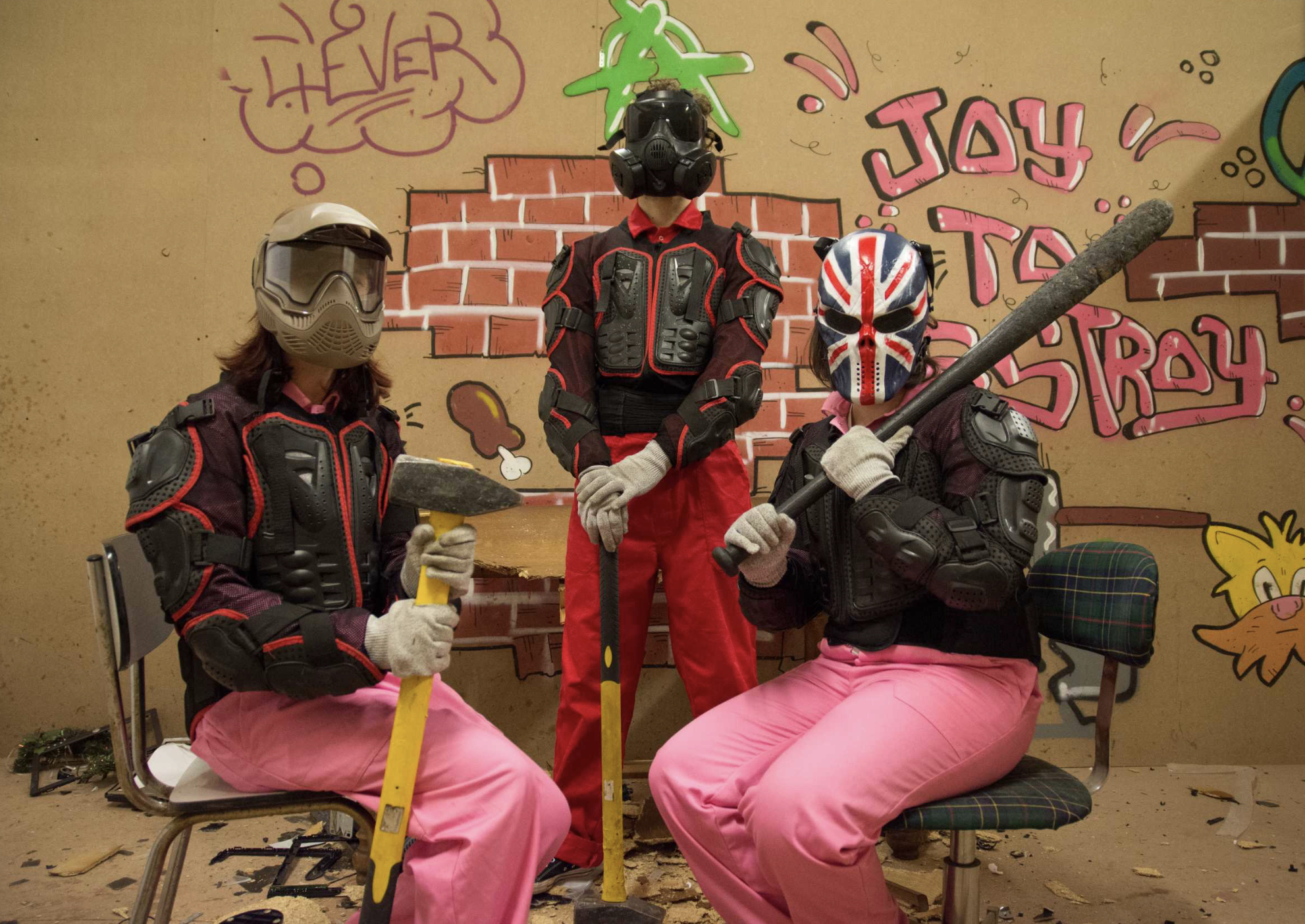
Participants at the Warrior Factory
The axe-throwing setup is broadly comparable to Woodcutter's: ten lanes separated by metal mesh, a coach on hand, a format designed to be safe and accessible. "It's a totally safe experience; everyone can get something out of it, but there are rules, just like traffic laws," Rassios explains. What distinguishes the Warrior Factory is what sits alongside the lanes.
The rage room is Rassios's most personal creation. Before opening it, he spent time watching YouTube videos of rage rooms from other countries, and the concept chimed with something he had carried since his teenage years: a fascination with the Dragon Ball Super manga, and particularly with a sequence in which the character Vegeta integrates his full, uncensored rage to undergo a transformation. The idea of a space where people could do something similar – safely, without consequence – stayed with him.
The room itself is around 30 square metres. Rassios installs empty bottles, screens and other electronics on a central table, depending on the package purchased, and visitors are given clubs, batons and cudgels to destroy them with. A rubber male mannequin named Charlie hangs on one wall, available to absorb whatever a visitor needs to direct at a human shape (Charlie has already suffered one complete decapitation, after clients used metallic cudgels on him; new rules now restrict which tools can be used on the mannequin). The session lasts 45 minutes and is filmed by a camera in the corner, so that Rassios can monitor from outside on a large screen. What he sees is sometimes difficult to watch: people cry, visibly, behind the closed door.
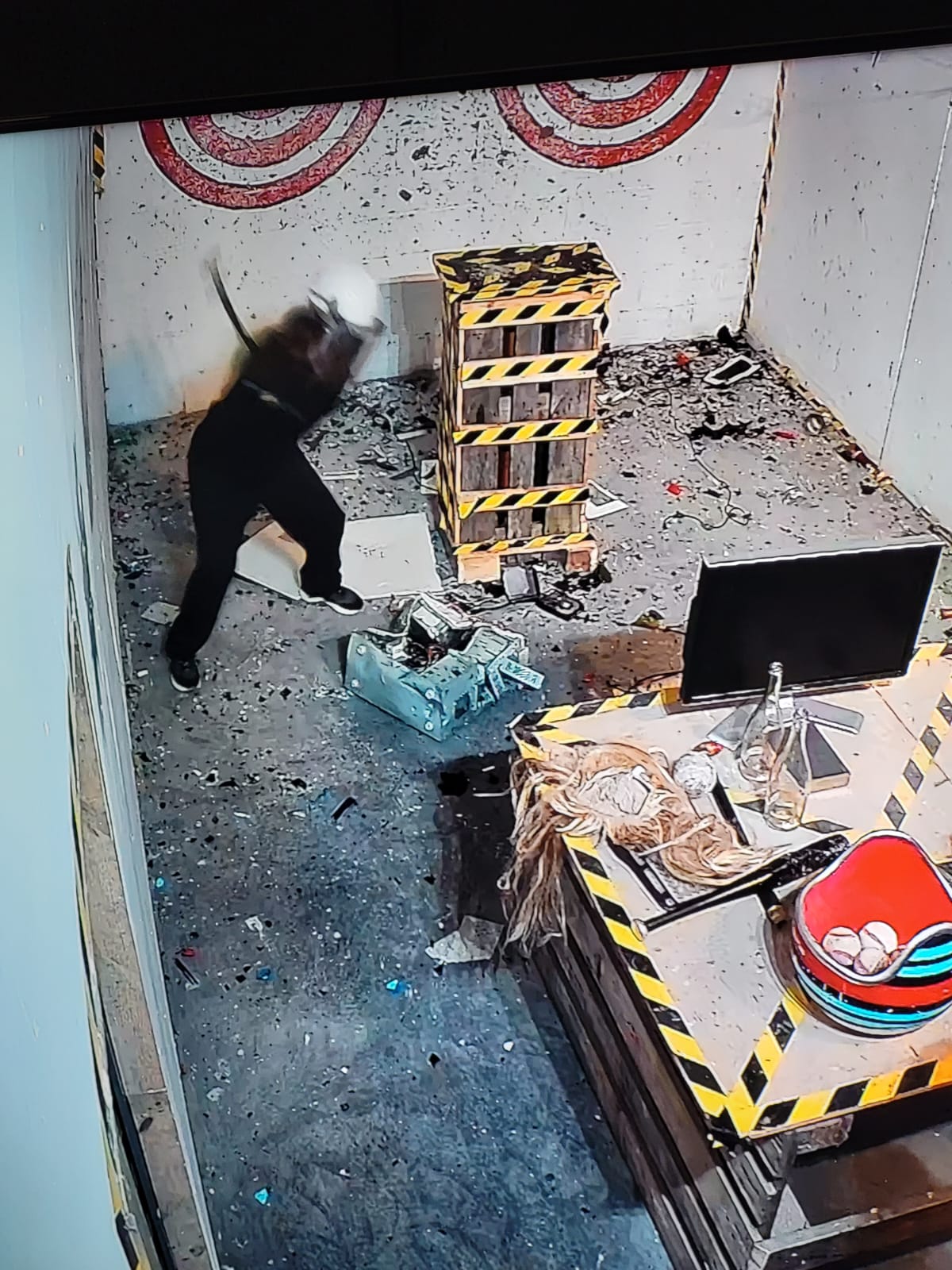
Rage room at Warrior Factory
Rassios estimates that around half of visitors come purely for the fun of destruction. The other half are working through something more specific. People arrive after bereavement, after family ruptures they cannot resolve through conversation, after accumulated frustrations they have nowhere else to put. Some come on the recommendation of their psychotherapists. Parents visit to release what has built up, so they can return to their children in a better state. The room accommodates up to four people, and visitors range in age from young adults to their seventies. Around 70% are women – a figure that still surprises Rassios.
After their sessions, some people say thank you and leave; others want to talk. One visitor, a woman in a difficult relationship with her mother, took a piece of something she had smashed in the room – a physical token of what she had released – and gave it to her mother. The relationship became more peaceful. A man arrived months after his girlfriend had died in a car accident, carrying grief he had been unable to express anywhere else.
Rassios always leaves a small amount of broken glass in the corner of the room rather than cleaning it perfectly between sessions. New visitors, he has observed, are more willing to let their emotions go when they can see evidence that others have done so before them. A pristine room, it turns out, creates its own kind of inhibition.
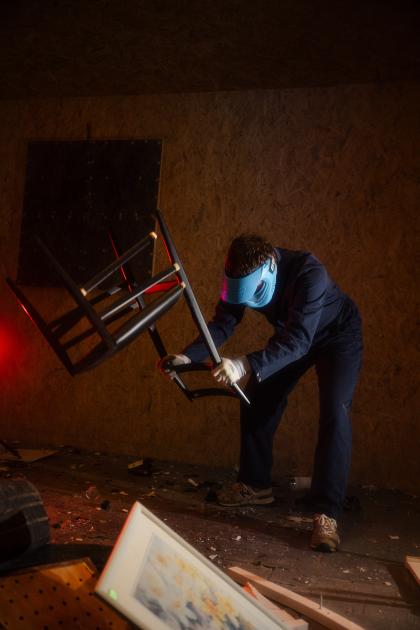
Warrior Factory
Yet perhaps the most comical detail is that alongside all the axe-throwing and controlled destruction sits an entirely different attraction. Karaoke.
There is, after all, a curious parallel between singing and smashing. Both require participants to abandon self-consciousness. Both involve taking a risk in front of other people. Both often leave participants laughing. And for some visitors, stepping up to a microphone may require even more courage than throwing an axe.
Rassios’s next plan is to open a second rage room – one with paint inside the bottles and objects, so that the emotional release leaves a colourful, physical trace on the walls and floor. The idea is that visitors would walk away not only having destroyed something but having made something too: a visible record that sometimes things need to break before something new can exist.
