
Minimum wage levels in Belgium may be high, but new data suggests minimum wage workers in Belgium are not earning a "fair and adequate" wage according to EU benchmarks.
Belgium has the fifth highest minimum wage level in Europe, behind Luxembourg, Ireland, Germany and the Netherlands.
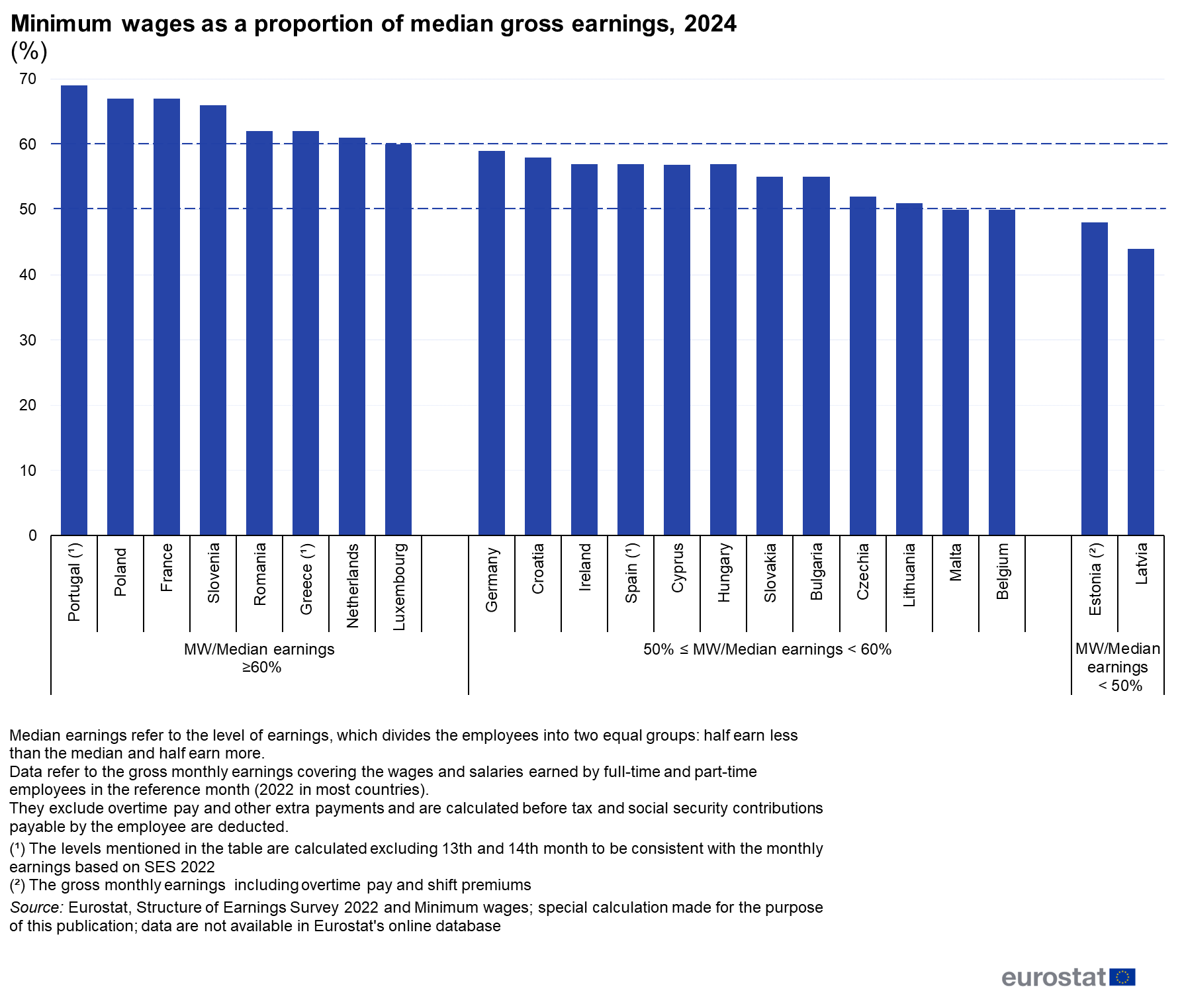
However, Eurostat figures released this week show that Belgium's minimum wage to median earnings ratio comes in at 50%, placing Belgium near the bottom of the EU pack. The figure falls short of the EU's recommended level for "fair and adequate" minimum pay, which sits at 60% of median earnings.
At the other end of the spectrum Portugal, Poland, France, Slovenia, Romania, Greece, the Netherlands and Luxembourg all have a ratio that places them above 60%.
"You could improve the minimum wage in relative terms, but it means wages in the country are quite high as well," noted Carlos Vacas from the European Foundation for the Improvement of Living and Working Conditions (Eurofound).
Vacas explained to The Brussels Times that its combination of high wages and increased levels of part-time workers may also explain why Belgium stands out compared to other countries in the latest figures.
Fair and adequate minimum wages
Passed in 2022, the EU's directive on fair and adequate wages aims to improve the "adequacy of minimum wages and to increase the access of workers to minimum wage protection".
The aim is to set a minimum benchmark which is deemed fair and adequate for a decent standard of living, with the a focus on how a country's minimum wage compares within the overall context of median wages in a country.
Eurostat's figures show that eight EU countries have met or exceeded the 60% minimum wage/median earnings ratio threshold recommended by the EU directive as a minimum floor.
Credit: Eurostat
The directive encourages countries to achieve this minimum floor through either legislation or collective bargaining. The latter is used in Belgium given the extensive use of collective bargaining agreements across Belgian employment sectors, although not all workers are covered.
Belgium's minimum wage is complicated
Belgium has one of the highest minimum wage levels in Europe – and this is known as the guaranteed average monthly minimum income (GAMMI). In Belgium, it stands at €2,189.81 for a 38-hour work week.
In the decade since 2016, Eurostat figures show minimum wage levels have increased the fastest in Lithuania (+11.7%), Romania (+11.6%), Bulgaria (+11.2%), and Poland (+10.4%). Belgium had the lowest increase over the period at just 3.8%.
The GAMMI level covers only 3% of the workforce, with separate rules for the public sector where a legal minimum wage exists. In addition, separate sectoral minimum wage agreements exist – these are on average 19% higher than the GAMMI, according to Eurofound. These separate agreements are negotiated through collective bargaining.
Vacas highlights this as a positive for Belgium as collective bargaining agreements cover most employees. "Unions move away from the minimum levels and negotiate better agreements in their sectors," he said. "So that should be a positive strong point of the country, because collective bargaining coverage is high and well functioning, when compared to other countries."
The rules in Belgium are further complicated as certain types of jobs are excluded from the GAMMI, including flexi-jobs which have expanded in use since their introduction.
Despite the high minimum wage level, a study by the FGTB-ABVV trade union in 2024 noted that "minimum wage increases continue to lag behind other wage increases".
The union's study noted that "Belgium was not in line with the international trend, as the minimum wage is close to the median wage in the other industrialised countries." Their analysis shows there were attempts to catch up between 2021 and 2023. Eurofound notes that the last real increase to the GAMMI happened in 2024.
A further increase in the GAMMI happened this year, with another scheduled for 2028. However given the complicated nature of Belgium's minimum wage rules, whether or not that will help to improve Belgium's ratio between minimum wages and median earnings is unclear at this stage.
