
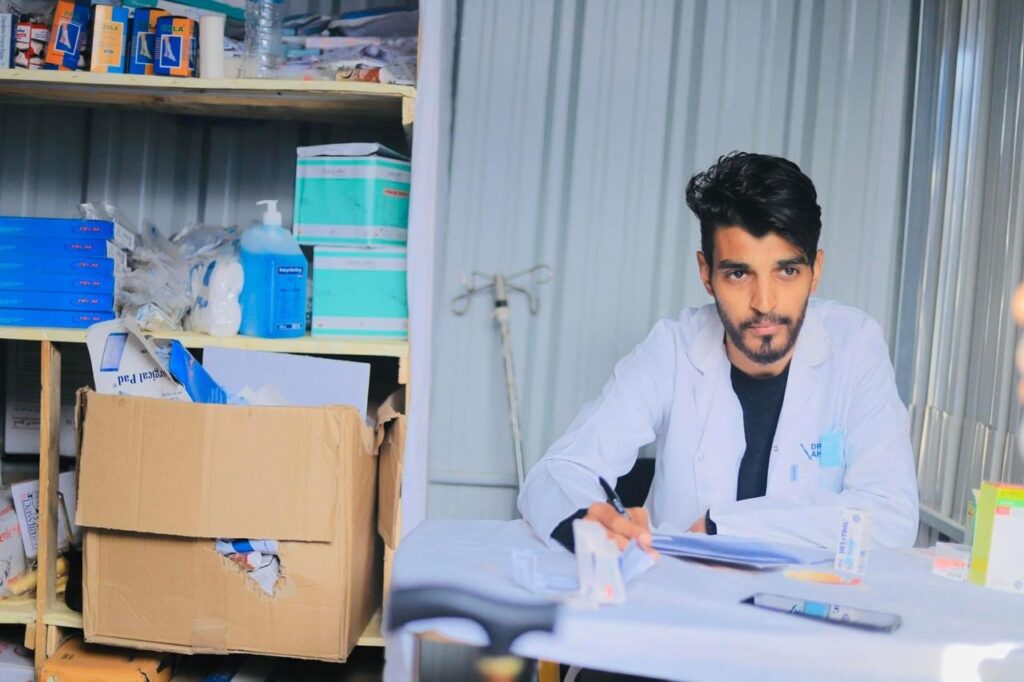
Palestinian doctor Ahmad Abu Jami, 28, had secured a fully funded scholarship to study at a Belgian university but was unable to apply for a visa and leave the Gaza Strip. However, there might be a way out for him.
Abu Jami was accepted into the Master of Public Health programme at the Institute of Tropical Medicine (ITM) in Antwerp after a competitive selection process. But his joy was short-lived as he quickly ran into difficulties with his visa process as the Belgian Ministry of Foreign Affairs did not accept online visa applications.
Asked if the European Commission could facilitate the visa application process and coordinate his and other student’s travel from Gaza, a spokesperson referred to the EU Member States who handle consular affairs.
While the immediate Belgian response was negative, there were signs of hope. The ITM institute said that their scholarship offer to the students remains open, should they be able to travel to Belgium at a later date. The UK and reportedly other EU Member States have found ways to facilitate the exit of students from Gaza.
For comparison, the UK allows Gaza students to apply for visa to UK remotely while in Gaza. Once they have a full scholarship confirmed by their university, the university passes their name on to a dedicated departures team operated by the UK government.
The UK gives an initial clearance to exit, then coordinates with the Israeli unit responsible for logistical and aid operations with the Gaza Strip (COGAT) and the Jordanian government to secure exit permissions. They are then transported through Israel to Jordan, where they provide biometrics. After that, they are transported to the UK to take up their university.
Established procedure
According to COGAT, there is an established procedure for the departure of Gaza Strip residents to third countries, including for academic studies.
"The departure of residents from the Gaza Strip is facilitated upon the submission of a request by a third country willing to receive the individual, and following the completion of a security screening by the competent Israeli authorities," a spokesperson of COGAT told The Brussels Times. There is no need for prior visa approval from the receiving country.
The vast majority of requests submitted are approved, he added. Since the beginning of the war, nearly 50,000 Gaza Strip residents have departed to third countries for various reasons, including medical treatment, foreign citizenship, residence visas, and academic studies.
Departures are carried out via the Kerem Shalom Crossing and continue through the Allenby Bridge Crossing or Ramon Airport.
This means that they do not have to leave via the Rafah border crossing to Egypt where traffic is still limited to between 150 and 200 people in both directions. The border crossing is supervised by the EU Border Assistance Mission (EUBAM), which deploys 30 experts in border management and security from 11 EU Member States.
EUBAM is a technical border assistance mission whose mandate is to monitor the work of the Palestinian border personnel at the crossing.
"The decision regarding which travellers are authorised to pass through the Rafah crossing point is made by the relevant authorities of the countries involved," a EUBAM press officer told The Brussels Times. "Hence, we are not involved in the travel procedures for students in Gaza who have received scholarships in EU Member States. We wish that everything will work out and that the students can leave Gaza very soon."
Laurens Soenen, spokesperson for Belgian Foreign Affairs Minister Maxime Prévot (Les Engagés), told The Brussels Times that it has sent response letters to the students concerned. According to him, the problem is not the whether visa applications can be made online or not, but whether the students can leave Gaza.
"Leaving Gaza is only possible through an evacuation organised by a third country, or through a medical evacuation carried out in cooperation with the World Health Organization," he said. "A visa procedure, even one started online and completed in Amman, presupposes that the person has already been able to leave Gaza, and that is precisely the obstacle."
He added that Minister Prévot understands these students' frustration.
"But we also have to be honest: the day it becomes possible to move forward again, other particularly vulnerable groups – children, for example – will most likely need to be prioritised. The objective will remain to facilitate a realistic and sustainable solution for as many people as possible, scholarship students included," he said.
The office of Foreign Affairs Minister Maxime Prévot (Les Engagés) did not respond to questions about COGAT's established procedure for the departure of Gaza Strip residents to third countries.
